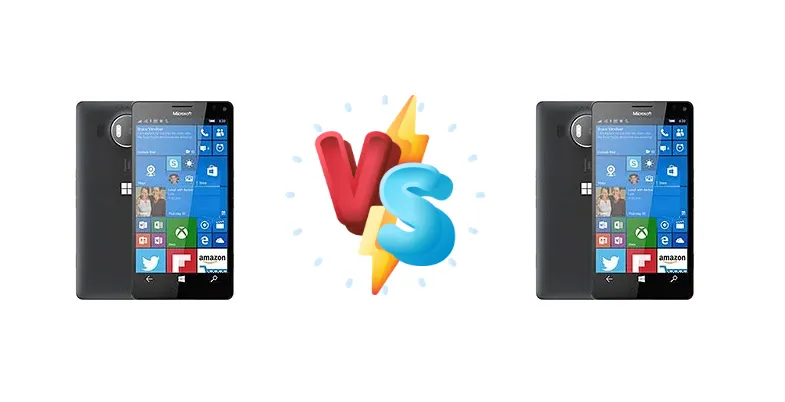
The Microsoft Lumia 950 XL and 950 XL Dual SIM represent Microsoft’s last major push into the smartphone market. While sharing nearly identical core hardware, a crucial difference in battery endurance and the addition of dual SIM functionality on one model create a significant divergence in target users. This comparison dissects these differences to help you determine which Lumia 950 XL variant best fits your needs.
🏆 Quick Verdict
For the average user prioritizing longevity, the standard Microsoft Lumia 950 XL is the clear winner. Its 62-hour endurance rating significantly outperforms the Dual SIM variant’s 47 hours. However, frequent travelers or those managing multiple numbers will find the Dual SIM model’s convenience invaluable, despite the battery trade-off.
| Network |
|---|
| 2G bands | GSM 850 / 900 / 1800 / 1900 | GSM 850 / 900 / 1800 / 1900 - SIM 1 & SIM 2 |
| 3G bands | HSDPA 850 / 900 / 1700(AWS) / 1900 / 2100 | HSDPA 850 / 900 / 1700(AWS) / 1900 / 2100 |
| 4G bands | 1, 2, 3, 4, 5, 7, 8, 12, 20, 28, 38, 40 - EMEA | 1, 2, 3, 4, 5, 7, 8, 12, 17, 20, 28, 38, 40 |
| Speed | HSPA 42.2/5.76 Mbps, LTE Cat6 300/50 Mbps | HSPA 42.2/5.76 Mbps, LTE Cat4 150/50 Mbps |
| Technology | GSM / HSPA / LTE | GSM / HSPA / LTE |
| | 1, 2, 3, 4, 5, 7, 8, 12, 17, 20, 28, 38, 40, 41 - USA | - |
| Launch |
|---|
| Announced | 2015, October. Released 2015, November | 2015, October. Released 2015, December |
| Status | Discontinued | Discontinued |
| Body |
|---|
| Dimensions | 151.9 x 78.4 x 8.1 mm (5.98 x 3.09 x 0.32 in) | 151.9 x 78.4 x 8.1 mm (5.98 x 3.09 x 0.32 in) |
| SIM | Nano-SIM | Nano-SIM + Nano-SIM |
| Weight | 165 g (5.82 oz) | 165 g (5.82 oz) |
| Display |
|---|
| Protection | Corning Gorilla Glass 4 | Corning Gorilla Glass 4 |
| Resolution | 1440 x 2560 pixels, 16:9 ratio (~518 ppi density) | 1440 x 2560 pixels, 16:9 ratio (~515 ppi density) |
| Size | 5.7 inches, 88.5 cm2 (~74.3% screen-to-body ratio) | 5.7 inches, 89.6 cm2 (~75.2% screen-to-body ratio) |
| Type | AMOLED | AMOLED |
| | ClearBlack display | ClearBlack display |
| Platform |
|---|
| CPU | Octa-core (4x1.5 GHz Cortex-A53 & 4x2.0 GHz Cortex-A57) | Octa-core (4x1.5 GHz Cortex-A53 & 4x2.0 GHz Cortex-A57) |
| Chipset | Qualcomm MSM8994 Snapdragon 810 (20 nm) | Qualcomm MSM8994 Snapdragon 810 (20 nm) |
| GPU | Adreno 430 | Adreno 430 |
| OS | Microsoft Windows 10 | Microsoft Windows 10 |
| Memory |
|---|
| Card slot | microSDXC (dedicated slot) | microSDXC (dedicated slot) |
| Internal | 32GB 3GB RAM | 32GB 3GB RAM |
| | eMMC 5.0 | eMMC 5.0 |
| Main Camera |
|---|
| Features | Zeiss optics, triple-LED RGB flash, panorama, HDR | Zeiss optics, triple-LED RGB flash, panorama, HDR |
| Single | 20 MP, f/1.9, 26mm (wide), 1/2.4", 1.12µm, AF, OIS | 20 MP, f/1.9, 26mm (wide), 1/2.4", 1.12µm, AF, OIS |
| Video | 4K@30fps, stereo sound rec., 1080p@30/60fps (after SW update) | 4K@30fps, stereo sound rec., 1080p@30/60fps (after SW update) |
| Selfie camera |
|---|
| Single | 5 MP, f/2.4 | 5 MP, f/2.4 |
| Video | 1080p@30fps | 1080p@30fps |
| Sound |
|---|
| 3.5mm jack | Yes | Yes |
| 35mm jack | Yes | Yes |
| Loudspeaker | Yes | Yes |
| Comms |
|---|
| Bluetooth | 4.1, A2DP | 4.1, A2DP |
| NFC | Yes | Yes |
| Positioning | GPS, GLONASS, BDS | GPS, GLONASS, BDS |
| Radio | FM radio | FM radio |
| USB | USB Type-C 3.1 | USB Type-C 3.1 |
| WLAN | Wi-Fi 802.11 a/b/g/n/ac, dual-band, hotspot | Wi-Fi 802.11 a/b/g/n/ac, dual-band, hotspot |
| Features |
|---|
| Sensors | Iris scanner, accelerometer, gyro, proximity, compass, barometer, sensor core | Iris scanner, accelerometer, gyro, proximity, compass, barometer, sensor core |
| | Microsoft Continuum support | Microsoft Continuum support |
| Battery |
|---|
| Charging | 18W wired
Wireless (Qi) (market dependent) | 18W wired
Wireless (Qi) (market dependent) |
| Music play | Up to 75 h | Up to 75 h |
| Stand-by | Up to 288 h (2G) / Up to 288 h (3G) | Up to 288 h (2G) / Up to 288 h (3G) |
| Talk time | Up to 25 h (2G) / Up to 19 h (3G) | Up to 25 h (2G) / Up to 19 h (3G) |
| Type | Li-Ion 3340 mAh, removable | Li-Ion 3340 mAh, removable |
| Misc |
|---|
| Colors | Black, White | Black, White |
| Price | About 350 EUR | About 350 EUR |
| Tests |
|---|
| Audio quality |
Noise -91.6dB / Crosstalk -89.3dB |
Noise -91.6dB / Crosstalk -89.3dB |
| Battery life |
Endurance rating 62h
|
Endurance rating 47h
|
| Camera |
Photo / Video | - |
| Display |
Contrast ratio: Infinite (nominal), 3.837 (sunlight) |
Contrast ratio: Infinite (nominal), 3.837 (sunlight) |
| Loudspeaker |
Voice 74dB / Noise 75dB / Ring 84dB
|
Voice 74dB / Noise 75dB / Ring 84dB
|
| Performance |
Basemark OS II 2.0: 1472Basemark X: 32178 |
Basemark OS II 2.0: 1472Basemark X: 32178 |
Microsoft Lumia 950 XL
- Superior battery life (62h endurance)
- Identical performance to Dual SIM model
- Same high-quality display as Dual SIM
- Lacks dual SIM functionality
- May not be ideal for frequent travelers
Microsoft Lumia 950 XL Dual SIM
- Convenient dual SIM support
- Identical performance to standard model
- Same high-quality display as standard model
- Significantly reduced battery life (47h endurance)
- Requires more frequent charging
Display Comparison
Both the Lumia 950 XL and 950 XL Dual SIM feature displays with an infinite (nominal) contrast ratio and a 3.837 contrast ratio in sunlight. This indicates excellent readability even in bright outdoor conditions. While the provided data doesn’t detail panel technology or resolution, both devices were positioned as high-end flagships, suggesting a high-quality AMOLED display. The identical display specifications mean visual experience will be consistent between the two models.
Camera Comparison
Both Lumia 950 XL models share the same 'Photo / Video' camera capabilities, suggesting identical camera hardware and software processing. The provided data doesn’t specify sensor size, aperture, or optical image stabilization (OIS), but as flagship devices, they likely featured a competitive camera system for their time. The absence of detail prevents a nuanced comparison, but image quality should be consistent between the two.
Performance
Both devices are powered by the Qualcomm MSM8994 Snapdragon 810 chipset, featuring an octa-core CPU configuration (4x1.5 GHz Cortex-A53 & 4x2.0 GHz Cortex-A57). This means processing power will be virtually identical for everyday tasks and demanding applications. The 20nm manufacturing process of the Snapdragon 810 was known to generate heat under sustained load; however, the identical chipset in both devices means thermal performance will be comparable. Neither device benefits from newer, more efficient chipsets.
Battery Life
The most significant difference lies in battery life. The standard Lumia 950 XL boasts an endurance rating of 62 hours, while the Dual SIM variant drops to 47 hours. Both support 18W wired charging and Qi wireless charging (market dependent). This 15-hour difference in endurance is substantial, translating to a noticeable impact on daily usage. The Dual SIM functionality inherently consumes more power due to the constant scanning for and connection to multiple networks, explaining the reduced battery life.
Buying Guide
Buy the Microsoft Lumia 950 XL if you need maximum battery life for extended use, such as long commutes or travel without frequent access to charging. Buy the Microsoft Lumia 950 XL Dual SIM if you regularly switch between multiple SIM cards – for work and personal use, or when traveling internationally – and are willing to accept a reduction in battery endurance for that added flexibility.
Frequently Asked Questions
❓ Will the Dual SIM functionality drain the battery even if I'm not actively using the second SIM?
Yes, the Dual SIM feature inherently consumes power even when the second SIM is idle. The phone constantly scans for network signals on both SIMs, contributing to the reduced battery endurance compared to the standard Lumia 950 XL.
❓ Does the Snapdragon 810 in either model suffer from significant overheating during prolonged gaming or video recording?
The Snapdragon 810 was known to experience thermal throttling under sustained heavy load. While both models share the same chipset, the reduced battery capacity in the Dual SIM variant might lead to slightly earlier throttling as the device heats up faster due to the increased power draw from the dual SIM functionality.
❓ Is the Qi wireless charging feature available in all regions for both models?
Qi wireless charging support was market-dependent for both the Lumia 950 XL and 950 XL Dual SIM. Availability varied based on regional regulations and carrier partnerships. It's crucial to verify compatibility with your local wireless charging standards before purchasing.