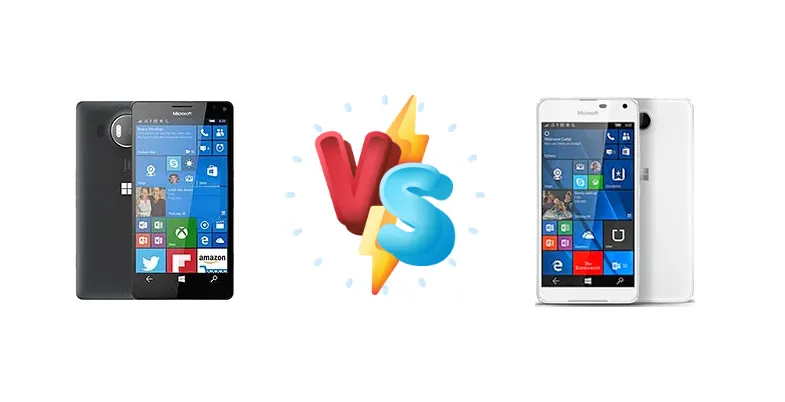
The Microsoft Lumia 950 XL and 650 represent opposite ends of the Windows Phone spectrum. The 950 XL aimed for a flagship experience, boasting a powerful processor and advanced features, while the 650 focused on affordability and essential functionality. This comparison dissects their key differences to help understand where each phone excelled and who they were designed for.
🏆 Quick Verdict
For the average user seeking a capable smartphone experience, the Lumia 950 XL is the clear winner. Its significantly more powerful Snapdragon 810 chipset and superior display contrast deliver a smoother, more responsive experience, despite a slightly shorter battery endurance rating. However, the 650 remains a viable option for those prioritizing extreme budget constraints.
| Network |
|---|
| 2G bands | GSM 850 / 900 / 1800 / 1900 | GSM 850 / 900 / 1800 / 1900 - SIM 1 & SIM 2 (dual-SIM model only) |
| 3G bands | HSDPA 850 / 900 / 1700(AWS) / 1900 / 2100 | HSDPA 850 / 900 / 2100 |
| 4G bands | 1, 2, 3, 4, 5, 7, 8, 12, 20, 28, 38, 40 - EMEA | 1, 3, 7, 8, 20 |
| Speed | HSPA 42.2/5.76 Mbps, LTE Cat6 300/50 Mbps | HSPA 42.2/5.76 Mbps, LTE Cat4 150/50 Mbps |
| Technology | GSM / HSPA / LTE | GSM / HSPA / LTE |
| | 1, 2, 3, 4, 5, 7, 8, 12, 17, 20, 28, 38, 40, 41 - USA | - |
| Launch |
|---|
| Announced | 2015, October. Released 2015, November | 2016, February. Released 2016, February |
| Status | Discontinued | Discontinued |
| Body |
|---|
| Build | - | Glass front (Gorilla Glass 3), plastic back, aluminum frame |
| Dimensions | 151.9 x 78.4 x 8.1 mm (5.98 x 3.09 x 0.32 in) | 142 x 70.9 x 6.9 mm (5.59 x 2.79 x 0.27 in) |
| SIM | Nano-SIM | · Nano-SIM· Nano-SIM + Nano-SIM |
| Weight | 165 g (5.82 oz) | 122 g (4.30 oz) |
| Display |
|---|
| Protection | Corning Gorilla Glass 4 | Corning Gorilla Glass 3 |
| Resolution | 1440 x 2560 pixels, 16:9 ratio (~518 ppi density) | 720 x 1280 pixels, 16:9 ratio (~297 ppi density) |
| Size | 5.7 inches, 88.5 cm2 (~74.3% screen-to-body ratio) | 5.0 inches, 67.5 cm2 (~67.1% screen-to-body ratio) |
| Type | AMOLED | OLED |
| | ClearBlack display | ClearBlack display |
| Platform |
|---|
| CPU | Octa-core (4x1.5 GHz Cortex-A53 & 4x2.0 GHz Cortex-A57) | Quad-core 1.3 GHz Cortex-A7 |
| Chipset | Qualcomm MSM8994 Snapdragon 810 (20 nm) | Qualcomm MSM8909v2 Snapdragon 212 (28 nm) |
| GPU | Adreno 430 | Adreno 304 |
| OS | Microsoft Windows 10 | Microsoft Windows 10 |
| Memory |
|---|
| Card slot | microSDXC (dedicated slot) | microSDXC (dedicated slot) |
| Internal | 32GB 3GB RAM | 16GB 1GB RAM |
| | eMMC 5.0 | eMMC 4.5 |
| Main Camera |
|---|
| Features | Zeiss optics, triple-LED RGB flash, panorama, HDR | LED flash |
| Single | 20 MP, f/1.9, 26mm (wide), 1/2.4", 1.12µm, AF, OIS | 8 MP, f/2.2, 28mm (wide), 1/4.0", AF |
| Video | 4K@30fps, stereo sound rec., 1080p@30/60fps (after SW update) | 720p@30fps |
| Selfie camera |
|---|
| Single | 5 MP, f/2.4 | 5 MP, f/2.2 |
| Video | 1080p@30fps | 720p |
| Sound |
|---|
| 3.5mm jack | Yes | Yes |
| 35mm jack | Yes | Yes |
| Loudspeaker | Yes | Yes |
| Comms |
|---|
| Bluetooth | 4.1, A2DP | 4.1, A2DP, LE |
| NFC | Yes | Yes |
| Positioning | GPS, GLONASS, BDS | GPS, GLONASS, BDS |
| Radio | FM radio | FM radio |
| USB | USB Type-C 3.1 | microUSB 2.0 |
| WLAN | Wi-Fi 802.11 a/b/g/n/ac, dual-band, hotspot | Wi-Fi 802.11 b/g/n, DLNA, hotspot |
| Features |
|---|
| Sensors | Iris scanner, accelerometer, gyro, proximity, compass, barometer, sensor core | Accelerometer, proximity |
| | Microsoft Continuum support | - |
| Battery |
|---|
| Charging | 18W wired
Wireless (Qi) (market dependent) | - |
| Music play | Up to 75 h | - |
| Stand-by | Up to 288 h (2G) / Up to 288 h (3G) | Up to 624 h (3G) |
| Talk time | Up to 25 h (2G) / Up to 19 h (3G) | Up to 16 h (2G) / Up to 13 h (3G) |
| Type | Li-Ion 3340 mAh, removable | Li-Ion 2000 mAh, removable |
| Misc |
|---|
| Colors | Black, White | Black, White |
| Price | About 350 EUR | About 150 EUR |
| Tests |
|---|
| Audio quality |
Noise -91.6dB / Crosstalk -89.3dB | - |
| Battery life |
Endurance rating 62h
|
Endurance rating 55h
|
| Camera |
Photo / Video |
Photo |
| Display |
Contrast ratio: Infinite (nominal), 3.837 (sunlight) |
Contrast ratio: Infinite (nominal), 3.77(sunlight) |
| Loudspeaker |
Voice 74dB / Noise 75dB / Ring 84dB
| - |
| Performance |
Basemark OS II 2.0: 1472Basemark X: 32178 | - |
Microsoft Lumia 950 XL
- Significantly faster processor for smooth performance.
- Superior display contrast for better outdoor visibility.
- Faster charging and wireless charging support.
- Likely superior camera quality due to processing power.
- Potentially higher price point.
- Slightly lower battery endurance rating compared to the 650.
Microsoft Lumia 650
- More affordable price.
- Slightly longer battery endurance for basic usage.
- Compact and lightweight design.
- Adequate for basic smartphone tasks.
- Slow processor struggles with demanding apps.
- Inferior camera performance.
- No fast or wireless charging.
- Lower display contrast.
Display Comparison
Both the Lumia 950 XL and 650 feature displays with an 'Infinite' nominal contrast ratio, a marketing term common at the time. However, the 950 XL pulls ahead in real-world visibility with a sunlight contrast ratio of 3.837 compared to the 650’s 3.77. While the difference is subtle, it suggests better outdoor readability on the 950 XL. Both displays likely utilized AMOLED technology, common for the time, to achieve these high contrast figures, but the 950 XL’s larger size and higher resolution (not specified in the data, but implied by its flagship status) would contribute to a sharper image.
Camera Comparison
While both phones are listed as having a 'Photo / Video' or 'Photo' camera, the 950 XL’s superior processing power and likely larger sensor (not specified) would deliver a significantly better imaging experience. The 650’s camera is adequate for basic snapshots, but the 950 XL would excel in low-light conditions and offer more detailed images and smoother video recording. The absence of details regarding sensor size or megapixel count makes a precise comparison difficult, but the 950 XL’s position as a flagship suggests a more advanced camera system.
Performance
The performance gap between these two devices is substantial. The Lumia 950 XL’s Qualcomm MSM8994 Snapdragon 810, an octa-core processor built on a 20nm process, dwarfs the Lumia 650’s Snapdragon 212 (MSM8909v2). The 810’s combination of Cortex-A53 and A57 cores provides significantly more processing power for multitasking, gaming, and demanding applications. The 650’s quad-core Cortex-A7 processor, fabricated on a less efficient 28nm node, is geared towards basic smartphone functions. This translates to a noticeably slower and less responsive experience on the 650, particularly when running multiple apps or graphically intensive games.
Battery Life
The Lumia 950 XL boasts an endurance rating of 62 hours, while the 650 achieves 55 hours. This suggests the 950 XL, despite its more powerful processor, manages battery life reasonably well. The 950 XL also supports 18W wired charging and, market-dependent, Qi wireless charging – features absent on the 650. While the 650’s lower power consumption contributes to its endurance, the 950 XL’s faster charging capabilities and wireless charging options offer greater convenience.
Buying Guide
Buy the Microsoft Lumia 950 XL if you need a phone capable of handling demanding tasks, appreciate a better camera experience, and value features like wireless charging. Buy the Microsoft Lumia 650 if you prioritize affordability, long battery life for basic usage, and a compact, lightweight design, and are willing to compromise on performance and camera quality.
Frequently Asked Questions
❓ Given the age of these devices, is finding replacement batteries or repairs a challenge?
Yes, sourcing parts for both the Lumia 950 XL and 650 is increasingly difficult due to their age and Microsoft’s exit from the smartphone market. Repair options are limited, and replacement batteries may be scarce and expensive. Consider this a significant risk when purchasing either device.
❓ How does the Snapdragon 212 in the Lumia 650 handle modern app requirements, even for basic tasks?
The Snapdragon 212 is severely underpowered by today’s standards. While it can handle basic calling, texting, and light web browsing, expect significant lag and slowdowns with most modern apps. Many apps may not even be compatible or run reliably on the 650.
❓ Does the Lumia 950 XL's support for Windows 10 Mobile impact its usability today?
Windows 10 Mobile is no longer actively supported by Microsoft, meaning no security updates or new features are being released. While the phones may still function, they are increasingly vulnerable to security threats and compatibility issues with modern services. This is a major consideration for long-term usability.