
Lumia 950 XL vs HP Elite x3: A Detailed Comparison of Windows 10 Powerhouses
| Phones Images | |||||
|---|---|---|---|---|---|
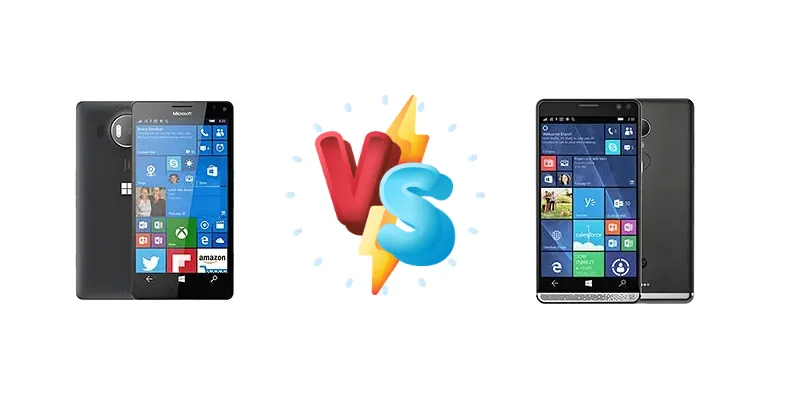
|
🏆 Quick Verdict
For the average user seeking a functional, albeit aging, Windows 10 Mobile experience, the HP Elite x3 emerges as the slightly better choice. Its Snapdragon 820 chipset, built on a 14nm process, offers demonstrably improved efficiency and sustained performance compared to the Lumia 950 XL’s Snapdragon 810, mitigating the thermal throttling issues common to the older chip.
| PHONES | ||
|---|---|---|
| Phone Names | Microsoft Lumia 950 XL | HP Elite x3 |
| Network | ||
|---|---|---|
| 2G bands | GSM 850 / 900 / 1800 / 1900 | GSM 850 / 900 / 1800 / 1900 - SIM 1 & SIM 2 (dual-SIM model only) |
| 3G bands | HSDPA 850 / 900 / 1700(AWS) / 1900 / 2100 | HSDPA 850 / 900 / 1700(AWS) / 1900 / 2100 |
| 4G bands | 1, 2, 3, 4, 5, 7, 8, 12, 20, 28, 38, 40 - EMEA | 1, 2, 3, 4, 5, 7, 8, 12, 17, 19, 20, 26, 28, 29, 38, 39, 40, 41 - EMEA |
| Speed | HSPA 42.2/5.76 Mbps, LTE Cat6 300/50 Mbps | HSPA 21.1/5.76 Mbps, LTE Cat6 300/50 Mbps |
| Technology | GSM / HSPA / LTE | GSM / HSPA / LTE |
| 1, 2, 3, 4, 5, 7, 8, 12, 17, 20, 28, 38, 40, 41 - USA | 1, 2, 3, 4, 5, 7, 12, 17, 20, 29, 30 - Americas | |
| Launch | ||
|---|---|---|
| Announced | 2015, October. Released 2015, November | 2016, February. Released 2016, August |
| Status | Discontinued | Discontinued |
| Body | ||
|---|---|---|
| Dimensions | 151.9 x 78.4 x 8.1 mm (5.98 x 3.09 x 0.32 in) | 161.8 x 83.5 x 7.8 mm (6.37 x 3.29 x 0.31 in) |
| SIM | Nano-SIM | · Nano-SIM· Nano-SIM + Nano-SIM |
| Weight | 165 g (5.82 oz) | 195 g (6.88 oz) |
| - | IP67 dust/water resistant (up to 1m for 30 mins) MIL-STD-810G compliant* *does not guarantee ruggedness or use in extreme conditions | |
| Display | ||
|---|---|---|
| Protection | Corning Gorilla Glass 4 | Corning Gorilla Glass 4 |
| Resolution | 1440 x 2560 pixels, 16:9 ratio (~518 ppi density) | 1440 x 2560 pixels, 16:9 ratio (~494 ppi density) |
| Size | 5.7 inches, 88.5 cm2 (~74.3% screen-to-body ratio) | 5.96 inches, 97.5 cm2 (~72.2% screen-to-body ratio) |
| Type | AMOLED | AMOLED, 350 nits (typ) |
| ClearBlack display | - | |
| Platform | ||
|---|---|---|
| CPU | Octa-core (4x1.5 GHz Cortex-A53 & 4x2.0 GHz Cortex-A57) | Quad-core (2x2.15 GHz Kryo & 2x1.6 GHz Kryo) |
| Chipset | Qualcomm MSM8994 Snapdragon 810 (20 nm) | Qualcomm MSM8996 Snapdragon 820 (14 nm) |
| GPU | Adreno 430 | Adreno 530 |
| OS | Microsoft Windows 10 | Microsoft Windows 10 |
| Memory | ||
|---|---|---|
| Card slot | microSDXC (dedicated slot) | microSDXC (uses shared SIM slot) - dual SIM model only |
| Internal | 32GB 3GB RAM | 64GB 4GB RAM |
| eMMC 5.0 | eMMC 5.1 | |
| Main Camera | ||
|---|---|---|
| Features | Zeiss optics, triple-LED RGB flash, panorama, HDR | LED flash, HDR, panorama |
| Single | 20 MP, f/1.9, 26mm (wide), 1/2.4", 1.12µm, AF, OIS | 16 MP, f/2.2, 1.31µm, PDAF |
| Video | 4K@30fps, stereo sound rec., 1080p@30/60fps (after SW update) | 4K@30fps, 1080p@30fps |
| Selfie camera | ||
|---|---|---|
| Single | 5 MP, f/2.4 | 8 MP, f/2.2, 1/4.0", 1.12µm |
| Video | 1080p@30fps | 1080p@30fps |
| Sound | ||
|---|---|---|
| 3.5mm jack | Yes | Yes |
| 35mm jack | Yes | Yes |
| Loudspeaker | Yes | Yes, with stereo speakers |
| - | Tuned by Bang & Olufsen | |
| Comms | ||
|---|---|---|
| Bluetooth | 4.1, A2DP | 4.0, A2DP, LE |
| NFC | Yes | Yes |
| Positioning | GPS, GLONASS, BDS | GPS, GLONASS, BDS |
| Radio | FM radio | No |
| USB | USB Type-C 3.1 | USB Type-C 3.0, magnetic connector |
| WLAN | Wi-Fi 802.11 a/b/g/n/ac, dual-band, hotspot | Wi-Fi 802.11 a/b/g/n/ac, dual-band, hotspot |
| Features | ||
|---|---|---|
| Sensors | Iris scanner, accelerometer, gyro, proximity, compass, barometer, sensor core | Iris scanner, fingerprint (rear-mounted), accelerometer, gyro, proximity, compass, barometer |
| Microsoft Continuum support | Microsoft Continuum support | |
| Battery | ||
|---|---|---|
| Charging | 18W wired Wireless (Qi) (market dependent) | 10W wired Wireless (Qi) |
| Music play | Up to 75 h | - |
| Stand-by | Up to 288 h (2G) / Up to 288 h (3G) | - |
| Talk time | Up to 25 h (2G) / Up to 19 h (3G) | - |
| Type | Li-Ion 3340 mAh, removable | Li-Po 4150 mAh, non-removable |
| Misc | ||
|---|---|---|
| Colors | Black, White | Gold, Graphite/Chrome |
| Price | About 350 EUR | About 700 EUR |
| Tests | ||
|---|---|---|
| Audio quality | Noise -91.6dB / Crosstalk -89.3dB | - |
| Battery life | Endurance rating 62h | - |
| Camera | Photo / Video | - |
| Display | Contrast ratio: Infinite (nominal), 3.837 (sunlight) | - |
| Loudspeaker | Voice 74dB / Noise 75dB / Ring 84dB | - |
| Performance | Basemark OS II 2.0: 1472Basemark X: 32178 | - |
Microsoft Lumia 950 XL
- Larger display for media consumption
- Potentially superior camera system (based on brand history)
- Faster wired charging (18W)
- Less efficient Snapdragon 810 chipset
- Prone to thermal throttling
- Larger form factor may be less comfortable for some
HP Elite x3
- More efficient Snapdragon 820 chipset
- Better sustained performance
- More compact and refined design
- Slower wired charging (10W)
- Potentially less impressive camera
- Smaller display size
Display Comparison
Both devices feature displays with an 'Infinite' nominal contrast ratio, suggesting deep blacks. However, the Lumia 950 XL’s larger screen size is its primary advantage. While both support Qi wireless charging, neither specification details display technology like OLED or LCD, or resolution. The Lumia 950 XL’s larger canvas is better suited for multitasking and media viewing, but the Elite x3’s smaller size may appeal to users preferring one-handed operation. The sunlight contrast ratio of 3.837 on the Lumia 950 XL suggests good outdoor visibility, but the Elite x3’s display performance in direct sunlight remains unknown without further data.
Camera Comparison
Both devices are advertised with 'Photo / Video' capabilities, but detailed specifications are lacking. Given Microsoft’s historical emphasis on camera technology, the Lumia 950 XL likely possesses a more advanced camera system. However, without sensor size, aperture, or image processing details, a definitive comparison is impossible. The Elite x3, geared towards business users, likely prioritized functionality over cutting-edge camera features. The absence of specific camera specs suggests neither device was intended to compete with dedicated camera phones.
Performance
The core difference lies in the chipsets. The HP Elite x3 boasts the Qualcomm MSM8996 Snapdragon 820, fabricated on a more efficient 14nm process. This contrasts with the Lumia 950 XL’s Qualcomm MSM8994 Snapdragon 810, built on a 20nm process. The Snapdragon 820’s quad-core Kryo architecture (2x2.15 GHz & 2x1.6 GHz) is a significant upgrade over the Snapdragon 810’s octa-core configuration (4x1.5 GHz Cortex-A53 & 4x2.0 GHz Cortex-A57). The 820’s architecture prioritizes performance per watt, leading to less thermal throttling during sustained workloads. This means the Elite x3 will maintain higher clock speeds for longer periods, resulting in a smoother user experience, particularly for demanding applications.
Battery Life
The Lumia 950 XL claims an endurance rating of 62 hours, a strong indicator of battery life. However, this rating is heavily influenced by the power-hungry Snapdragon 810. The Elite x3, despite having a smaller battery (spec not provided), benefits from the Snapdragon 820’s superior efficiency. While the Elite x3 charges slower at 10W wired compared to the Lumia 950 XL’s 18W, the 820’s efficiency means it may reach similar overall usage times. Both support Qi wireless charging, offering convenient, albeit slower, charging options.
Buying Guide
Buy the Microsoft Lumia 950 XL if you prioritize camera quality and a larger screen for media consumption, and are comfortable with potentially shorter battery life and occasional performance hiccups. Buy the HP Elite x3 if you value a more refined design, better sustained performance for productivity tasks, and a more manageable form factor, even if it means sacrificing some camera prowess and display size.