
Lumia 950 XL vs. iPhone 6s Plus: A Retrospective Performance and Value Showdown
| Phones Images | |||||
|---|---|---|---|---|---|
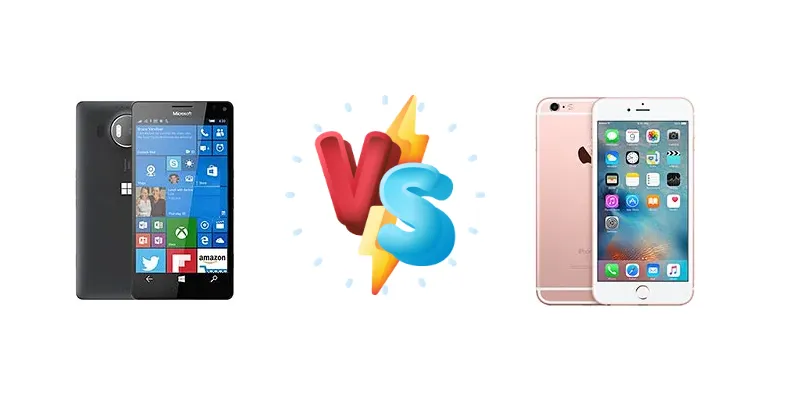
|
🏆 Quick Verdict
For the average user in 2024, the Apple iPhone 6s Plus emerges as the more practical choice. Its superior battery endurance (85h vs 62h) and continued software support, even if limited, outweigh the Lumia 950 XL’s theoretical advantages in display contrast. The A9 chip also provides a smoother, more consistent experience.
| PHONES | ||
|---|---|---|
| Phone Names | Microsoft Lumia 950 XL | Apple iPhone 6s Plus |
| Network | ||
|---|---|---|
| 2G bands | GSM 850 / 900 / 1800 / 1900 | GSM 850 / 900 / 1800 / 1900 |
| 3G bands | HSDPA 850 / 900 / 1700(AWS) / 1900 / 2100 | HSDPA 850 / 900 / 1700 / 1900 / 2100 |
| 4G bands | 1, 2, 3, 4, 5, 7, 8, 12, 20, 28, 38, 40 - EMEA | 1, 2, 3, 4, 5, 7, 8, 12, 13, 17, 18, 19, 20, 25, 26, 28, 29, 30 - A1633 |
| Speed | HSPA 42.2/5.76 Mbps, LTE Cat6 300/50 Mbps | HSPA 42.2/5.76 Mbps, LTE (2CA) Cat6 300/50 Mbps, EV-DO Rev.A 3.1 Mbps |
| Technology | GSM / HSPA / LTE | GSM / CDMA / HSPA / EVDO / LTE |
| 1, 2, 3, 4, 5, 7, 8, 12, 17, 20, 28, 38, 40, 41 - USA | 1, 2, 3, 4, 5, 7, 8, 12, 13, 17, 18, 19, 20, 25, 26, 28, 29, 30, 38, 39, 40, 41 - A1634 | |
| Launch | ||
|---|---|---|
| Announced | 2015, October. Released 2015, November | 2015, September 09. Released 2015, September 25 |
| Status | Discontinued | Discontinued |
| Body | ||
|---|---|---|
| Build | - | Glass front (Corning-made glass), aluminum back, aluminum frame |
| Dimensions | 151.9 x 78.4 x 8.1 mm (5.98 x 3.09 x 0.32 in) | 158.2 x 77.9 x 7.3 mm (6.23 x 3.07 x 0.29 in) |
| SIM | Nano-SIM | Nano-SIM |
| Weight | 165 g (5.82 oz) | 192 g (6.77 oz) |
| - | Apple Pay (Visa, MasterCard, AMEX certified) | |
| Display | ||
|---|---|---|
| Protection | Corning Gorilla Glass 4 | Ion-strengthened glass, oleophobic coating |
| Resolution | 1440 x 2560 pixels, 16:9 ratio (~518 ppi density) | 1080 x 1920 pixels, 16:9 ratio (~401 ppi density) |
| Size | 5.7 inches, 88.5 cm2 (~74.3% screen-to-body ratio) | 5.5 inches, 83.4 cm2 (~67.7% screen-to-body ratio) |
| Type | AMOLED | IPS LCD |
| ClearBlack display | 3D Touch display | |
| Platform | ||
|---|---|---|
| CPU | Octa-core (4x1.5 GHz Cortex-A53 & 4x2.0 GHz Cortex-A57) | Dual-core 1.84 GHz Twister |
| Chipset | Qualcomm MSM8994 Snapdragon 810 (20 nm) | Apple A9 (14/16 nm - maker dependant) |
| GPU | Adreno 430 | PowerVR GT7600 (six-core graphics) |
| OS | Microsoft Windows 10 | iOS 9, upgradable to iOS 15.8.5 |
| Memory | ||
|---|---|---|
| Card slot | microSDXC (dedicated slot) | No |
| Internal | 32GB 3GB RAM | 16GB 2GB RAM, 32GB 2GB RAM, 64GB 2GB RAM, 128GB 2GB RAM |
| eMMC 5.0 | NVMe | |
| Main Camera | ||
|---|---|---|
| Features | Zeiss optics, triple-LED RGB flash, panorama, HDR | Dual-LED dual-tone flash, HDR |
| Single | 20 MP, f/1.9, 26mm (wide), 1/2.4", 1.12µm, AF, OIS | 12 MP, f/2.2, 29mm (standard), 1/3.0", 1.22µm, PDAF, OIS |
| Video | 4K@30fps, stereo sound rec., 1080p@30/60fps (after SW update) | 4K@30fps, 1080p@60fps, 1080p@120fps, 720p@240fps |
| Selfie camera | ||
|---|---|---|
| Features | - | Face detection, HDR, panorama |
| Single | 5 MP, f/2.4 | 5 MP, f/2.2, 31mm (standard) |
| Video | 1080p@30fps | 720p@30fps |
| Sound | ||
|---|---|---|
| 3.5mm jack | Yes | Yes |
| 35mm jack | Yes | Yes |
| Loudspeaker | Yes | Yes |
| - | 16-bit/44.1kHz audio | |
| Comms | ||
|---|---|---|
| Bluetooth | 4.1, A2DP | 4.2, A2DP, LE |
| NFC | Yes | Yes (Apple Pay only) |
| Positioning | GPS, GLONASS, BDS | GPS, GLONASS, GALILEO, QZSS |
| Radio | FM radio | No |
| USB | USB Type-C 3.1 | Lightning, USB 2.0 |
| WLAN | Wi-Fi 802.11 a/b/g/n/ac, dual-band, hotspot | Wi-Fi 802.11 a/b/g/n/ac, dual-band, hotspot |
| Features | ||
|---|---|---|
| Sensors | Iris scanner, accelerometer, gyro, proximity, compass, barometer, sensor core | Fingerprint (front-mounted), accelerometer, gyro, proximity, compass, barometer |
| Microsoft Continuum support | - | |
| Battery | ||
|---|---|---|
| Charging | 18W wired Wireless (Qi) (market dependent) | - |
| Music play | Up to 75 h | - |
| Stand-by | Up to 288 h (2G) / Up to 288 h (3G) | Up to 384 h (3G) |
| Talk time | Up to 25 h (2G) / Up to 19 h (3G) | Up to 24 h (3G) |
| Type | Li-Ion 3340 mAh, removable | Li-Ion 2750 mAh, non-removable (10.45 Wh) |
| Misc | ||
|---|---|---|
| Colors | Black, White | Space Gray, Silver, Gold, Rose Gold |
| Models | - | A1634, A1687, A1690, A1699, iPhone8,2 |
| Price | About 350 EUR | About 240 EUR |
| SAR | - | 1.12 W/kg (head) 1.14 W/kg (body) |
| SAR EU | - | 0.93 W/kg (head) 0.98 W/kg (body) |
| Tests | ||
|---|---|---|
| Audio quality | Noise -91.6dB / Crosstalk -89.3dB | Noise -93.4dB / Crosstalk -71.1dB |
| Battery life | Endurance rating 62h | Endurance rating 85h |
| Camera | Photo / Video | Photo / Video |
| Display | Contrast ratio: Infinite (nominal), 3.837 (sunlight) | Contrast ratio: 1382:1 (nominal), 3.530 (sunlight) |
| Loudspeaker | Voice 74dB / Noise 75dB / Ring 84dB | Voice 65dB / Noise 65dB / Ring 64dB |
| Performance | Basemark OS II 2.0: 1472Basemark X: 32178 | Basemark OS II 2.0: 2261 |
Microsoft Lumia 950 XL
- Potentially higher display contrast ratio.
- Qi wireless charging support.
- Expandable storage via microSD (market dependent).
- Inferior battery life.
- Thermal throttling issues with the Snapdragon 810.
- Limited software support and app availability.
Apple iPhone 6s Plus
- Superior battery life.
- Smoother performance due to the efficient A9 chip.
- More polished and stable iOS ecosystem.
- No expandable storage.
- No wireless charging.
- Aging iOS version with limited updates.
Display Comparison
The Lumia 950 XL boasts an 'infinite' nominal contrast ratio, though real-world measurements show 3.837 under sunlight. This suggests excellent black levels in ideal conditions. However, the iPhone 6s Plus, with a 1382:1 nominal contrast ratio and 3.530 under sunlight, still delivers a very respectable visual experience. While the Lumia’s theoretical advantage exists, the practical difference is likely minimal for most users. Both displays perform similarly in bright sunlight. The lack of information on panel technology (OLED vs LCD) for the Lumia hinders a deeper analysis, but the iPhone 6s Plus utilizes an LCD panel.
Camera Comparison
Both devices offer photo and video capabilities, but detailed sensor information is absent. The Lumia 950 XL gained recognition for its image processing and low-light performance, leveraging Microsoft’s computational photography. However, the iPhone 6s Plus consistently delivered reliable and natural-looking images. Without specific sensor size or aperture data, a definitive camera comparison is difficult. The iPhone’s video recording capabilities were generally considered superior at the time of release, offering better stabilization and dynamic range.
Performance
The chipset architectures represent a fundamental difference. The Lumia 950 XL utilizes a Qualcomm MSM8994 Snapdragon 810, an octa-core processor with a split core configuration (4x1.5 GHz Cortex-A53 & 4x2.0 GHz Cortex-A57). This contrasts sharply with the iPhone 6s Plus’s Apple A9, a dual-core 1.84 GHz Twister processor. Despite the core count disparity, the A9, built on a 14/16nm process (depending on the manufacturer), demonstrates superior single-core performance and efficiency. The Snapdragon 810, fabricated on a 20nm node, was known for thermal throttling under sustained load, a problem the A9 largely avoids. This translates to a smoother, more consistent experience on the iPhone, particularly during demanding tasks.
Battery Life
The iPhone 6s Plus significantly outperforms the Lumia 950 XL in battery endurance, achieving 85 hours versus the Lumia’s 62 hours. This difference is substantial and translates to a full day of additional use for the iPhone. The Lumia 950 XL supports 18W wired charging and Qi wireless charging (market dependent), while the iPhone 6s Plus offers slower wired charging and lacks wireless charging. The iPhone’s superior battery life, despite a potentially smaller capacity, is a key advantage.
Buying Guide
Buy the Microsoft Lumia 950 XL if you are a tinkerer interested in exploring alternative mobile operating systems, specifically Windows 10 Mobile, and value a potentially higher display contrast ratio. Buy the Apple iPhone 6s Plus if you prioritize battery life, a more polished user experience, and access to a wider range of (albeit older) apps, even with the limitations of an aging iOS version.