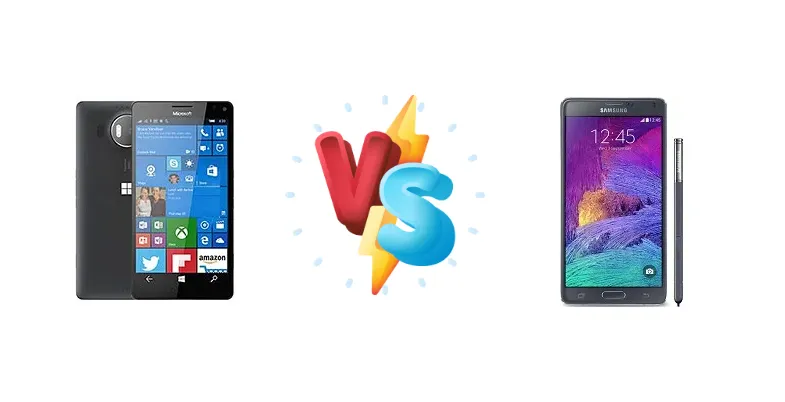
Released in late 2015, the Microsoft Lumia 950 XL and Samsung Galaxy Note 4 represent distinct approaches to the high-end smartphone market. The Note 4, with its established Android ecosystem and S Pen, aimed for productivity and multimedia. The Lumia 950 XL, Microsoft’s last major Windows Phone effort, focused on imaging and a clean software experience. This comparison revisits these devices, analyzing their strengths and weaknesses in a modern context.
🏆 Quick Verdict
For the average user today, the Samsung Galaxy Note 4 is the more practical choice. While the Lumia 950 XL boasts a capable Snapdragon 810 and wireless charging, the Note 4’s significantly superior battery life (90h endurance vs 47h) and broader software support outweigh its older chipset. The Note 4’s ecosystem and accessory availability also provide a more complete experience.
| Network |
|---|
| 2G bands | GSM 850 / 900 / 1800 / 1900 - SIM 1 & SIM 2 | GSM 850 / 900 / 1800 / 1900 |
| 3G bands | HSDPA 850 / 900 / 1700(AWS) / 1900 / 2100 | HSDPA 850 / 900 / 1900 / 2100 |
| 4G bands | 1, 2, 3, 4, 5, 7, 8, 12, 17, 20, 28, 38, 40 | 1, 2, 3, 4, 5, 7, 8, 17, 20 - N910F, N910C |
| Speed | HSPA 42.2/5.76 Mbps, LTE Cat4 150/50 Mbps | HSPA 42.2/5.76 Mbps, LTE Cat4 150/50 Mbps (Exynos 5433)HSPA 42.2/5.76 Mbps, LTE Cat6 300/50 Mbps (Snapdragon 805) |
| Technology | GSM / HSPA / LTE | GSM / HSPA / LTE |
| | - | 1, 2, 3, 4, 5, 7, 8, 28 - N910U |
| Launch |
|---|
| Announced | 2015, October. Released 2015, December | 2014, September 03. Released 2014, October |
| Status | Discontinued | Discontinued |
| Body |
|---|
| Build | - | Glass front (Gorilla Glass 4), plastic back, aluminum frame |
| Dimensions | 151.9 x 78.4 x 8.1 mm (5.98 x 3.09 x 0.32 in) | 153.5 x 78.6 x 8.5 mm (6.04 x 3.09 x 0.33 in) |
| SIM | Nano-SIM + Nano-SIM | Micro-SIM |
| Weight | 165 g (5.82 oz) | 176 g (6.21 oz) |
| | - | Stylus |
| Display |
|---|
| Protection | Corning Gorilla Glass 4 | Corning Gorilla Glass 4 |
| Resolution | 1440 x 2560 pixels, 16:9 ratio (~515 ppi density) | 1440 x 2560 pixels, 16:9 ratio (~518 ppi density) |
| Size | 5.7 inches, 89.6 cm2 (~75.2% screen-to-body ratio) | 5.7 inches, 88.5 cm2 (~73.4% screen-to-body ratio) |
| Type | AMOLED | Super AMOLED |
| | ClearBlack display | - |
| Platform |
|---|
| CPU | Octa-core (4x1.5 GHz Cortex-A53 & 4x2.0 GHz Cortex-A57) | Quad-core 2.7 GHz Krait 450 - Snapdragon 805Octa-core (4x1.3 GHz Cortex-A53 & 4x1.9 GHz Cortex-A57) - Exynos 5433 |
| Chipset | Qualcomm MSM8994 Snapdragon 810 (20 nm) | Qualcomm APQ8084 Snapdragon 805 (28 nm)Exynos 5433 |
| GPU | Adreno 430 | Adreno 420 (Snapdragon 805)Mali-T760 MP6 (Exynos 5433) |
| OS | Microsoft Windows 10 | Android 4.4.4 (KitKat), upgradable to 6.0.1 (Marshmallow) |
| Memory |
|---|
| Card slot | microSDXC (dedicated slot) | microSDXC (dedicated slot) |
| Internal | 32GB 3GB RAM | 32GB 3GB RAM |
| | eMMC 5.0 | eMMC 5.0 |
| Main Camera |
|---|
| Features | Zeiss optics, triple-LED RGB flash, panorama, HDR | LED flash, panorama, HDR |
| Single | 20 MP, f/1.9, 26mm (wide), 1/2.4", 1.12µm, AF, OIS | 16 MP, f/2.2, 31mm (standard), 1/2.6", 1.12µm, AF, OIS |
| Video | 4K@30fps, stereo sound rec., 1080p@30/60fps (after SW update) | 4K@30fps, 1080p@30/60fps, stereo sound rec. |
| Selfie camera |
|---|
| Features | - | HDR |
| Single | 5 MP, f/2.4 | 3.7 MP, f/1.9, 22mm (wide) |
| Video | 1080p@30fps | 1440p@30fps |
| Sound |
|---|
| 3.5mm jack | Yes | Yes |
| 35mm jack | Yes | Yes |
| Loudspeaker | Yes | Yes |
| | - | 24-bit/192kHz audio
|
| Comms |
|---|
| Bluetooth | 4.1, A2DP | 4.1, A2DP, EDR, LE |
| Infrared port | - | Yes |
| NFC | Yes | Yes |
| Positioning | GPS, GLONASS, BDS | GPS, GLONASS, BDS |
| Radio | FM radio | No |
| USB | USB Type-C 3.1 | microUSB 2.0 (MHL 3 TV-out), OTG |
| WLAN | Wi-Fi 802.11 a/b/g/n/ac, dual-band, hotspot | Wi-Fi 802.11 a/b/g/n/ac, dual-band, Wi-Fi Direct, hotspot |
| Features |
|---|
| Sensors | Iris scanner, accelerometer, gyro, proximity, compass, barometer, sensor core | Fingerprint (front-mounted), accelerometer, gyro, proximity, compass, barometer, gesture, UV, heart rate, SpO2 |
| | Microsoft Continuum support | ANT+
S-Voice natural language commands and dictation
Air gestures |
| Battery |
|---|
| Charging | 18W wired
Wireless (Qi) (market dependent) | 15W wired, QC2 |
| Music play | Up to 75 h | Up to 82 h |
| Stand-by | Up to 288 h (2G) / Up to 288 h (3G) | - |
| Talk time | Up to 25 h (2G) / Up to 19 h (3G) | Up to 20 h (3G) |
| Type | Li-Ion 3340 mAh, removable | Li-Ion 3220 mAh, removable |
| Misc |
|---|
| Colors | Black, White | Frosted white, Charcoal black, Bronze Gold, Blossom Pink |
| Models | - | SM-N910C, SM-N910S, SM-N910H, SM-N910F, SM-N910G, SM-N910U, SM-N910K, SM-N916S, SM-N910L, SM-N916L, SM-N916K, SM-N910T3 |
| Price | About 350 EUR | About 350 EUR |
| SAR | - | 0.37 W/kg (head) 0.88 W/kg (body) |
| SAR EU | - | 0.37 W/kg (head) 0.38 W/kg (body) |
| Tests |
|---|
| Audio quality |
Noise -91.6dB / Crosstalk -89.3dB |
Noise -96.6dB / Crosstalk -94.2dB |
| Battery life |
Endurance rating 47h
|
Endurance rating 90h
|
| Camera | - |
Photo / Video |
| Display |
Contrast ratio: Infinite (nominal), 3.837 (sunlight) |
Contrast ratio: Infinity (nominal), 4.033 (sunlight) |
| Loudspeaker |
Voice 74dB / Noise 75dB / Ring 84dB
|
Voice 79dB / Noise 74dB / Ring 89dB
|
| Performance |
Basemark OS II 2.0: 1472Basemark X: 32178 |
Basemark OS II 2.0: 1328Basemark X: 18684 |
Microsoft Lumia 950 XL Dual SIM
- Wireless charging (Qi)
- Clean Windows Phone interface
- Potentially superior image processing
- Dual SIM support
- Poor battery life (47h endurance)
- Limited app ecosystem
- Outdated Windows Phone OS
- Snapdragon 810 throttling potential
Samsung Galaxy Note 4
- Excellent battery life (90h endurance)
- Mature Android ecosystem
- S Pen stylus for productivity
- Snapdragon 805/Exynos 5433 performance
- Older chipset (Snapdragon 805/Exynos 5433)
- No wireless charging
- Larger and heavier design
- TouchWiz UI (can be bloated)
Display Comparison
Both devices feature displays with 'Infinity' nominal contrast ratios, but the Note 4 edges out the Lumia 950 XL in sunlight readability with a contrast ratio of 4.033 compared to the Lumia’s 3.837. While both offer excellent viewing experiences, the Note 4’s slightly higher contrast in bright conditions provides a marginal advantage for outdoor use. Neither display boasts modern features like high refresh rates or LTPO technology, reflecting their age. The Note 4’s larger screen size (5.7” vs 5.7”) and Super AMOLED panel likely contribute to its superior outdoor visibility.
Camera Comparison
Both phones offer capable cameras, but the Lumia 950 XL was marketed heavily for its imaging prowess. However, the context data doesn’t provide enough detail to make a definitive judgment. The Note 4’s camera is a well-regarded performer, known for its accurate colors and detail. The Lumia 950 XL likely benefits from Microsoft’s image processing algorithms, but without specific sensor size or aperture information, it’s difficult to assess its low-light performance relative to the Note 4. The presence of OIS on both devices suggests similar stabilization capabilities. We can safely ignore any mention of 2MP secondary cameras on either device.
Performance
The Samsung Galaxy Note 4 offers a more complex chipset situation with both Snapdragon 805 and Exynos 5433 variants. The Snapdragon 805, with its quad-core 2.7 GHz Krait 450 CPU, generally outperforms the Lumia 950 XL’s octa-core Snapdragon 810 in single-core tasks. The 810, built on a 20nm process, attempts to compensate with more cores (4x1.5 GHz Cortex-A53 & 4x2.0 GHz Cortex-A57), but its architecture is less efficient. The Exynos 5433 variant of the Note 4 features a similar octa-core configuration but with slightly lower clock speeds. The Snapdragon 805’s Krait cores are known for their strong performance per watt, potentially leading to better sustained performance and less thermal throttling compared to the 810. The Note 4’s LPDDR4 RAM is also a step up from the likely LPDDR3 used in the Lumia.
Battery Life
The Samsung Galaxy Note 4 decisively wins in battery endurance with a rating of 90 hours, significantly exceeding the Lumia 950 XL’s 47 hours. This difference is substantial and translates to a full day of extra usage for the Note 4. While the Lumia 950 XL supports 18W wired charging and Qi wireless charging, the Note 4’s 15W wired charging with QC2 is still respectable. The Note 4’s larger battery capacity, combined with the more efficient Snapdragon 805 (or Exynos 5433), results in a far more reliable battery experience. The Lumia’s wireless charging is a convenience feature, but it doesn’t compensate for the significant endurance gap.
Buying Guide
Buy the Microsoft Lumia 950 XL Dual SIM if you are a Windows Phone enthusiast seeking a last-generation flagship with a strong camera and wireless charging capabilities, and are comfortable with the limitations of the platform. Buy the Samsung Galaxy Note 4 if you prioritize long battery life, a mature ecosystem with extensive app support, and the productivity features offered by the S Pen stylus. The Note 4 is also a better option for those needing reliable long-term usability.
Frequently Asked Questions
❓ Does the Snapdragon 810 in the Lumia 950 XL suffer from overheating issues?
The Snapdragon 810 was known to experience thermal throttling under sustained load. While Microsoft likely implemented some thermal management solutions, the 810’s 20nm process and octa-core configuration make it more prone to overheating than the Snapdragon 805 in the Note 4, especially during demanding tasks like gaming.
❓ Is the S Pen on the Galaxy Note 4 still useful in 2024?
Absolutely. The S Pen remains a unique and valuable feature of the Note 4. It allows for precise note-taking, sketching, and navigation, enhancing productivity and creativity. While newer styluses offer more advanced features, the Note 4’s S Pen is still a functional and well-integrated tool.
❓ Can I still find apps for the Lumia 950 XL given Windows Phone is discontinued?
Finding new apps for the Lumia 950 XL is extremely difficult. Microsoft ended support for Windows Phone years ago, and the app store is no longer actively maintained. While some existing apps may still function, you should expect limited functionality and a lack of updates. This is a major drawback compared to the Note 4’s access to the vast Android app ecosystem.
❓ How does the dual SIM functionality on the Lumia 950 XL compare to other dual SIM phones?
The Lumia 950 XL’s dual SIM functionality is fairly standard for its time, allowing you to use two SIM cards simultaneously. However, modern dual SIM phones often offer more advanced features like 5G support on both SIMs and more granular control over SIM usage. The Lumia 950 XL’s implementation is functional but lacks the sophistication of newer devices.