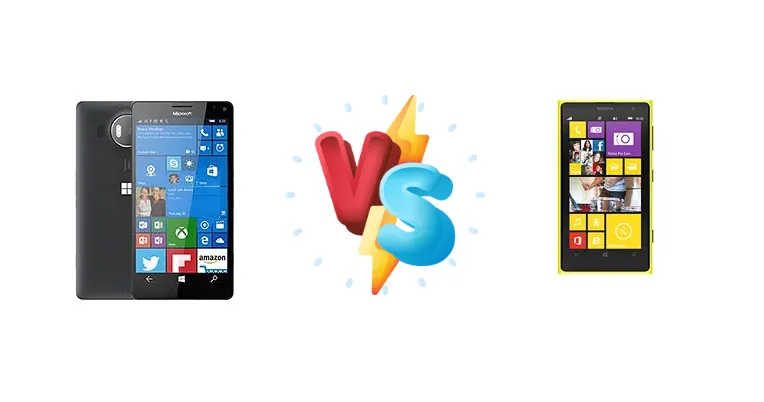
The Lumia 950 XL and Nokia Lumia 1020 represent different eras of Windows Phone. The 950 XL aimed for flagship performance, while the 1020 prioritized camera excellence. Let's dive into a detailed comparison to see which phone holds up best today.
🏆 Quick Verdict
The Nokia Lumia 1020 wins for its exceptional camera and longer battery life, despite its older processor. The Lumia 950 XL offers a more modern chipset and display, but falls short in camera quality and battery endurance. It depends on your priorities.
| Network |
|---|
| 2G bands | GSM 850 / 900 / 1800 / 1900 - SIM 1 & SIM 2 | GSM 850 / 900 / 1800 / 1900 - all versions |
| 3G bands | HSDPA 850 / 900 / 1700(AWS) / 1900 / 2100 | HSDPA 850 / 900 / 1900 / 2100 - RM-875, RM-877 |
| 4G bands | 1, 2, 3, 4, 5, 7, 8, 12, 17, 20, 28, 38, 40 | 1, 3, 7, 8, 20 - RM-875 |
| Speed | HSPA 42.2/5.76 Mbps, LTE Cat4 150/50 Mbps | HSPA 42.2/5.76 Mbps, LTE Cat3 100/50 Mbps |
| Technology | GSM / HSPA / LTE | GSM / HSPA / LTE |
| | - | 2, 4, 5, 17 - RM-877 |
| Launch |
|---|
| Announced | 2015, October. Released 2015, December | 2013, July 11. Released 2013, July 22 |
| Status | Discontinued | Discontinued |
| Body |
|---|
| Build | - | Glass front (Gorilla Glass 3), plastic back, plastic frame |
| Dimensions | 151.9 x 78.4 x 8.1 mm (5.98 x 3.09 x 0.32 in) | 130.4 x 71.4 x 10.4 mm, 96.9 cc (5.13 x 2.81 x 0.41 in) |
| SIM | Nano-SIM + Nano-SIM | Micro-SIM |
| Weight | 165 g (5.82 oz) | 158 g (5.57 oz) |
| Display |
|---|
| Protection | Corning Gorilla Glass 4 | Corning Gorilla Glass 3 |
| Resolution | 1440 x 2560 pixels, 16:9 ratio (~515 ppi density) | 768 x 1280 pixels, 5:3 ratio (~332 ppi density) |
| Size | 5.7 inches, 89.6 cm2 (~75.2% screen-to-body ratio) | 4.5 inches, 57.6 cm2 (~61.9% screen-to-body ratio) |
| Type | AMOLED | AMOLED |
| | ClearBlack display | PureMotion HD+ ClearBlack display |
| Platform |
|---|
| CPU | Octa-core (4x1.5 GHz Cortex-A53 & 4x2.0 GHz Cortex-A57) | Dual-core 1.5 GHz Krait |
| Chipset | Qualcomm MSM8994 Snapdragon 810 (20 nm) | Qualcomm MSM8960 Snapdragon S4 Plus |
| GPU | Adreno 430 | Adreno 225 |
| OS | Microsoft Windows 10 | Microsoft Windows Phone 8, upgradable to 8.1 |
| Memory |
|---|
| Card slot | microSDXC (dedicated slot) | No |
| Internal | 32GB 3GB RAM | 32GB 2GB RAM, 64GB 2GB RAM (Telefonica exclusive) |
| | eMMC 5.0 | - |
| Main Camera |
|---|
| Features | Zeiss optics, triple-LED RGB flash, panorama, HDR | Carl Zeiss optics, Xenon & LED flash, panorama |
| Single | 20 MP, f/1.9, 26mm (wide), 1/2.4", 1.12µm, AF, OIS | 41 MP, f/2.2, 26mm (wide), 1/1.5", 1.12µm, AF, OIS |
| Video | 4K@30fps, stereo sound rec., 1080p@30/60fps (after SW update) | 1080p@30fps, 4x lossless digital zoom |
| Selfie camera |
|---|
| Single | 5 MP, f/2.4 | 1.2 MP |
| Video | 1080p@30fps | 720p@30fps |
| Sound |
|---|
| 3.5mm jack | Yes | Yes |
| 35mm jack | Yes | Yes |
| Loudspeaker | Yes | Yes |
| Comms |
|---|
| Bluetooth | 4.1, A2DP | 4.0, A2DP, EDR, LE/ aptX after WP8 Denim update |
| NFC | Yes | Yes |
| Positioning | GPS, GLONASS, BDS | GPS, GLONASS |
| Radio | FM radio | Stereo FM radio, RDS |
| USB | USB Type-C 3.1 | microUSB 2.0 |
| WLAN | Wi-Fi 802.11 a/b/g/n/ac, dual-band, hotspot | Wi-Fi 802.11 a/b/g/n, dual-band, DLNA, hotspot |
| Features |
|---|
| Sensors | Iris scanner, accelerometer, gyro, proximity, compass, barometer, sensor core | Accelerometer, gyro, proximity, compass, barometer |
| | Microsoft Continuum support | - |
| Battery |
|---|
| Charging | 18W wired
Wireless (Qi) (market dependent) | - |
| Music play | Up to 75 h | Up to 63 h |
| Stand-by | Up to 288 h (2G) / Up to 288 h (3G) | Up to 384 h (3G) |
| Talk time | Up to 25 h (2G) / Up to 19 h (3G) | Up to 19 h (2G) / Up to 13 h 20 min (3G) |
| Type | Li-Ion 3340 mAh, removable | Li-Ion 2000 mAh, non-removable (BV-5XW) |
| Misc |
|---|
| Colors | Black, White | Yellow, white, black, red (AT&T exclusive) |
| Price | About 350 EUR | About 400 EUR |
| SAR | - | 1.23 W/kg (head) 0.97 W/kg (body) |
| SAR EU | - | 0.76 W/kg (head) 0.67 W/kg (body) |
| Tests |
|---|
| Audio quality |
Noise -91.6dB / Crosstalk -89.3dB | - |
| Battery life |
Endurance rating 47h
|
Endurance rating 61h
|
| Camera | - |
Photo / Video |
| Display |
Contrast ratio: Infinite (nominal), 3.837 (sunlight) |
Contrast ratio: Infinite (nominal), 2.103 (sunlight) |
| Loudspeaker |
Voice 74dB / Noise 75dB / Ring 84dB
|
Voice 69dB / Noise 66dB / Ring 72dB
|
| Performance |
Basemark OS II 2.0: 1472Basemark X: 32178 | - |
Microsoft Lumia 950 XL Dual SIM
- Faster Processor
- Larger, Sharper Display
- Modern Design
- Wireless Charging (market dependent)
- More RAM (3GB vs 2GB)
- Shorter Battery Life
- Camera Not as Good as 1020
- Snapdragon 810 Thermal Throttling
- Software Support Ended
Nokia Lumia 1020
- Exceptional Camera Quality
- Longer Battery Life
- Compact Size
- Excellent Low-Light Performance
- PureView Technology
- Slower Processor
- Smaller Display
- Older Design
- Limited App Support
- No Wireless Charging
Display Comparison
The Lumia 950 XL boasts a larger 5.7-inch display with a higher resolution (2560 x 1440) compared to the 1020's 4.5-inch (1920 x 1080) screen. While both have excellent contrast ratios (nominally infinite, 3.837 vs 2.103 in sunlight), the 950 XL's display is noticeably sharper and more vibrant. The 1020's smaller size might be preferable for one-handed use.
Camera Comparison
This is where the Lumia 1020 truly shines. Its 41MP PureView camera with optical image stabilization (OIS) delivers exceptional image quality, particularly in low light. The 950 XL's 20MP camera is capable, but doesn't match the 1020's detail and dynamic range. The 1020's oversampling technology is a key differentiator.
Performance
The 950 XL's Snapdragon 810 chipset and Octa-core CPU provide significantly better performance than the 1020's Snapdragon S4 Plus and Dual-core processor. Expect smoother multitasking, faster app loading, and better gaming performance on the 950 XL. However, the 810 was known for thermal throttling under sustained load.
Battery Life
The Nokia Lumia 1020 edges out the 950 XL in battery life, boasting an endurance rating of 61 hours compared to the 950 XL's 47 hours. This difference is likely due to the 1020's less power-hungry processor and smaller display.
Buying Guide
Who should buy the Microsoft Lumia 950 XL Dual SIM? Users prioritizing a slightly faster processor and a larger screen. Who should buy the Nokia Lumia 1020? Photography enthusiasts who value image quality and extended battery life above all else.
Frequently Asked Questions
❓ Are apps still available for these phones?
App support for both devices is limited. Windows Phone store is largely defunct. While some apps may still function, don't expect regular updates or new releases.
❓ Which phone is better for photography?
The Nokia Lumia 1020 is the clear winner for photography. Its 41MP PureView camera and OIS produce superior image quality, especially in challenging lighting conditions.