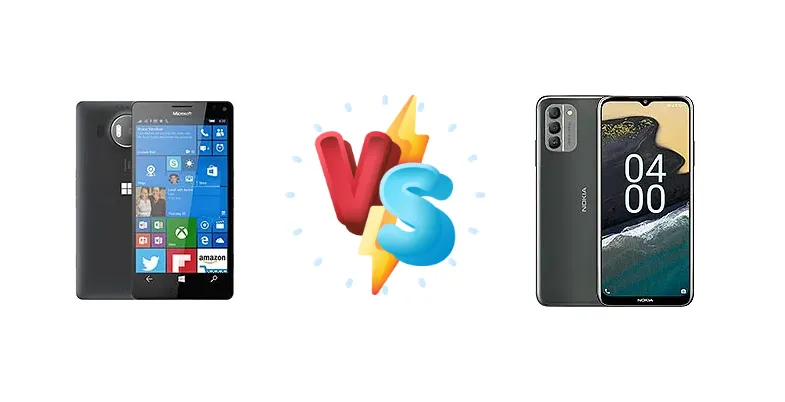
The Microsoft Lumia 950 XL, a relic of Windows Phone's ambition, resurfaces as a budget option. We pit it against the Nokia G400, a modern 5G device, to determine if a powerful older chipset can still compete with newer, more efficient silicon. This comparison isn't about raw specs; it's about real-world usability and value in 2024.
🏆 Quick Verdict
For the average user, the Nokia G400 emerges as the more sensible choice. While the Lumia 950 XL boasts a more powerful (on paper) Snapdragon 810, the G400’s Snapdragon 480+ offers a better balance of performance, efficiency, and modern features like 5G connectivity, all at a likely lower price point.
| Network |
|---|
| 2G bands | GSM 850 / 900 / 1800 / 1900 - SIM 1 & SIM 2 | GSM 850 / 900 / 1800 / 1900 |
| 3G bands | HSDPA 850 / 900 / 1700(AWS) / 1900 / 2100 | HSDPA 850 / 1700(AWS) / 1900 |
| 4G bands | 1, 2, 3, 4, 5, 7, 8, 12, 17, 20, 28, 38, 40 | 2, 4, 5, 12, 13, 25, 26, 41, 66, 71 |
| 5G bands | - | 2, 5, 25, 41, 66, 71, 77 SA/NSA |
| Speed | HSPA 42.2/5.76 Mbps, LTE Cat4 150/50 Mbps | HSPA, LTE, 5G |
| Technology | GSM / HSPA / LTE | GSM / HSPA / LTE / 5G |
| Launch |
|---|
| Announced | 2015, October. Released 2015, December | 2022, January 05 |
| Status | Discontinued | Available. Released 2022, August 24 |
| Body |
|---|
| Build | - | Glass front (Gorilla Glass 3), aluminum frame |
| Dimensions | 151.9 x 78.4 x 8.1 mm (5.98 x 3.09 x 0.32 in) | 166.4 x 76.7 x 8.8 mm (6.55 x 3.02 x 0.35 in) |
| SIM | Nano-SIM + Nano-SIM | Nano-SIM |
| Weight | 165 g (5.82 oz) | 198 g (6.98 oz) |
| Display |
|---|
| Protection | Corning Gorilla Glass 4 | Corning Gorilla Glass 3 |
| Resolution | 1440 x 2560 pixels, 16:9 ratio (~515 ppi density) | 1080 x 2408 pixels, 20:9 ratio (~401 ppi density) |
| Size | 5.7 inches, 89.6 cm2 (~75.2% screen-to-body ratio) | 6.58 inches, 104.3 cm2 (~81.7% screen-to-body ratio) |
| Type | AMOLED | IPS LCD, 120Hz |
| | ClearBlack display | - |
| Platform |
|---|
| CPU | Octa-core (4x1.5 GHz Cortex-A53 & 4x2.0 GHz Cortex-A57) | Octa-core (2x2.2 GHz Kryo 460 & 6x1.9 GHz Kryo 460) |
| Chipset | Qualcomm MSM8994 Snapdragon 810 (20 nm) | Qualcomm SM4350-AC Snapdragon 480+ 5G (8 nm) |
| GPU | Adreno 430 | Adreno 619 |
| OS | Microsoft Windows 10 | Android 12 |
| Memory |
|---|
| Card slot | microSDXC (dedicated slot) | microSDXC (dedicated slot) |
| Internal | 32GB 3GB RAM | 64GB 4GB RAM |
| | eMMC 5.0 | - |
| Main Camera |
|---|
| Features | Zeiss optics, triple-LED RGB flash, panorama, HDR | LED flash, HDR, panorama |
| Single | 20 MP, f/1.9, 26mm (wide), 1/2.4", 1.12µm, AF, OIS | 16 MP, (wide) |
| Triple | - | 48 MP, f/1.8, (wide), PDAF
5 MP, f/2.2, 115˚ (ultrawide)
Auxiliary lens |
| Video | 4K@30fps, stereo sound rec., 1080p@30/60fps (after SW update) | 1080p@30/60fps |
| Selfie camera |
|---|
| Single | 5 MP, f/2.4 | 16 MP, (wide) |
| Video | 1080p@30fps | 1080p@30fps |
| Sound |
|---|
| 3.5mm jack | Yes | Yes |
| 35mm jack | Yes | Yes |
| Loudspeaker | Yes | Yes |
| Comms |
|---|
| Bluetooth | 4.1, A2DP | 5.1, A2DP, LE, aptX HD, aptX Adaptive |
| NFC | Yes | Yes |
| Positioning | GPS, GLONASS, BDS | GPS, GALILEO |
| Radio | FM radio | FM radio |
| USB | USB Type-C 3.1 | USB Type-C 2.0, OTG |
| WLAN | Wi-Fi 802.11 a/b/g/n/ac, dual-band, hotspot | Wi-Fi 802.11 b/g/n/ac |
| Features |
|---|
| Sensors | Iris scanner, accelerometer, gyro, proximity, compass, barometer, sensor core | Fingerprint (side-mounted), accelerometer, gyro, proximity, compass, barometer |
| | Microsoft Continuum support | - |
| Battery |
|---|
| Charging | 18W wired
Wireless (Qi) (market dependent) | 20W wired, PD3.0 |
| Music play | Up to 75 h | - |
| Stand-by | Up to 288 h (2G) / Up to 288 h (3G) | - |
| Talk time | Up to 25 h (2G) / Up to 19 h (3G) | - |
| Type | Li-Ion 3340 mAh, removable | Li-Po 5000 mAh |
| Misc |
|---|
| Colors | Black, White | Meteor Grey |
| Models | - | TA-1530, TA-1448, TA-1476, N1530DL |
| Price | About 350 EUR | About 70 EUR |
| SAR | - | 1.05 W/kg (head) 1.09 W/kg (body) |
| Tests |
|---|
| Audio quality |
Noise -91.6dB / Crosstalk -89.3dB | - |
| Battery life |
Endurance rating 47h
| - |
| Display |
Contrast ratio: Infinite (nominal), 3.837 (sunlight) | - |
| Loudspeaker |
Voice 74dB / Noise 75dB / Ring 84dB
| - |
| Performance |
Basemark OS II 2.0: 1472Basemark X: 32178 | - |
Microsoft Lumia 950 XL Dual SIM
- Potentially higher peak CPU performance (Snapdragon 810)
- Qi wireless charging (market dependent)
- Dual SIM functionality
- Aging battery and potential degradation
- Outdated operating system (Windows Phone)
- Less efficient chipset (20nm)
- Likely limited software support
Nokia G400
- Modern Android operating system
- 5G connectivity
- More efficient chipset (8nm)
- Faster 20W charging with PD3.0
- Likely better software support
- Lower peak CPU performance compared to the 950 XL
- Potentially lower camera quality (depending on sensors)
- No wireless charging
Display Comparison
Both devices share a similar contrast ratio specification – infinite (nominal) and 3.837 in sunlight – suggesting comparable outdoor visibility. However, the Lumia 950 XL’s display technology is unknown, while the Nokia G400 likely utilizes an IPS LCD panel common in its price bracket. The Lumia’s age means potential color shift and burn-in are concerns, while the G400 offers a fresh, albeit potentially less vibrant, viewing experience. The lack of detailed display specs for the Lumia makes a definitive judgment difficult, but its age is a significant disadvantage.
Camera Comparison
Detailed camera specifications are absent for both devices. Given the Lumia 950 XL’s flagship origins, it likely featured a more capable primary sensor than the Nokia G400. However, image processing technology has advanced significantly since 2015. Without knowing sensor sizes, apertures, or image processing algorithms, it’s difficult to declare a clear winner. The Nokia G400’s camera is likely optimized for social media sharing, while the Lumia’s may offer more detail but potentially suffer from noise and outdated processing.
Performance
The core difference lies in the chipsets. The Lumia 950 XL’s Snapdragon 810 (20nm) was a flagship processor in its time, featuring an octa-core configuration with a mix of Cortex-A53 and A57 cores. However, its 20nm process is significantly less efficient than the Nokia G400’s Snapdragon 480+ (8nm). The 480+ uses Kryo 460 cores, designed for better sustained performance and power efficiency. While the 810’s peak performance might be higher in benchmarks, the 480+ will likely deliver a smoother, more consistent experience in everyday tasks and light gaming due to better thermal management and a more modern architecture. The 8nm process node is a key advantage for the G400.
Battery Life
The Lumia 950 XL boasts an endurance rating of 47 hours, a respectable figure for its time. However, battery degradation is a major concern given its age. The Nokia G400, while lacking a specific endurance rating, benefits from a more efficient chipset. The G400’s 20W charging with PD3.0 is also a significant advantage over the Lumia’s 18W charging and market-dependent Qi wireless charging. The faster charging speeds will translate to less downtime, a crucial benefit for modern users.
Buying Guide
Buy the Microsoft Lumia 950 XL Dual SIM if you prioritize raw CPU performance for legacy applications and absolutely require Qi wireless charging, and can live with an older operating system and potentially degraded battery health. Buy the Nokia G400 if you prefer a modern Android experience, 5G connectivity, faster charging with PD3.0, and a device that’s more likely to receive security updates (even if limited).
Frequently Asked Questions
❓ Is the Snapdragon 810 in the Lumia 950 XL still capable of running modern apps?
While the Snapdragon 810 was powerful for its time, the Windows Phone operating system is no longer supported, severely limiting app availability. Even if you can sideload apps, compatibility and performance will be inconsistent. The Snapdragon 480+ in the Nokia G400, paired with Android, offers a far more reliable and supported app ecosystem.
❓ How does the 5G connectivity of the Nokia G400 impact real-world usage compared to the Lumia 950 XL's 4G?
The Nokia G400’s 5G connectivity provides significantly faster download and upload speeds where 5G networks are available. This translates to quicker app downloads, smoother streaming, and a more responsive online experience. The Lumia 950 XL is limited to 4G speeds, which are considerably slower in comparison.
❓ Given the age of the Lumia 950 XL, what is the likelihood of finding a replacement battery?
Finding a replacement battery for the Lumia 950 XL is becoming increasingly difficult and expensive. Even if you find one, its capacity may not match the original, and the installation process can be challenging. The Nokia G400, being a newer device, has a better chance of having readily available replacement parts.