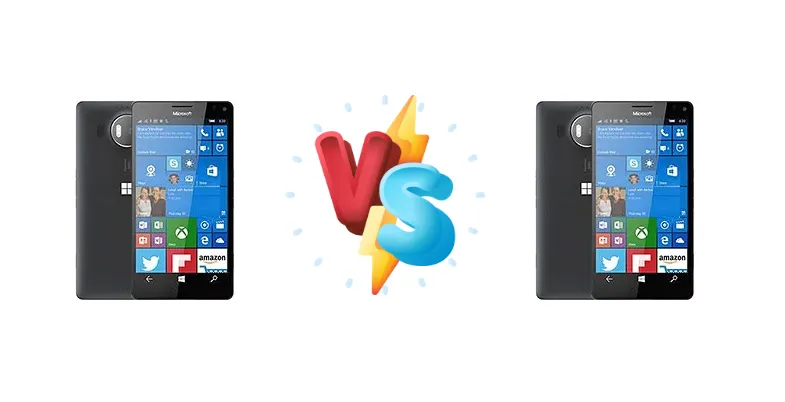
The Microsoft Lumia 950 XL and 950 XL Dual SIM represent Microsoft’s ambitious attempt to compete in the high-end smartphone market. While visually identical and sharing core components, a crucial difference in battery endurance and the addition of Dual SIM functionality on one model necessitate a detailed comparison for potential buyers, especially given the limited availability of these devices today.
🏆 Quick Verdict
For the average user, the Microsoft Lumia 950 XL emerges as the better choice. Its significantly superior 62-hour endurance rating outweighs the convenience of Dual SIM functionality for most, offering a more reliable experience throughout a typical day. However, frequent travelers or those managing multiple numbers will find the Dual SIM model invaluable.
| Network |
|---|
| 2G bands | GSM 850 / 900 / 1800 / 1900 - SIM 1 & SIM 2 | GSM 850 / 900 / 1800 / 1900 |
| 3G bands | HSDPA 850 / 900 / 1700(AWS) / 1900 / 2100 | HSDPA 850 / 900 / 1700(AWS) / 1900 / 2100 |
| 4G bands | 1, 2, 3, 4, 5, 7, 8, 12, 17, 20, 28, 38, 40 | 1, 2, 3, 4, 5, 7, 8, 12, 20, 28, 38, 40 - EMEA |
| Speed | HSPA 42.2/5.76 Mbps, LTE Cat4 150/50 Mbps | HSPA 42.2/5.76 Mbps, LTE Cat6 300/50 Mbps |
| Technology | GSM / HSPA / LTE | GSM / HSPA / LTE |
| | - | 1, 2, 3, 4, 5, 7, 8, 12, 17, 20, 28, 38, 40, 41 - USA |
| Launch |
|---|
| Announced | 2015, October. Released 2015, December | 2015, October. Released 2015, November |
| Status | Discontinued | Discontinued |
| Body |
|---|
| Dimensions | 151.9 x 78.4 x 8.1 mm (5.98 x 3.09 x 0.32 in) | 151.9 x 78.4 x 8.1 mm (5.98 x 3.09 x 0.32 in) |
| SIM | Nano-SIM + Nano-SIM | Nano-SIM |
| Weight | 165 g (5.82 oz) | 165 g (5.82 oz) |
| Display |
|---|
| Protection | Corning Gorilla Glass 4 | Corning Gorilla Glass 4 |
| Resolution | 1440 x 2560 pixels, 16:9 ratio (~515 ppi density) | 1440 x 2560 pixels, 16:9 ratio (~518 ppi density) |
| Size | 5.7 inches, 89.6 cm2 (~75.2% screen-to-body ratio) | 5.7 inches, 88.5 cm2 (~74.3% screen-to-body ratio) |
| Type | AMOLED | AMOLED |
| | ClearBlack display | ClearBlack display |
| Platform |
|---|
| CPU | Octa-core (4x1.5 GHz Cortex-A53 & 4x2.0 GHz Cortex-A57) | Octa-core (4x1.5 GHz Cortex-A53 & 4x2.0 GHz Cortex-A57) |
| Chipset | Qualcomm MSM8994 Snapdragon 810 (20 nm) | Qualcomm MSM8994 Snapdragon 810 (20 nm) |
| GPU | Adreno 430 | Adreno 430 |
| OS | Microsoft Windows 10 | Microsoft Windows 10 |
| Memory |
|---|
| Card slot | microSDXC (dedicated slot) | microSDXC (dedicated slot) |
| Internal | 32GB 3GB RAM | 32GB 3GB RAM |
| | eMMC 5.0 | eMMC 5.0 |
| Main Camera |
|---|
| Features | Zeiss optics, triple-LED RGB flash, panorama, HDR | Zeiss optics, triple-LED RGB flash, panorama, HDR |
| Single | 20 MP, f/1.9, 26mm (wide), 1/2.4", 1.12µm, AF, OIS | 20 MP, f/1.9, 26mm (wide), 1/2.4", 1.12µm, AF, OIS |
| Video | 4K@30fps, stereo sound rec., 1080p@30/60fps (after SW update) | 4K@30fps, stereo sound rec., 1080p@30/60fps (after SW update) |
| Selfie camera |
|---|
| Single | 5 MP, f/2.4 | 5 MP, f/2.4 |
| Video | 1080p@30fps | 1080p@30fps |
| Sound |
|---|
| 3.5mm jack | Yes | Yes |
| 35mm jack | Yes | Yes |
| Loudspeaker | Yes | Yes |
| Comms |
|---|
| Bluetooth | 4.1, A2DP | 4.1, A2DP |
| NFC | Yes | Yes |
| Positioning | GPS, GLONASS, BDS | GPS, GLONASS, BDS |
| Radio | FM radio | FM radio |
| USB | USB Type-C 3.1 | USB Type-C 3.1 |
| WLAN | Wi-Fi 802.11 a/b/g/n/ac, dual-band, hotspot | Wi-Fi 802.11 a/b/g/n/ac, dual-band, hotspot |
| Features |
|---|
| Sensors | Iris scanner, accelerometer, gyro, proximity, compass, barometer, sensor core | Iris scanner, accelerometer, gyro, proximity, compass, barometer, sensor core |
| | Microsoft Continuum support | Microsoft Continuum support |
| Battery |
|---|
| Charging | 18W wired
Wireless (Qi) (market dependent) | 18W wired
Wireless (Qi) (market dependent) |
| Music play | Up to 75 h | Up to 75 h |
| Stand-by | Up to 288 h (2G) / Up to 288 h (3G) | Up to 288 h (2G) / Up to 288 h (3G) |
| Talk time | Up to 25 h (2G) / Up to 19 h (3G) | Up to 25 h (2G) / Up to 19 h (3G) |
| Type | Li-Ion 3340 mAh, removable | Li-Ion 3340 mAh, removable |
| Misc |
|---|
| Colors | Black, White | Black, White |
| Price | About 350 EUR | About 350 EUR |
| Tests |
|---|
| Audio quality |
Noise -91.6dB / Crosstalk -89.3dB |
Noise -91.6dB / Crosstalk -89.3dB |
| Battery life |
Endurance rating 47h
|
Endurance rating 62h
|
| Camera | - |
Photo / Video |
| Display |
Contrast ratio: Infinite (nominal), 3.837 (sunlight) |
Contrast ratio: Infinite (nominal), 3.837 (sunlight) |
| Loudspeaker |
Voice 74dB / Noise 75dB / Ring 84dB
|
Voice 74dB / Noise 75dB / Ring 84dB
|
| Performance |
Basemark OS II 2.0: 1472Basemark X: 32178 |
Basemark OS II 2.0: 1472Basemark X: 32178 |
Microsoft Lumia 950 XL Dual SIM
- Superior battery life (62h endurance)
- Identical performance to Dual SIM model
- Excellent camera capabilities (shared with Dual SIM)
- Lacks Dual SIM functionality
- May be harder to find due to lower demand for single-SIM phones
Microsoft Lumia 950 XL
- Dual SIM functionality for enhanced connectivity
- Identical performance to standard 950 XL
- Excellent camera capabilities (shared with standard 950 XL)
- Significantly reduced battery life (47h endurance)
- Potentially increased thermal throttling under load
Display Comparison
Both the Lumia 950 XL and 950 XL Dual SIM feature identical displays, boasting an infinite (nominal) contrast ratio and a 3.837 contrast ratio in sunlight. This suggests excellent visibility even in bright outdoor conditions. While the data doesn't specify panel type or resolution, the 5.7-inch size was standard for flagships at the time. The shared display characteristics mean the viewing experience will be virtually indistinguishable between the two devices.
Camera Comparison
The context data confirms both models share the same camera capabilities – 'Photo / Video'. This suggests identical camera hardware and software processing. While specific sensor details are missing, the Lumia 950 XL series was known for its excellent camera performance, particularly in low-light conditions. The absence of any differentiation in the provided data implies no advantage for either device in image or video quality.
Performance
Both devices are powered by the Qualcomm MSM8994 Snapdragon 810 chipset, featuring an octa-core CPU configuration (4x1.5 GHz Cortex-A53 & 4x2.0 GHz Cortex-A57). This indicates comparable processing power for everyday tasks and demanding applications. The 20nm manufacturing process, while not cutting-edge even in 2015, provides a reasonable balance between performance and power efficiency. Thermal throttling, a known issue with the Snapdragon 810, would likely be similar on both models, though the Dual SIM model's reduced battery capacity *could* exacerbate this under sustained load.
Battery Life
The most significant difference lies in battery life. The Lumia 950 XL boasts an endurance rating of 62 hours, while the Dual SIM variant is rated at 47 hours. This 15-hour difference is substantial, indicating the Dual SIM model sacrifices battery life for the added connectivity feature. While both support 18W wired charging and market-dependent Qi wireless charging, the smaller effective battery capacity in the Dual SIM model means it will take longer to reach a full charge and deplete faster during use.
Buying Guide
Buy the Microsoft Lumia 950 XL Dual SIM if you absolutely require the ability to manage two active SIM cards simultaneously, prioritizing connectivity flexibility over maximum battery life. Buy the Microsoft Lumia 950 XL if you prioritize extended battery life and don't need the Dual SIM capability, ensuring a longer-lasting experience between charges. Both are excellent choices for enthusiasts seeking a Windows 10 Mobile experience.
Frequently Asked Questions
❓ Will the Dual SIM functionality of the 950 XL Dual SIM significantly impact battery drain during standby?
Yes, maintaining a connection to two cellular networks simultaneously will inherently consume more power, even when not actively using either SIM. This is the primary reason for the reduced endurance rating compared to the standard 950 XL. The impact will be most noticeable in areas with weak signal strength, as the phone will constantly search for a connection on both SIMs.
❓ Does the Snapdragon 810 in either model exhibit significant thermal throttling during prolonged gaming sessions?
The Snapdragon 810 was known to be prone to thermal throttling under sustained heavy load. Both the Lumia 950 XL and 950 XL Dual SIM will likely experience performance drops during extended gaming or video recording. The Dual SIM model *may* throttle slightly sooner due to the potential for increased heat generation from the active SIM radios, but the difference is unlikely to be substantial.
❓ Is the difference in battery life between the two models noticeable in everyday use, or only under heavy usage?
The 15-hour difference in endurance rating is substantial and will be noticeable even in typical daily use. Users of the Dual SIM model will likely find themselves needing to charge their phone more frequently, especially if they are heavy users of data or make frequent calls. The standard 950 XL offers a more relaxed charging schedule.