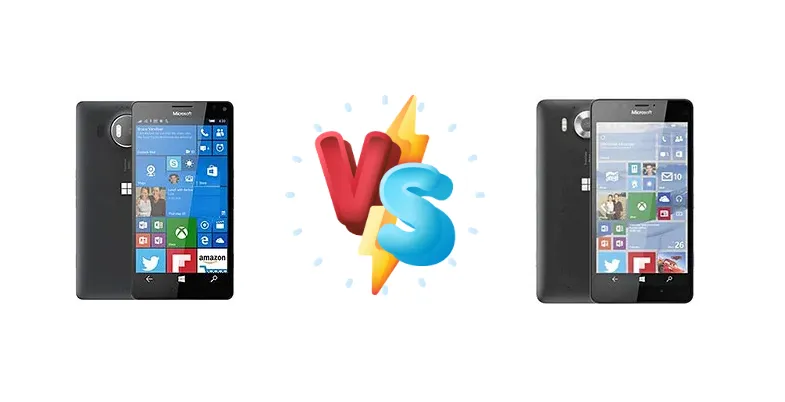
The Microsoft Lumia 950 and 950 XL represented Microsoft’s last serious push into the smartphone hardware space. While both devices ran Windows 10 Mobile and shared a similar design language, significant internal differences catered to distinct user needs. This comparison dissects those differences, focusing on the core trade-offs between the larger, more powerful 950 XL and the more compact 950.
🏆 Quick Verdict
For most users, the Lumia 950 XL is the superior choice. Its Snapdragon 810 chipset and larger battery deliver noticeably better performance and endurance, justifying its larger size. However, those prioritizing pocketability and potentially slightly cooler operation under sustained load may prefer the 950.
| Network |
|---|
| 2G bands | GSM 850 / 900 / 1800 / 1900 - SIM 1 & SIM 2 | GSM 850 / 900 / 1800 / 1900 - SIM 1 & SIM 2 |
| 3G bands | HSDPA 850 / 900 / 1700(AWS) / 1900 / 2100 | HSDPA 850 / 900 / 1700(AWS) / 1900 / 2100 |
| 4G bands | 1, 2, 3, 4, 5, 7, 8, 12, 17, 20, 28, 38, 40 | 1, 2, 3, 4, 5, 7, 8, 12, 17, 20, 28, 38, 40 |
| Speed | HSPA 42.2/5.76 Mbps, LTE Cat4 150/50 Mbps | HSPA 42.2/5.76 Mbps, LTE Cat4 150/50 Mbps |
| Technology | GSM / HSPA / LTE | GSM / HSPA / LTE |
| Launch |
|---|
| Announced | 2015, October. Released 2015, December | 2015, October. Released 2015, December |
| Status | Discontinued | Discontinued |
| Body |
|---|
| Dimensions | 151.9 x 78.4 x 8.1 mm (5.98 x 3.09 x 0.32 in) | 145 x 73.2 x 8.2 mm (5.71 x 2.88 x 0.32 in) |
| SIM | Nano-SIM + Nano-SIM | Nano-SIM + Nano-SIM |
| Weight | 165 g (5.82 oz) | 150 g (5.29 oz) |
| Display |
|---|
| Protection | Corning Gorilla Glass 4 | Corning Gorilla Glass 3 |
| Resolution | 1440 x 2560 pixels, 16:9 ratio (~515 ppi density) | 1440 x 2560 pixels, 16:9 ratio (~565 ppi density) |
| Size | 5.7 inches, 89.6 cm2 (~75.2% screen-to-body ratio) | 5.2 inches, 74.5 cm2 (~70.2% screen-to-body ratio) |
| Type | AMOLED | AMOLED |
| | ClearBlack display | ClearBlack display |
| Platform |
|---|
| CPU | Octa-core (4x1.5 GHz Cortex-A53 & 4x2.0 GHz Cortex-A57) | Hexa-core (4x1.4 GHz Cortex-A53 & 2x1.8 GHz Cortex-A57) |
| Chipset | Qualcomm MSM8994 Snapdragon 810 (20 nm) | Qualcomm MSM8992 Snapdragon 808 (20 nm) |
| GPU | Adreno 430 | Adreno 418 |
| OS | Microsoft Windows 10 | Microsoft Windows 10 |
| Memory |
|---|
| Card slot | microSDXC (dedicated slot) | microSDXC (dedicated slot) |
| Internal | 32GB 3GB RAM | 32GB 3GB RAM |
| | eMMC 5.0 | eMMC 5.0 |
| Main Camera |
|---|
| Features | Zeiss optics, triple-LED RGB flash, panorama, HDR | Zeiss optics, triple-LED RGB flash, panorama, HDR |
| Single | 20 MP, f/1.9, 26mm (wide), 1/2.4", 1.12µm, AF, OIS | 20 MP, f/1.9, 26mm (wide), 1/2.4", 1.12µm, AF, OIS |
| Video | 4K@30fps, stereo sound rec., 1080p@30/60fps (after SW update) | 4K@30fps, stereo sound rec., 1080p@30/60fps (after SW update) |
| Selfie camera |
|---|
| Single | 5 MP, f/2.4 | 5 MP, f/2.4 |
| Video | 1080p@30fps | 1080p@30fps |
| Sound |
|---|
| 3.5mm jack | Yes | Yes |
| 35mm jack | Yes | Yes |
| Loudspeaker | Yes | Yes |
| Comms |
|---|
| Bluetooth | 4.1, A2DP | 4.1, A2DP |
| NFC | Yes | Yes |
| Positioning | GPS, GLONASS, BDS | GPS, GLONASS, BDS |
| Radio | FM radio | FM radio |
| USB | USB Type-C 3.1 | USB Type-C 3.1 |
| WLAN | Wi-Fi 802.11 a/b/g/n/ac, dual-band, hotspot | Wi-Fi 802.11 a/b/g/n/ac, dual-band, hotspot |
| Features |
|---|
| Sensors | Iris scanner, accelerometer, gyro, proximity, compass, barometer, sensor core | Iris scanner, accelerometer, gyro, proximity, compass, barometer, sensor core |
| | Microsoft Continuum support | Microsoft Continuum support |
| Battery |
|---|
| Charging | 18W wired
Wireless (Qi) (market dependent) | 18W wired
Wireless (Qi) |
| Music play | Up to 75 h | Up to 67 h |
| Stand-by | Up to 288 h (2G) / Up to 288 h (3G) | Up to 288 h (2G) / Up to 288 h (3G) |
| Talk time | Up to 25 h (2G) / Up to 19 h (3G) | Up to 23 h (2G) / Up to 18 h (3G) |
| Type | Li-Ion 3340 mAh, removable | Li-Ion 3000 mAh, removable |
| Misc |
|---|
| Colors | Black, White | Black, White |
| Price | About 350 EUR | About 280 EUR |
| Tests |
|---|
| Audio quality |
Noise -91.6dB / Crosstalk -89.3dB | - |
| Battery life |
Endurance rating 47h
| - |
| Display |
Contrast ratio: Infinite (nominal), 3.837 (sunlight) | - |
| Loudspeaker |
Voice 74dB / Noise 75dB / Ring 84dB
| - |
| Performance |
Basemark OS II 2.0: 1472Basemark X: 32178 | - |
Microsoft Lumia 950 XL Dual SIM
- Superior performance with the Snapdragon 810
- Longer battery life (47h endurance rating)
- Larger, more immersive display
- Potential for thermal throttling under heavy load
- Larger and less pocketable design
Microsoft Lumia 950 Dual SIM
- More compact and easier to handle
- Potentially cooler operation due to the Snapdragon 808
- Slightly more efficient chipset
- Lower overall performance
- Shorter battery life
Display Comparison
Both the Lumia 950 XL and 950 boast displays with an infinite (nominal) contrast ratio, indicating excellent black levels. However, the 950 XL’s larger size is the primary difference. While both achieve a sunlight contrast ratio of 3.837, the larger screen real estate of the XL provides a more immersive viewing experience. Details regarding panel technology (AMOLED vs IPS) and resolution are missing, but given the era, both likely utilized AMOLED for vibrant colors and efficient power consumption. The 950 XL’s larger display will consume more power, but offers a better experience for media consumption.
Camera Comparison
Unfortunately, detailed camera specifications are absent. However, both devices were marketed as having excellent camera capabilities for their time. The focus should be on image processing differences, which are difficult to ascertain without sample images. Given Microsoft’s software prowess, image processing likely played a significant role in the final image quality. The absence of information regarding sensor size and aperture makes a direct comparison impossible, but the 950 XL’s larger size *could* have accommodated a slightly larger sensor.
Performance
The core difference lies in the chipsets: the 950 XL features the Qualcomm MSM8994 Snapdragon 810, an octa-core processor with a mix of Cortex-A53 and A57 cores clocked at 1.5 GHz and 2.0 GHz respectively. The 950, conversely, uses the MSM8992 Snapdragon 808, a hexa-core processor with Cortex-A53 cores at 1.4 GHz and A57 cores at 1.8 GHz. The 810’s eight cores provide a theoretical performance advantage, particularly in multi-threaded tasks. However, the Snapdragon 810 was known for thermal throttling under sustained load, a potential drawback. The 808, while less powerful on paper, generally ran cooler. Both chipsets are fabricated on a 20nm process, meaning power efficiency isn’t a strong suit for either device by modern standards.
Battery Life
The Lumia 950 XL’s endurance rating of 47 hours significantly surpasses what would be expected from a phone of that era, suggesting optimized power management. Both devices support 18W wired charging and Qi wireless charging (market dependent). The 950 XL’s larger battery capacity (specific mAh not provided) is the primary driver of its superior endurance. While both offer fast charging, the 950 XL’s larger battery will take longer to fully replenish, but provide considerably more usage time between charges.
Buying Guide
Buy the Microsoft Lumia 950 XL Dual SIM if you prioritize sustained performance for demanding tasks like video editing or gaming, and battery life is paramount. You’re willing to accept a larger device for these benefits. Buy the Microsoft Lumia 950 Dual SIM if you prefer a more manageable size for one-handed use and are less concerned with pushing the device to its absolute performance limits. It’s ideal for everyday tasks and photography.
Frequently Asked Questions
❓ Is the Snapdragon 810 in the Lumia 950 XL prone to overheating during extended gaming sessions?
The Snapdragon 810 was known to throttle under sustained load due to thermal limitations. While the Lumia 950 XL’s cooling system likely mitigated this to some extent, users engaging in prolonged gaming or other demanding tasks may experience performance drops. The 950, with its Snapdragon 808, generally runs cooler but offers less raw performance.
❓ Does the Lumia 950 XL's larger size significantly impact one-handed usability?
Yes, the Lumia 950 XL is a considerably larger device than the 950. Reaching all corners of the screen with one hand can be challenging for users with smaller hands. The 950 offers a more comfortable one-handed experience due to its more compact dimensions.
❓ Given the age of these devices, how reliable are they in 2024?
Reliability is a concern given the age of these devices and the discontinued support for Windows 10 Mobile. Battery degradation is likely, and finding replacement parts may be difficult. However, with careful handling, they can still function as basic smartphones or collectors' items.