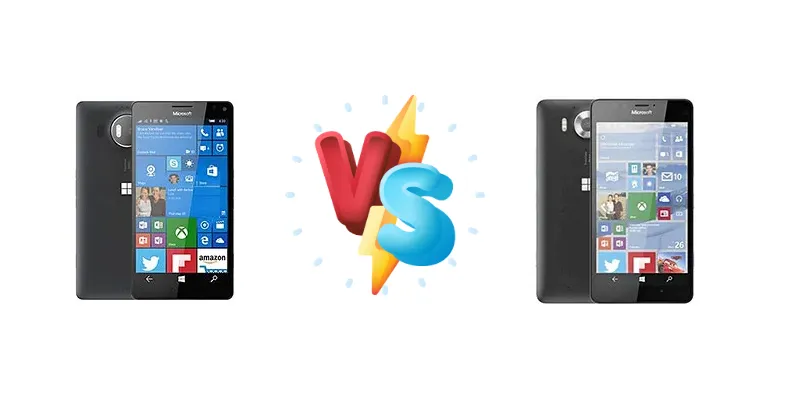
The Microsoft Lumia 950 and 950 XL were flagship Windows Phones, offering a glimpse into Microsoft's mobile ambitions. While both devices packed premium features, they catered to slightly different users. This comparison dives deep into their specs and performance to help you decide which one is right for you.
🏆 Quick Verdict
The Lumia 950 XL edges out the 950 with its larger display and slightly better sunlight readability, though both offer impressive battery life. The 950 is more compact and potentially easier to handle. Ultimately, the choice depends on your preference for screen size and portability.
| Network |
|---|
| 2G bands | GSM 850 / 900 / 1800 / 1900 - SIM 1 & SIM 2 | GSM 850 / 900 / 1800 / 1900 |
| 3G bands | HSDPA 850 / 900 / 1700(AWS) / 1900 / 2100 | HSDPA 850 / 900 / 1700(AWS) / 1900 / 2100 |
| 4G bands | 1, 2, 3, 4, 5, 7, 8, 12, 17, 20, 28, 38, 40 | 1, 2, 3, 4, 5, 7, 8, 12, 17, 20, 28, 38, 40 - EMEA |
| Speed | HSPA 42.2/5.76 Mbps, LTE Cat4 150/50 Mbps | HSPA 42.2/5.76 Mbps, LTE Cat6 300/50 Mbps |
| Technology | GSM / HSPA / LTE | GSM / HSPA / LTE |
| | - | 1, 2, 3, 4, 5, 7, 8, 12, 17, 20, 28, 38, 40, 41 - USA |
| Launch |
|---|
| Announced | 2015, October. Released 2015, December | 2015, October. Released 2015, November |
| Status | Discontinued | Discontinued |
| Body |
|---|
| Dimensions | 151.9 x 78.4 x 8.1 mm (5.98 x 3.09 x 0.32 in) | 145 x 73.2 x 8.2 mm (5.71 x 2.88 x 0.32 in) |
| SIM | Nano-SIM + Nano-SIM | Nano-SIM |
| Weight | 165 g (5.82 oz) | 150 g (5.29 oz) |
| Display |
|---|
| Protection | Corning Gorilla Glass 4 | Corning Gorilla Glass 3 |
| Resolution | 1440 x 2560 pixels, 16:9 ratio (~515 ppi density) | 1440 x 2560 pixels, 16:9 ratio (~564 ppi density) |
| Size | 5.7 inches, 89.6 cm2 (~75.2% screen-to-body ratio) | 5.2 inches, 74.8 cm2 (~70.5% screen-to-body ratio) |
| Type | AMOLED | AMOLED |
| | ClearBlack display | ClearBlack display |
| Platform |
|---|
| CPU | Octa-core (4x1.5 GHz Cortex-A53 & 4x2.0 GHz Cortex-A57) | Hexa-core (4x1.4 GHz Cortex-A53 & 2x1.8 GHz Cortex-A57) |
| Chipset | Qualcomm MSM8994 Snapdragon 810 (20 nm) | Qualcomm MSM8992 Snapdragon 808 (20 nm) |
| GPU | Adreno 430 | Adreno 418 |
| OS | Microsoft Windows 10 | Microsoft Windows 10 |
| Memory |
|---|
| Card slot | microSDXC (dedicated slot) | microSDXC (dedicated slot) |
| Internal | 32GB 3GB RAM | 32GB 3GB RAM |
| | eMMC 5.0 | eMMC 5.0 |
| Main Camera |
|---|
| Features | Zeiss optics, triple-LED RGB flash, panorama, HDR | Zeiss optics, triple-LED RGB flash, panorama, HDR |
| Single | 20 MP, f/1.9, 26mm (wide), 1/2.4", 1.12µm, AF, OIS | 20 MP, f/1.9, 26mm (wide), 1/2.4", 1.12µm, AF, OIS |
| Video | 4K@30fps, stereo sound rec., 1080p@30/60fps (after SW update) | 4K@30fps, stereo sound rec., 1080p@30/60fps (after SW update) |
| Selfie camera |
|---|
| Single | 5 MP, f/2.4 | 5 MP, f/2.4 |
| Video | 1080p@30fps | 1080p@30fps |
| Sound |
|---|
| 3.5mm jack | Yes | Yes |
| 35mm jack | Yes | Yes |
| Loudspeaker | Yes | Yes |
| Comms |
|---|
| Bluetooth | 4.1, A2DP | 4.1, A2DP |
| NFC | Yes | Yes |
| Positioning | GPS, GLONASS, BDS | GPS, GLONASS, BDS |
| Radio | FM radio | FM radio |
| USB | USB Type-C 3.1 | USB Type-C 3.1 |
| WLAN | Wi-Fi 802.11 a/b/g/n/ac, dual-band, hotspot | Wi-Fi 802.11 a/b/g/n/ac, dual-band, hotspot |
| Features |
|---|
| Sensors | Iris scanner, accelerometer, gyro, proximity, compass, barometer, sensor core | Iris scanner, accelerometer, gyro, proximity, compass, barometer, sensor core |
| | Microsoft Continuum support | Microsoft Continuum support |
| Battery |
|---|
| Charging | 18W wired
Wireless (Qi) (market dependent) | 18W wired
Wireless (Qi) (market dependent) |
| Music play | Up to 75 h | Up to 67 h |
| Stand-by | Up to 288 h (2G) / Up to 288 h (3G) | Up to 288 h (2G) / Up to 288 h (3G) |
| Talk time | Up to 25 h (2G) / Up to 19 h (3G) | Up to 23 h (2G) / Up to 18 h (3G) |
| Type | Li-Ion 3340 mAh, removable | Li-Ion 3000 mAh, removable |
| Misc |
|---|
| Colors | Black, White | Black, White |
| Price | About 350 EUR | About 280 EUR |
| Tests |
|---|
| Audio quality |
Noise -91.6dB / Crosstalk -89.3dB |
Noise -91.3dB / Crosstalk -91.6dB |
| Battery life |
Endurance rating 47h
|
Endurance rating 48h
|
| Camera | - |
Photo / Video |
| Display |
Contrast ratio: Infinite (nominal), 3.837 (sunlight) |
Contrast ratio: Infinite (nominal), 3512 (sunlight) |
| Loudspeaker |
Voice 74dB / Noise 75dB / Ring 84dB
|
Voice 71dB / Noise 73dB / Ring 77dB
|
| Performance |
Basemark OS II 2.0: 1472Basemark X: 32178 |
Basemark OS II 2.0: 1281Basemark X: 26330 |
Microsoft Lumia 950 XL Dual SIM
- Larger, more immersive display
- Slightly better sunlight readability
- Potentially better camera performance
- Excellent battery life
- Wireless Charging (market dependent)
- Larger size and weight
- Snapdragon 810 can exhibit thermal throttling under heavy load
Microsoft Lumia 950
- More compact and pocketable
- Excellent battery life
- Wireless Charging (market dependent)
- Smooth performance for everyday tasks
- Slightly lower sunlight readability
- Potentially slightly inferior camera performance compared to 950 XL
Display Comparison
Both Lumias boast OLED displays with excellent contrast ratios (nominally infinite). However, the 950 XL's sunlight readability is noticeably better at 3.837 compared to the 950's 3512. The 950 XL's larger 5.7-inch screen provides a more immersive experience, while the 950's 5.2-inch display is easier to handle with one hand.
Camera Comparison
Both devices offer capable cameras, but detailed specifications are limited in the provided data. Generally, the 950 XL is believed to have a slightly better camera sensor and image processing capabilities, resulting in marginally better photo and video quality, especially in low-light conditions. Both support manual controls and offer a good range of shooting modes.
Performance
The 950 XL features the Snapdragon 810, a slightly more powerful chipset than the 950's Snapdragon 808. While both offer smooth performance for everyday tasks, the 810 provides a marginal edge in demanding games and applications. Both phones utilize octa/hexa-core processors with Cortex-A53 and A57 cores, ensuring responsive multitasking.
Battery Life
Both phones achieve an impressive endurance rating of 47-48 hours, indicating excellent battery life. This is a significant strength for both devices, allowing for extended usage without frequent charging.
Buying Guide
The Microsoft Lumia 950 XL Dual SIM is ideal for users who prioritize a large, immersive display and don't mind a larger device. It's great for media consumption and productivity on the go. The Microsoft Lumia 950 is better suited for those who prefer a more pocketable phone with a slightly more manageable size, while still enjoying flagship features.
Frequently Asked Questions
❓ Are these phones still receiving updates?
Microsoft ended active support for Windows 10 Mobile in January 2020. Security updates are no longer provided, so using these devices poses a security risk.
❓ Can I use Android apps on these phones?
While there were attempts to port Android apps, the experience was generally unreliable and not officially supported. Don't expect a smooth Android experience.