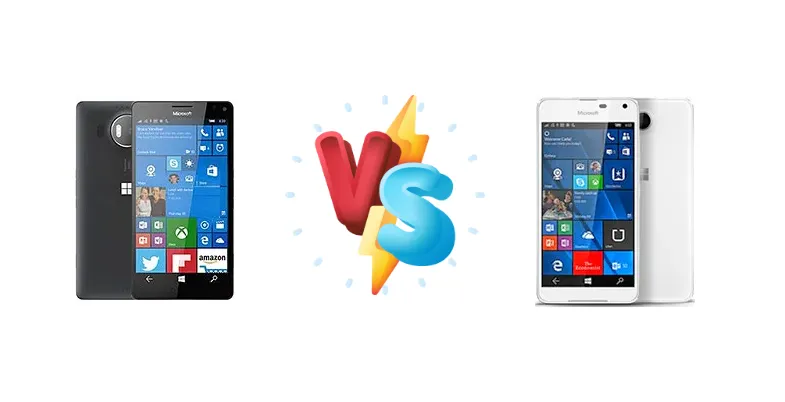
Microsoft's Lumia line offered a unique Windows experience, but with a range of models, choosing the right one can be tricky. Today, we're pitting the flagship Lumia 950 XL against the more budget-friendly Lumia 650 to see which phone offers the best value and performance.
🏆 Quick Verdict
The Lumia 950 XL boasts significantly more power thanks to its Snapdragon 810 chipset and larger display. However, the Lumia 650 offers impressive battery life and a more compact design. For performance enthusiasts, the 950 XL wins, but budget-conscious users might prefer the 650.
| Network |
|---|
| 2G bands | GSM 850 / 900 / 1800 / 1900 - SIM 1 & SIM 2 | GSM 850 / 900 / 1800 / 1900 - SIM 1 & SIM 2 (dual-SIM model only) |
| 3G bands | HSDPA 850 / 900 / 1700(AWS) / 1900 / 2100 | HSDPA 850 / 900 / 2100 |
| 4G bands | 1, 2, 3, 4, 5, 7, 8, 12, 17, 20, 28, 38, 40 | 1, 3, 7, 8, 20 |
| Speed | HSPA 42.2/5.76 Mbps, LTE Cat4 150/50 Mbps | HSPA 42.2/5.76 Mbps, LTE Cat4 150/50 Mbps |
| Technology | GSM / HSPA / LTE | GSM / HSPA / LTE |
| Launch |
|---|
| Announced | 2015, October. Released 2015, December | 2016, February. Released 2016, February |
| Status | Discontinued | Discontinued |
| Body |
|---|
| Build | - | Glass front (Gorilla Glass 3), plastic back, aluminum frame |
| Dimensions | 151.9 x 78.4 x 8.1 mm (5.98 x 3.09 x 0.32 in) | 142 x 70.9 x 6.9 mm (5.59 x 2.79 x 0.27 in) |
| SIM | Nano-SIM + Nano-SIM | · Nano-SIM· Nano-SIM + Nano-SIM |
| Weight | 165 g (5.82 oz) | 122 g (4.30 oz) |
| Display |
|---|
| Protection | Corning Gorilla Glass 4 | Corning Gorilla Glass 3 |
| Resolution | 1440 x 2560 pixels, 16:9 ratio (~515 ppi density) | 720 x 1280 pixels, 16:9 ratio (~297 ppi density) |
| Size | 5.7 inches, 89.6 cm2 (~75.2% screen-to-body ratio) | 5.0 inches, 67.5 cm2 (~67.1% screen-to-body ratio) |
| Type | AMOLED | OLED |
| | ClearBlack display | ClearBlack display |
| Platform |
|---|
| CPU | Octa-core (4x1.5 GHz Cortex-A53 & 4x2.0 GHz Cortex-A57) | Quad-core 1.3 GHz Cortex-A7 |
| Chipset | Qualcomm MSM8994 Snapdragon 810 (20 nm) | Qualcomm MSM8909v2 Snapdragon 212 (28 nm) |
| GPU | Adreno 430 | Adreno 304 |
| OS | Microsoft Windows 10 | Microsoft Windows 10 |
| Memory |
|---|
| Card slot | microSDXC (dedicated slot) | microSDXC (dedicated slot) |
| Internal | 32GB 3GB RAM | 16GB 1GB RAM |
| | eMMC 5.0 | eMMC 4.5 |
| Main Camera |
|---|
| Features | Zeiss optics, triple-LED RGB flash, panorama, HDR | LED flash |
| Single | 20 MP, f/1.9, 26mm (wide), 1/2.4", 1.12µm, AF, OIS | 8 MP, f/2.2, 28mm (wide), 1/4.0", AF |
| Video | 4K@30fps, stereo sound rec., 1080p@30/60fps (after SW update) | 720p@30fps |
| Selfie camera |
|---|
| Single | 5 MP, f/2.4 | 5 MP, f/2.2 |
| Video | 1080p@30fps | 720p |
| Sound |
|---|
| 3.5mm jack | Yes | Yes |
| 35mm jack | Yes | Yes |
| Loudspeaker | Yes | Yes |
| Comms |
|---|
| Bluetooth | 4.1, A2DP | 4.1, A2DP, LE |
| NFC | Yes | Yes |
| Positioning | GPS, GLONASS, BDS | GPS, GLONASS, BDS |
| Radio | FM radio | FM radio |
| USB | USB Type-C 3.1 | microUSB 2.0 |
| WLAN | Wi-Fi 802.11 a/b/g/n/ac, dual-band, hotspot | Wi-Fi 802.11 b/g/n, DLNA, hotspot |
| Features |
|---|
| Sensors | Iris scanner, accelerometer, gyro, proximity, compass, barometer, sensor core | Accelerometer, proximity |
| | Microsoft Continuum support | - |
| Battery |
|---|
| Charging | 18W wired
Wireless (Qi) (market dependent) | - |
| Music play | Up to 75 h | - |
| Stand-by | Up to 288 h (2G) / Up to 288 h (3G) | Up to 624 h (3G) |
| Talk time | Up to 25 h (2G) / Up to 19 h (3G) | Up to 16 h (2G) / Up to 13 h (3G) |
| Type | Li-Ion 3340 mAh, removable | Li-Ion 2000 mAh, removable |
| Misc |
|---|
| Colors | Black, White | Black, White |
| Price | About 350 EUR | About 150 EUR |
| Tests |
|---|
| Audio quality |
Noise -91.6dB / Crosstalk -89.3dB | - |
| Battery life |
Endurance rating 47h
|
Endurance rating 55h
|
| Camera | - |
Photo |
| Display |
Contrast ratio: Infinite (nominal), 3.837 (sunlight) |
Contrast ratio: Infinite (nominal), 3.77(sunlight) |
| Loudspeaker |
Voice 74dB / Noise 75dB / Ring 84dB
| - |
| Performance |
Basemark OS II 2.0: 1472Basemark X: 32178 | - |
Microsoft Lumia 950 XL Dual SIM
- Powerful Snapdragon 810 processor
- Large, vibrant Quad HD OLED display
- Excellent camera performance
- Wireless charging (market dependent)
- Larger size and weight
- Battery life slightly shorter than 650
- Older model, limited software updates
Microsoft Lumia 650
- Excellent battery life
- Compact and lightweight design
- Affordable price
- Reliable performance for basic tasks
- Less powerful processor
- Lower resolution display
- Camera performance not as good as 950 XL
- Limited storage
Display Comparison
The Lumia 950 XL features a 5.7-inch Quad HD (2560 x 1440) OLED display with a contrast ratio of Infinite (nominal) and 3.837 in sunlight. This provides vibrant colors and sharp details. The Lumia 650 has a 5-inch HD (1280 x 720) LCD display with a contrast ratio of Infinite (nominal) and 3.77 in sunlight. While both offer good outdoor visibility, the 950 XL's higher resolution and OLED technology deliver a superior viewing experience.
Camera Comparison
Both phones feature cameras, but the 950 XL generally offers better image quality. The 950 XL has a 20MP rear camera and a 5MP front camera, while the 650 has an 8MP rear camera and a 5MP front camera. The 950 XL's larger sensor and more powerful image processing capabilities result in more detailed and vibrant photos, especially in low-light conditions. Both offer photo capabilities.
Performance
Here's where the 950 XL truly shines. Its Qualcomm Snapdragon 810 chipset with an Octa-core CPU provides significantly more processing power than the Lumia 650's Snapdragon 212 and Quad-core CPU. Expect smoother multitasking, faster app loading times, and better performance in demanding games on the 950 XL. The 650 is adequate for basic tasks but will struggle with more intensive applications.
Battery Life
The Lumia 650 surprisingly edges out the 950 XL in battery endurance, boasting an endurance rating of 55 hours compared to the 950 XL's 47 hours. This is likely due to the 650's less power-hungry processor and smaller display. While both offer decent battery life, the 650 provides a slight advantage for extended use.
Buying Guide
The Microsoft Lumia 950 XL Dual SIM is ideal for users who prioritize performance, a large display, and are comfortable with a larger device. It's suitable for power users and those who enjoy multitasking. The Microsoft Lumia 650 is a great choice for those seeking a reliable, compact, and affordable Windows phone with excellent battery life, perfect for everyday use and basic tasks.
Frequently Asked Questions
❓ Are there still software updates available for these Lumia phones?
Microsoft has ended active software support for these devices. While some security updates may have been released, don't expect major feature updates. Consider this when purchasing.
❓ Which phone is better for gaming?
The Lumia 950 XL is significantly better for gaming due to its more powerful processor and higher resolution display. The Lumia 650 can handle basic games, but will struggle with more demanding titles.