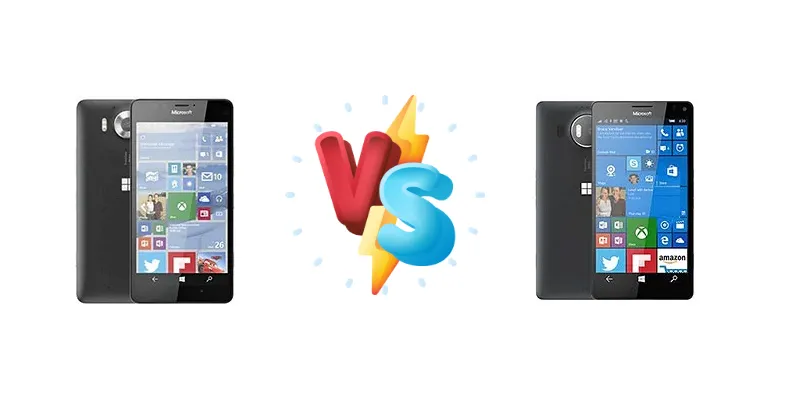
The Microsoft Lumia 950 and 950 XL represent the final, ambitious push into the smartphone market with Windows 10 Mobile. While both aimed to deliver a premium experience, they catered to slightly different users. The 950 prioritized a more manageable size, while the XL focused on maximizing screen real estate and performance. This comparison dissects the key differences to help you determine which, if either, remains a viable option today.
🏆 Quick Verdict
For the average user seeking a functional Lumia experience, the Lumia 950 XL is the better choice. Its Snapdragon 810 chipset provides a noticeable performance uplift over the 950’s 808, and despite sharing the same endurance rating, the larger device offers a more immersive experience. However, both are aging devices with limited software support.
| Network |
|---|
| 2G bands | GSM 850 / 900 / 1800 / 1900 - SIM 1 & SIM 2 | GSM 850 / 900 / 1800 / 1900 - SIM 1 & SIM 2 |
| 3G bands | HSDPA 850 / 900 / 1700(AWS) / 1900 / 2100 | HSDPA 850 / 900 / 1700(AWS) / 1900 / 2100 |
| 4G bands | 1, 2, 3, 4, 5, 7, 8, 12, 17, 20, 28, 38, 40 | 1, 2, 3, 4, 5, 7, 8, 12, 17, 20, 28, 38, 40 |
| Speed | HSPA 42.2/5.76 Mbps, LTE Cat4 150/50 Mbps | HSPA 42.2/5.76 Mbps, LTE Cat4 150/50 Mbps |
| Technology | GSM / HSPA / LTE | GSM / HSPA / LTE |
| Launch |
|---|
| Announced | 2015, October. Released 2015, December | 2015, October. Released 2015, December |
| Status | Discontinued | Discontinued |
| Body |
|---|
| Dimensions | 145 x 73.2 x 8.2 mm (5.71 x 2.88 x 0.32 in) | 151.9 x 78.4 x 8.1 mm (5.98 x 3.09 x 0.32 in) |
| SIM | Nano-SIM + Nano-SIM | Nano-SIM + Nano-SIM |
| Weight | 150 g (5.29 oz) | 165 g (5.82 oz) |
| Display |
|---|
| Protection | Corning Gorilla Glass 3 | Corning Gorilla Glass 4 |
| Resolution | 1440 x 2560 pixels, 16:9 ratio (~565 ppi density) | 1440 x 2560 pixels, 16:9 ratio (~515 ppi density) |
| Size | 5.2 inches, 74.5 cm2 (~70.2% screen-to-body ratio) | 5.7 inches, 89.6 cm2 (~75.2% screen-to-body ratio) |
| Type | AMOLED | AMOLED |
| | ClearBlack display | ClearBlack display |
| Platform |
|---|
| CPU | Hexa-core (4x1.4 GHz Cortex-A53 & 2x1.8 GHz Cortex-A57) | Octa-core (4x1.5 GHz Cortex-A53 & 4x2.0 GHz Cortex-A57) |
| Chipset | Qualcomm MSM8992 Snapdragon 808 (20 nm) | Qualcomm MSM8994 Snapdragon 810 (20 nm) |
| GPU | Adreno 418 | Adreno 430 |
| OS | Microsoft Windows 10 | Microsoft Windows 10 |
| Memory |
|---|
| Card slot | microSDXC (dedicated slot) | microSDXC (dedicated slot) |
| Internal | 32GB 3GB RAM | 32GB 3GB RAM |
| | eMMC 5.0 | eMMC 5.0 |
| Main Camera |
|---|
| Features | Zeiss optics, triple-LED RGB flash, panorama, HDR | Zeiss optics, triple-LED RGB flash, panorama, HDR |
| Single | 20 MP, f/1.9, 26mm (wide), 1/2.4", 1.12µm, AF, OIS | 20 MP, f/1.9, 26mm (wide), 1/2.4", 1.12µm, AF, OIS |
| Video | 4K@30fps, stereo sound rec., 1080p@30/60fps (after SW update) | 4K@30fps, stereo sound rec., 1080p@30/60fps (after SW update) |
| Selfie camera |
|---|
| Single | 5 MP, f/2.4 | 5 MP, f/2.4 |
| Video | 1080p@30fps | 1080p@30fps |
| Sound |
|---|
| 3.5mm jack | Yes | Yes |
| 35mm jack | Yes | Yes |
| Loudspeaker | Yes | Yes |
| Comms |
|---|
| Bluetooth | 4.1, A2DP | 4.1, A2DP |
| NFC | Yes | Yes |
| Positioning | GPS, GLONASS, BDS | GPS, GLONASS, BDS |
| Radio | FM radio | FM radio |
| USB | USB Type-C 3.1 | USB Type-C 3.1 |
| WLAN | Wi-Fi 802.11 a/b/g/n/ac, dual-band, hotspot | Wi-Fi 802.11 a/b/g/n/ac, dual-band, hotspot |
| Features |
|---|
| Sensors | Iris scanner, accelerometer, gyro, proximity, compass, barometer, sensor core | Iris scanner, accelerometer, gyro, proximity, compass, barometer, sensor core |
| | Microsoft Continuum support | Microsoft Continuum support |
| Battery |
|---|
| Charging | 18W wired
Wireless (Qi) | 18W wired
Wireless (Qi) (market dependent) |
| Music play | Up to 67 h | Up to 75 h |
| Stand-by | Up to 288 h (2G) / Up to 288 h (3G) | Up to 288 h (2G) / Up to 288 h (3G) |
| Talk time | Up to 23 h (2G) / Up to 18 h (3G) | Up to 25 h (2G) / Up to 19 h (3G) |
| Type | Li-Ion 3000 mAh, removable | Li-Ion 3340 mAh, removable |
| Misc |
|---|
| Colors | Black, White | Black, White |
| Price | About 280 EUR | About 350 EUR |
| Tests |
|---|
| Audio quality | - |
Noise -91.6dB / Crosstalk -89.3dB |
| Battery life | - |
Endurance rating 47h
|
| Display | - |
Contrast ratio: Infinite (nominal), 3.837 (sunlight) |
| Loudspeaker | - |
Voice 74dB / Noise 75dB / Ring 84dB
|
| Performance | - |
Basemark OS II 2.0: 1472Basemark X: 32178 |
Microsoft Lumia 950 Dual SIM
- More compact and pocketable design.
- Slightly more efficient Snapdragon 808 chipset.
- Qi wireless charging support.
- Less powerful Snapdragon 808 processor.
- Smaller display size.
- Potentially slower multitasking.
Microsoft Lumia 950 XL Dual SIM
- More powerful Snapdragon 810 processor.
- Larger, more immersive display.
- Better multitasking capabilities.
- Larger and less pocketable design.
- Qi wireless charging support is market dependent.
- Potentially slightly lower battery efficiency due to larger screen.
Display Comparison
Both the Lumia 950 and 950 XL share an identical contrast ratio of infinite (nominal) and 3.837 in sunlight, suggesting similar outdoor visibility. However, the XL boasts a larger 5.7-inch display compared to the 950’s 5.2-inch panel. This difference significantly impacts usability for tasks like video playback and document editing. While both resolutions are adequate, the pixel density on the XL is lower, potentially resulting in slightly less sharpness. The larger screen size of the XL is the primary differentiator, catering to users who prioritize immersive content consumption.
Camera Comparison
Unfortunately, the provided data doesn't detail camera specifications beyond the device models themselves. However, based on contemporary reviews, both devices featured a 20MP PureView camera with Carl Zeiss optics. The XL often benefited from slightly more refined image processing due to its more powerful processor, allowing for faster image capture and potentially better low-light performance. The absence of detailed sensor size or aperture information prevents a definitive camera comparison, but the XL’s processing power likely gave it a slight edge.
Performance
The core difference lies in the chipsets: the Lumia 950 utilizes the Qualcomm MSM8992 Snapdragon 808, a hexa-core processor, while the 950 XL features the MSM8994 Snapdragon 810, an octa-core processor. The 810’s four Cortex-A57 cores clocked at 2.0 GHz represent a substantial upgrade over the 950’s 1.8 GHz A57 cores. This translates to faster application loading times and smoother multitasking. While both are built on a 20nm process, the 810’s additional cores provide a clear performance advantage, particularly in graphically intensive tasks. The 950 XL is the clear winner for users who prioritize responsiveness and speed.
Battery Life
Both the Lumia 950 and 950 XL are listed with an endurance rating of 47 hours, suggesting comparable real-world battery life despite the XL’s larger display and more powerful processor. Both support 18W wired charging and Qi wireless charging (market dependent for the XL). The XL’s larger battery capacity, though not explicitly stated, likely contributes to this similar endurance. The shared charging speeds mean neither device offers significantly faster charging than the other. The XL’s larger screen and more powerful processor are offset by a larger battery, resulting in similar overall battery performance.
Buying Guide
Buy the Microsoft Lumia 950 Dual SIM if you prioritize pocketability and a slightly more efficient chipset. It’s ideal for users who value a compact form factor and don’t demand the absolute highest performance. Buy the Microsoft Lumia 950 XL Dual SIM if you prefer a larger display for media consumption and productivity, and require the extra processing power for multitasking or demanding applications. It’s the better option for power users and those who appreciate a more expansive viewing experience.
Frequently Asked Questions
❓ Is the Snapdragon 810 in the Lumia 950 XL prone to overheating?
The Snapdragon 810 was known to experience thermal throttling under sustained load. However, Microsoft implemented cooling solutions in the 950 XL to mitigate this issue. While it may get warm during extended gaming sessions, it’s unlikely to experience severe overheating that significantly impacts performance.
❓ Does either the Lumia 950 or 950 XL receive Windows 10 Mobile updates anymore?
No. Microsoft officially ended support for Windows 10 Mobile in January 2020. Neither device receives official updates, leaving them vulnerable to security risks and lacking new features. Any continued use relies on community-driven efforts.
❓ Can I still use the Lumia 950 or 950 XL with modern apps?
The app ecosystem for Windows 10 Mobile is severely limited. Many popular apps are no longer supported, and finding alternatives can be challenging. While some apps may still function, the overall experience is significantly hampered by the lack of app availability.