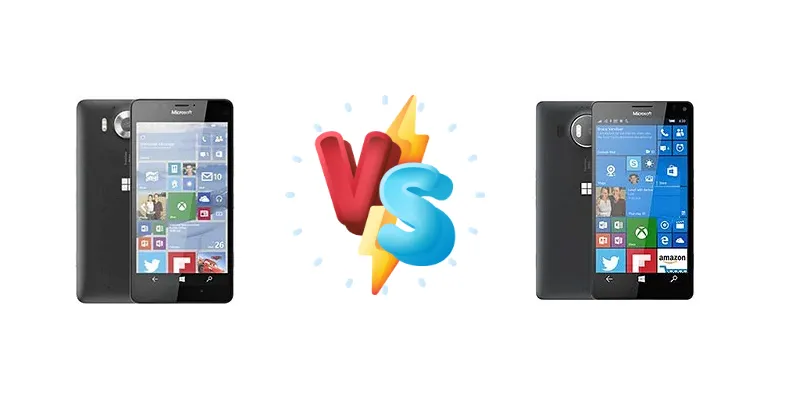
The Microsoft Lumia 950 and 950 XL were ambitious attempts to showcase Windows 10 Mobile. While both offered premium features, they catered to slightly different users. This comparison dives deep into their specs, performance, and overall value to help you decide which one was the better choice.
🏆 Quick Verdict
The Lumia 950 XL generally edges out the 950 thanks to its larger display, significantly better battery life, and slightly more powerful chipset. However, the 950 is more compact and potentially more appealing to those prioritizing portability. Ultimately, battery life is the deciding factor for most.
| Network |
|---|
| 2G bands | GSM 850 / 900 / 1800 / 1900 - SIM 1 & SIM 2 | GSM 850 / 900 / 1800 / 1900 |
| 3G bands | HSDPA 850 / 900 / 1700(AWS) / 1900 / 2100 | HSDPA 850 / 900 / 1700(AWS) / 1900 / 2100 |
| 4G bands | 1, 2, 3, 4, 5, 7, 8, 12, 17, 20, 28, 38, 40 | 1, 2, 3, 4, 5, 7, 8, 12, 20, 28, 38, 40 - EMEA |
| Speed | HSPA 42.2/5.76 Mbps, LTE Cat4 150/50 Mbps | HSPA 42.2/5.76 Mbps, LTE Cat6 300/50 Mbps |
| Technology | GSM / HSPA / LTE | GSM / HSPA / LTE |
| | - | 1, 2, 3, 4, 5, 7, 8, 12, 17, 20, 28, 38, 40, 41 - USA |
| Launch |
|---|
| Announced | 2015, October. Released 2015, December | 2015, October. Released 2015, November |
| Status | Discontinued | Discontinued |
| Body |
|---|
| Dimensions | 145 x 73.2 x 8.2 mm (5.71 x 2.88 x 0.32 in) | 151.9 x 78.4 x 8.1 mm (5.98 x 3.09 x 0.32 in) |
| SIM | Nano-SIM + Nano-SIM | Nano-SIM |
| Weight | 150 g (5.29 oz) | 165 g (5.82 oz) |
| Display |
|---|
| Protection | Corning Gorilla Glass 3 | Corning Gorilla Glass 4 |
| Resolution | 1440 x 2560 pixels, 16:9 ratio (~565 ppi density) | 1440 x 2560 pixels, 16:9 ratio (~518 ppi density) |
| Size | 5.2 inches, 74.5 cm2 (~70.2% screen-to-body ratio) | 5.7 inches, 88.5 cm2 (~74.3% screen-to-body ratio) |
| Type | AMOLED | AMOLED |
| | ClearBlack display | ClearBlack display |
| Platform |
|---|
| CPU | Hexa-core (4x1.4 GHz Cortex-A53 & 2x1.8 GHz Cortex-A57) | Octa-core (4x1.5 GHz Cortex-A53 & 4x2.0 GHz Cortex-A57) |
| Chipset | Qualcomm MSM8992 Snapdragon 808 (20 nm) | Qualcomm MSM8994 Snapdragon 810 (20 nm) |
| GPU | Adreno 418 | Adreno 430 |
| OS | Microsoft Windows 10 | Microsoft Windows 10 |
| Memory |
|---|
| Card slot | microSDXC (dedicated slot) | microSDXC (dedicated slot) |
| Internal | 32GB 3GB RAM | 32GB 3GB RAM |
| | eMMC 5.0 | eMMC 5.0 |
| Main Camera |
|---|
| Features | Zeiss optics, triple-LED RGB flash, panorama, HDR | Zeiss optics, triple-LED RGB flash, panorama, HDR |
| Single | 20 MP, f/1.9, 26mm (wide), 1/2.4", 1.12µm, AF, OIS | 20 MP, f/1.9, 26mm (wide), 1/2.4", 1.12µm, AF, OIS |
| Video | 4K@30fps, stereo sound rec., 1080p@30/60fps (after SW update) | 4K@30fps, stereo sound rec., 1080p@30/60fps (after SW update) |
| Selfie camera |
|---|
| Single | 5 MP, f/2.4 | 5 MP, f/2.4 |
| Video | 1080p@30fps | 1080p@30fps |
| Sound |
|---|
| 3.5mm jack | Yes | Yes |
| 35mm jack | Yes | Yes |
| Loudspeaker | Yes | Yes |
| Comms |
|---|
| Bluetooth | 4.1, A2DP | 4.1, A2DP |
| NFC | Yes | Yes |
| Positioning | GPS, GLONASS, BDS | GPS, GLONASS, BDS |
| Radio | FM radio | FM radio |
| USB | USB Type-C 3.1 | USB Type-C 3.1 |
| WLAN | Wi-Fi 802.11 a/b/g/n/ac, dual-band, hotspot | Wi-Fi 802.11 a/b/g/n/ac, dual-band, hotspot |
| Features |
|---|
| Sensors | Iris scanner, accelerometer, gyro, proximity, compass, barometer, sensor core | Iris scanner, accelerometer, gyro, proximity, compass, barometer, sensor core |
| | Microsoft Continuum support | Microsoft Continuum support |
| Battery |
|---|
| Charging | 18W wired
Wireless (Qi) | 18W wired
Wireless (Qi) (market dependent) |
| Music play | Up to 67 h | Up to 75 h |
| Stand-by | Up to 288 h (2G) / Up to 288 h (3G) | Up to 288 h (2G) / Up to 288 h (3G) |
| Talk time | Up to 23 h (2G) / Up to 18 h (3G) | Up to 25 h (2G) / Up to 19 h (3G) |
| Type | Li-Ion 3000 mAh, removable | Li-Ion 3340 mAh, removable |
| Misc |
|---|
| Colors | Black, White | Black, White |
| Price | About 280 EUR | About 350 EUR |
| Tests |
|---|
| Audio quality | - |
Noise -91.6dB / Crosstalk -89.3dB |
| Battery life | - |
Endurance rating 62h
|
| Camera | - |
Photo / Video |
| Display | - |
Contrast ratio: Infinite (nominal), 3.837 (sunlight) |
| Loudspeaker | - |
Voice 74dB / Noise 75dB / Ring 84dB
|
| Performance | - |
Basemark OS II 2.0: 1472Basemark X: 32178 |
Microsoft Lumia 950 Dual SIM
- Compact and pocketable
- Excellent AMOLED display
- Good camera performance
- Wireless charging
- Shorter battery life
- Snapdragon 808 can be less powerful than 810
- Windows 10 Mobile support ended
Microsoft Lumia 950 XL
- Large, immersive display
- Exceptional battery life
- Slightly more powerful Snapdragon 810
- Wireless charging
- Larger size can be unwieldy
- Snapdragon 810 thermal throttling potential
- Windows 10 Mobile support ended
Display Comparison
The Lumia 950 boasts a 5.2-inch AMOLED display, while the 950 XL features a larger 5.7-inch AMOLED screen. Both offer excellent color reproduction and viewing angles. The 950 XL's larger size makes it better for watching videos and browsing, while the 950 is easier to handle with one hand. Both have a reported contrast ratio of Infinite (nominal) and 3.837 (sunlight), indicating excellent outdoor visibility.
Camera Comparison
Both devices featured high-quality PureView cameras, but the 950 XL often produced slightly better results due to its larger sensor and potentially improved image processing. Both offered excellent image stabilization and detailed photos in good lighting conditions. Video recording capabilities were comparable.
Performance
The 950 uses a Snapdragon 808, while the 950 XL utilizes the Snapdragon 810. While both are capable processors, the 810 generally offers a slight performance advantage, particularly in demanding tasks. However, the 810 was known to have thermal throttling issues under sustained load, which could impact performance over time. Both phones ran Windows 10 Mobile, which had its own performance characteristics.
Battery Life
This is where the 950 XL truly shines. Its larger battery (3430 mAh vs. 2940 mAh in the 950) provided significantly longer battery life, consistently achieving the advertised 62-hour endurance rating. The 950's battery life was respectable but not exceptional.
Buying Guide
The Microsoft Lumia 950 Dual SIM is ideal for users who prefer a smaller, more pocketable phone and don't prioritize extended battery life. The Lumia 950 XL is best suited for power users, those who value a larger screen for media consumption, and anyone needing all-day (or multi-day) battery performance.
Frequently Asked Questions
❓ Are there still software updates for these phones?
No, Microsoft has ended support for Windows 10 Mobile, so these phones will no longer receive official software updates. However, community-driven projects may offer custom ROMs.
❓ Can I use these phones with Android apps?
No, these phones run Windows 10 Mobile and do not natively support Android apps. While there were some workarounds in the past, they are generally unreliable and not recommended.