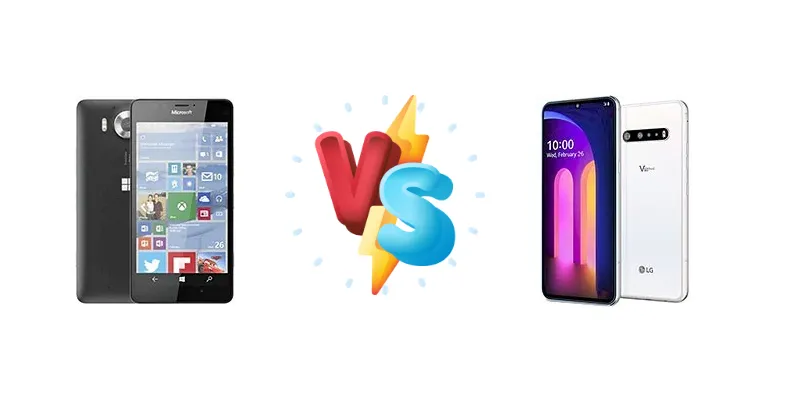
The Microsoft Lumia 950 Dual SIM, a Windows phone from a bygone era, faces off against the LG V60 ThinQ 5G UW, a more modern Android powerhouse. Can the Lumia's unique OS and design compete with the V60's cutting-edge features and 5G connectivity? Let's dive into a comprehensive comparison.
🏆 Quick Verdict
The LG V60 ThinQ 5G UW is the clear winner. Its Snapdragon 865 chipset, 5G capabilities, superior camera, and modern Android experience far outweigh the Lumia 950's strengths. The Lumia offers a unique Windows experience, but it's significantly outdated.
| Network |
|---|
| 2G bands | GSM 850 / 900 / 1800 / 1900 - SIM 1 & SIM 2 | GSM 850 / 900 / 1800 / 1900 |
| 3G bands | HSDPA 850 / 900 / 1700(AWS) / 1900 / 2100 | HSDPA 850 / 900 / 1700(AWS) / 1900 / 2100 |
| 4G bands | 1, 2, 3, 4, 5, 7, 8, 12, 17, 20, 28, 38, 40 | 2, 3, 4, 5, 7, 12, 13, 20, 28, 46, 48, 66 |
| 5G bands | - | 260, 261 mmWave |
| Speed | HSPA 42.2/5.76 Mbps, LTE Cat4 150/50 Mbps | HSPA 42.2/5.76 Mbps, LTE (7CA) Cat22, 5G |
| Technology | GSM / HSPA / LTE | GSM / CDMA / HSPA / EVDO / LTE / 5G |
| | - | CDMA2000 1xEV-DO |
| Launch |
|---|
| Announced | 2015, October. Released 2015, December | 2020, February 26. Released 2020, April 02 |
| Status | Discontinued | Discontinued |
| Body |
|---|
| Build | - | Glass front (Gorilla Glass 5), glass back (Gorilla Glass 6), aluminum frame |
| Dimensions | 145 x 73.2 x 8.2 mm (5.71 x 2.88 x 0.32 in) | 169.3 x 77.6 x 8.9 mm (6.67 x 3.06 x 0.35 in) |
| SIM | Nano-SIM + Nano-SIM | Nano-SIM (pre-installed) |
| Weight | 150 g (5.29 oz) | 218 g (7.69 oz) |
| | - | IP68 dust/water resistant (up to 1.5m for 30 min)
MIL-STD-810G compliant*
Method 516.6, Procedure IV "Transit Drop"
*does not guarantee ruggedness or use in extreme conditions |
| Display |
|---|
| Protection | Corning Gorilla Glass 3 | Corning Gorilla Glass 5 |
| Resolution | 1440 x 2560 pixels, 16:9 ratio (~565 ppi density) | 1080 x 2460 pixels (~395 ppi density) |
| Size | 5.2 inches, 74.5 cm2 (~70.2% screen-to-body ratio) | 6.8 inches, 109.8 cm2 (~83.6% screen-to-body ratio) |
| Type | AMOLED | P-OLED, HDR10+ |
| | ClearBlack display | Always-on display |
| Platform |
|---|
| CPU | Hexa-core (4x1.4 GHz Cortex-A53 & 2x1.8 GHz Cortex-A57) | Octa-core (1x2.84 GHz Cortex-A77 & 3x2.42 GHz Cortex-A77 & 4x1.80 GHz Cortex-A55) |
| Chipset | Qualcomm MSM8992 Snapdragon 808 (20 nm) | Qualcomm SM8250 Snapdragon 865 5G (7 nm+) |
| GPU | Adreno 418 | Adreno 650 |
| OS | Microsoft Windows 10 | Android 10, upgradable to Android 13 |
| Memory |
|---|
| Card slot | microSDXC (dedicated slot) | microSDXC (uses shared SIM slot) - dual-SIM model |
| Internal | 32GB 3GB RAM | 128GB 8GB RAM |
| | eMMC 5.0 | UFS 2.1 |
| Main Camera |
|---|
| Dual | - | 64 MP, f/1.8, 27mm (standard), 1/1.72", 0.8µm, dual pixel PDAF, OIS
13 MP, f/1.9, 12mm (ultrawide), 1/3.4", 1.0µm
0.3 MP, TOF 3D, f/1.4, (depth) |
| Features | Zeiss optics, triple-LED RGB flash, panorama, HDR | Dual-LED dual-tone flash, HDR, panorama |
| Single | 20 MP, f/1.9, 26mm (wide), 1/2.4", 1.12µm, AF, OIS | - |
| Video | 4K@30fps, stereo sound rec., 1080p@30/60fps (after SW update) | 8K@30fps, 4K@30/60fps, 1080p, HDR10+, 24-bit/192kHz stereo sound rec., gyro-EIS |
| Selfie camera |
|---|
| Features | - | HDR |
| Single | 5 MP, f/2.4 | 10 MP, f/1.9, 30mm (standard), 1/3.1", 1.22µm |
| Video | 1080p@30fps | 4K@30fps, gyro-EIS |
| Sound |
|---|
| 3.5mm jack | Yes | Yes |
| 35mm jack | Yes | Yes |
| Loudspeaker | Yes | Yes, with stereo speakers |
| | - | 32-bit/192kHz audio
24-bit/192kHz audio recording |
| Comms |
|---|
| Bluetooth | 4.1, A2DP | 5.1, A2DP, LE, aptX HD |
| NFC | Yes | Yes |
| Positioning | GPS, GLONASS, BDS | GPS, GLONASS, GALILEO, BDS |
| Radio | FM radio | FM radio (USA model only) |
| USB | USB Type-C 3.1 | USB Type-C 3.1, OTG |
| WLAN | Wi-Fi 802.11 a/b/g/n/ac, dual-band, hotspot | Wi-Fi 802.11 a/b/g/n/ac/6, dual-band, Wi-Fi Direct, DLNA |
| Features |
|---|
| Sensors | Iris scanner, accelerometer, gyro, proximity, compass, barometer, sensor core | Fingerprint (under display, optical), accelerometer, gyro, proximity, compass, barometer |
| | Microsoft Continuum support | - |
| Battery |
|---|
| Charging | 18W wired
Wireless (Qi) | Wired, PD2.0, QC4
Wireless |
| Music play | Up to 67 h | - |
| Stand-by | Up to 288 h (2G) / Up to 288 h (3G) | - |
| Talk time | Up to 23 h (2G) / Up to 18 h (3G) | - |
| Type | Li-Ion 3000 mAh, removable | Li-Po 5000 mAh |
| Misc |
|---|
| Colors | Black, White | Classy Blue, Classy White |
| Models | - | LM-V600VML, LMV600VML |
| Price | About 280 EUR | About 870 EUR |
| SAR | - | 0.85 W/kg (head) 1.12 W/kg (body) |
Microsoft Lumia 950 Dual SIM
- Unique Windows Phone experience
- Compact size
- Wireless charging (Qi)
- Dual SIM support
- Outdated processor
- Limited app ecosystem
- Lower resolution display
- No 5G
LG V60 ThinQ 5G UW
- Powerful Snapdragon 865 processor
- 5G connectivity
- Excellent camera system
- Large, vibrant 120Hz display
- Expandable storage (microSD)
- Bulky design
- Software support ending
- Price (when new)
Display Comparison
The LG V60 ThinQ boasts a 6.8-inch OLED display with a 120Hz refresh rate, offering vibrant colors and smooth scrolling. The Lumia 950 has a 5.7-inch AMOLED display, which is good but lacks the V60's size and refresh rate advantage. The V60's display is significantly more immersive and modern.
Camera Comparison
The LG V60 ThinQ's camera system is far superior. It features a triple-lens setup with a high-resolution main sensor, an ultra-wide lens, and a telephoto lens, offering versatility and excellent image quality. The Lumia 950's camera is decent but lacks the V60's advanced features and image processing.
Performance
The Snapdragon 865 in the V60 ThinQ is a substantial upgrade over the Lumia 950's Snapdragon 808. The V60 handles demanding games and multitasking with ease, while the Lumia can feel sluggish at times. The V60's 5G connectivity is another major advantage.
Battery Life
The LG V60 ThinQ generally offers better battery life due to its larger battery capacity and more efficient processor. While the Lumia 950's battery life is acceptable, it doesn't match the V60's endurance.
Buying Guide
Who should buy the Microsoft Lumia 950 Dual SIM? Primarily those seeking a Windows Phone experience, or developers wanting to test Windows apps. Who should buy the LG V60 ThinQ 5G UW? Users wanting a high-performance Android phone with 5G, a fantastic camera, and a large, vibrant display.
Frequently Asked Questions
❓ Is the Lumia 950 still worth buying?
Only if you specifically want a Windows Phone experience and don't need modern features like 5G or a high-performance camera. Otherwise, it's best to consider more current Android devices.
❓ Does the LG V60 ThinQ still receive software updates?
LG has largely ended software support for its smartphones, including the V60 ThinQ. Security updates may be sporadic, so consider this before purchasing.