
Microsoft Lumia 950 Dual SIM vs HP Elite x3: A Detailed Performance and Feature Comparison
| Phones Images | |||||
|---|---|---|---|---|---|
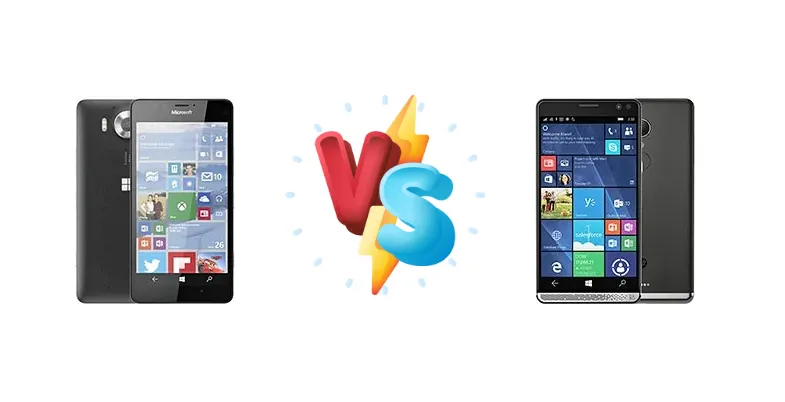
|
🏆 Quick Verdict
For the average user seeking a functional, albeit aging, Windows 10 Mobile device, the HP Elite x3 emerges as the better choice. The Snapdragon 820’s superior processing power and more efficient 14nm process offer a noticeable performance advantage, mitigating some of the inherent software limitations of the platform. While the Lumia 950 has its merits, the Elite x3’s more modern chipset provides a smoother, more responsive experience.
| PHONES | ||
|---|---|---|
| Phone Names | Microsoft Lumia 950 Dual SIM | HP Elite x3 |
| Network | ||
|---|---|---|
| 2G bands | GSM 850 / 900 / 1800 / 1900 - SIM 1 & SIM 2 | GSM 850 / 900 / 1800 / 1900 - SIM 1 & SIM 2 (dual-SIM model only) |
| 3G bands | HSDPA 850 / 900 / 1700(AWS) / 1900 / 2100 | HSDPA 850 / 900 / 1700(AWS) / 1900 / 2100 |
| 4G bands | 1, 2, 3, 4, 5, 7, 8, 12, 17, 20, 28, 38, 40 | 1, 2, 3, 4, 5, 7, 8, 12, 17, 19, 20, 26, 28, 29, 38, 39, 40, 41 - EMEA |
| Speed | HSPA 42.2/5.76 Mbps, LTE Cat4 150/50 Mbps | HSPA 21.1/5.76 Mbps, LTE Cat6 300/50 Mbps |
| Technology | GSM / HSPA / LTE | GSM / HSPA / LTE |
| - | 1, 2, 3, 4, 5, 7, 12, 17, 20, 29, 30 - Americas | |
| Launch | ||
|---|---|---|
| Announced | 2015, October. Released 2015, December | 2016, February. Released 2016, August |
| Status | Discontinued | Discontinued |
| Body | ||
|---|---|---|
| Dimensions | 145 x 73.2 x 8.2 mm (5.71 x 2.88 x 0.32 in) | 161.8 x 83.5 x 7.8 mm (6.37 x 3.29 x 0.31 in) |
| SIM | Nano-SIM + Nano-SIM | · Nano-SIM· Nano-SIM + Nano-SIM |
| Weight | 150 g (5.29 oz) | 195 g (6.88 oz) |
| - | IP67 dust/water resistant (up to 1m for 30 mins) MIL-STD-810G compliant* *does not guarantee ruggedness or use in extreme conditions | |
| Display | ||
|---|---|---|
| Protection | Corning Gorilla Glass 3 | Corning Gorilla Glass 4 |
| Resolution | 1440 x 2560 pixels, 16:9 ratio (~565 ppi density) | 1440 x 2560 pixels, 16:9 ratio (~494 ppi density) |
| Size | 5.2 inches, 74.5 cm2 (~70.2% screen-to-body ratio) | 5.96 inches, 97.5 cm2 (~72.2% screen-to-body ratio) |
| Type | AMOLED | AMOLED, 350 nits (typ) |
| ClearBlack display | - | |
| Platform | ||
|---|---|---|
| CPU | Hexa-core (4x1.4 GHz Cortex-A53 & 2x1.8 GHz Cortex-A57) | Quad-core (2x2.15 GHz Kryo & 2x1.6 GHz Kryo) |
| Chipset | Qualcomm MSM8992 Snapdragon 808 (20 nm) | Qualcomm MSM8996 Snapdragon 820 (14 nm) |
| GPU | Adreno 418 | Adreno 530 |
| OS | Microsoft Windows 10 | Microsoft Windows 10 |
| Memory | ||
|---|---|---|
| Card slot | microSDXC (dedicated slot) | microSDXC (uses shared SIM slot) - dual SIM model only |
| Internal | 32GB 3GB RAM | 64GB 4GB RAM |
| eMMC 5.0 | eMMC 5.1 | |
| Main Camera | ||
|---|---|---|
| Features | Zeiss optics, triple-LED RGB flash, panorama, HDR | LED flash, HDR, panorama |
| Single | 20 MP, f/1.9, 26mm (wide), 1/2.4", 1.12µm, AF, OIS | 16 MP, f/2.2, 1.31µm, PDAF |
| Video | 4K@30fps, stereo sound rec., 1080p@30/60fps (after SW update) | 4K@30fps, 1080p@30fps |
| Selfie camera | ||
|---|---|---|
| Single | 5 MP, f/2.4 | 8 MP, f/2.2, 1/4.0", 1.12µm |
| Video | 1080p@30fps | 1080p@30fps |
| Sound | ||
|---|---|---|
| 3.5mm jack | Yes | Yes |
| 35mm jack | Yes | Yes |
| Loudspeaker | Yes | Yes, with stereo speakers |
| - | Tuned by Bang & Olufsen | |
| Comms | ||
|---|---|---|
| Bluetooth | 4.1, A2DP | 4.0, A2DP, LE |
| NFC | Yes | Yes |
| Positioning | GPS, GLONASS, BDS | GPS, GLONASS, BDS |
| Radio | FM radio | No |
| USB | USB Type-C 3.1 | USB Type-C 3.0, magnetic connector |
| WLAN | Wi-Fi 802.11 a/b/g/n/ac, dual-band, hotspot | Wi-Fi 802.11 a/b/g/n/ac, dual-band, hotspot |
| Features | ||
|---|---|---|
| Sensors | Iris scanner, accelerometer, gyro, proximity, compass, barometer, sensor core | Iris scanner, fingerprint (rear-mounted), accelerometer, gyro, proximity, compass, barometer |
| Microsoft Continuum support | Microsoft Continuum support | |
| Battery | ||
|---|---|---|
| Charging | 18W wired Wireless (Qi) | 10W wired Wireless (Qi) |
| Music play | Up to 67 h | - |
| Stand-by | Up to 288 h (2G) / Up to 288 h (3G) | - |
| Talk time | Up to 23 h (2G) / Up to 18 h (3G) | - |
| Type | Li-Ion 3000 mAh, removable | Li-Po 4150 mAh, non-removable |
| Misc | ||
|---|---|---|
| Colors | Black, White | Gold, Graphite/Chrome |
| Price | About 280 EUR | About 700 EUR |
Microsoft Lumia 950 Dual SIM
- Faster Wired Charging (18W)
- Potentially Superior Camera System
- More Compact Form Factor
- Older Snapdragon 808 Chipset
- Less Efficient 20nm Process
- Potentially Lower Sustained Performance
HP Elite x3
- More Powerful Snapdragon 820 Chipset
- More Efficient 14nm Process
- Better Sustained Performance
- Robust Build Quality
- Slower Wired Charging (10W)
- Larger Form Factor
- Camera Likely Prioritizes Functionality over Innovation
Display Comparison
Neither device boasts a cutting-edge display by today’s standards, but differences exist. While specific display specs (resolution, brightness) are not provided, the Elite x3’s positioning as a business device likely prioritized readability and efficiency over vibrant colors. The Lumia 950, as a consumer device, may have had a slightly more saturated display. However, the core difference lies in the underlying processors impacting UI responsiveness. A smoother UI experience, driven by the Snapdragon 820, will *feel* like a better display experience, even if the raw panel specs are similar.
Camera Comparison
Without detailed camera specifications, a direct comparison is difficult. However, the Lumia line historically emphasized camera performance. It’s reasonable to assume the Lumia 950 likely featured a more advanced camera system, potentially with a larger sensor and more sophisticated image processing algorithms. The Elite x3, geared towards business, likely prioritized a functional and reliable camera over cutting-edge features. The Snapdragon 820’s ISP (Image Signal Processor) is an improvement over the 808’s, offering faster processing and potentially better low-light performance, but this advantage may be offset by the Lumia 950’s potentially superior camera hardware.
Performance
The core of this comparison rests on the Snapdragon 808 in the Lumia 950 versus the Snapdragon 820 in the Elite x3. The 820, built on a 14nm process, represents a significant architectural leap over the 808’s 20nm fabrication. This translates to improved power efficiency and, crucially, higher sustained performance. The 820’s quad-core Kryo CPU (2x2.15 GHz & 2x1.6 GHz) is designed for more efficient task handling compared to the 808’s hexa-core (4x1.4 GHz Cortex-A53 & 2x1.8 GHz Cortex-A57) configuration. While the 808’s extra cores might appear advantageous, the 820’s superior architecture and process node deliver a more consistent and responsive experience, particularly in multitasking and graphically intensive applications. Users who intend to run demanding apps or experience a smoother UI will benefit from the Elite x3.
Battery Life
Both devices support Qi wireless charging, a convenience feature. The Lumia 950 offers 18W wired charging, while the Elite x3 is limited to 10W. This suggests the Lumia 950 could achieve faster charging speeds, potentially offsetting a smaller battery capacity (spec not provided). However, the Snapdragon 820’s greater power efficiency in the Elite x3 means it will likely consume less power during typical usage, potentially resulting in comparable or even better real-world battery life despite the slower charging speed. The 14nm process is key here; less power draw translates to more time between charges.
Buying Guide
Buy the Microsoft Lumia 950 Dual SIM if you prioritize a more compact form factor and are comfortable with potentially slower performance in demanding applications. Its dual SIM capability is also a significant advantage for frequent travelers. Buy the HP Elite x3 if you value performance, a more robust build quality, and the potential for future software tinkering, despite the challenges of maintaining a legacy Windows Mobile device. The Elite x3’s focus on security features also makes it appealing to privacy-conscious users.