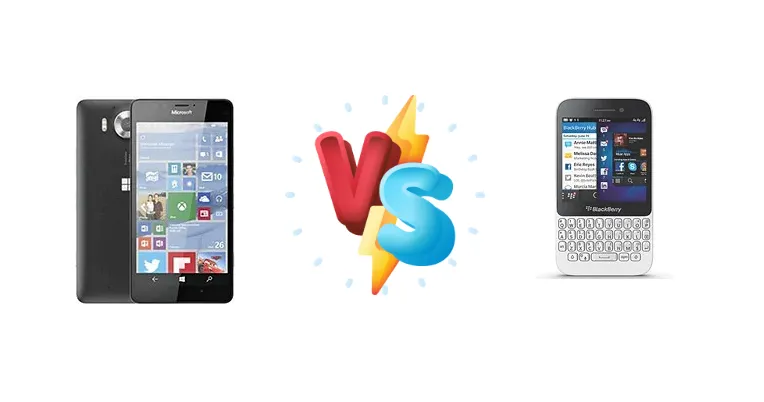
Released years apart and targeting vastly different user bases, the Microsoft Lumia 950 Dual SIM and the BlackBerry Q5 represent contrasting philosophies in smartphone design. The Lumia 950, a late entrant into Microsoft’s flagship ambitions, aimed for raw performance and camera prowess. The BlackBerry Q5, meanwhile, doubled down on the physical QWERTY keyboard and secure communication, hallmarks of the BlackBerry brand. This comparison dissects their core differences to help understand which device holds up better today.
🏆 Quick Verdict
For the average user in 2024, the Microsoft Lumia 950 Dual SIM is the more capable device. Its significantly more powerful Snapdragon 808 chipset and modern features, despite the OS limitations, offer a better overall experience than the aging BlackBerry Q5. However, the Q5’s exceptional battery endurance and physical keyboard remain compelling for specific users.
| Network |
|---|
| 2G bands | GSM 850 / 900 / 1800 / 1900 - SIM 1 & SIM 2 | GSM 850 / 900 / 1800 / 1900 - all versions |
| 3G bands | HSDPA 850 / 900 / 1700(AWS) / 1900 / 2100 | HSDPA 800 / 850 / 1700 / 1900 / 2100 - SQR100-1 |
| 4G bands | 1, 2, 3, 4, 5, 7, 8, 12, 17, 20, 28, 38, 40 | 2, 4, 5, 17 - SQR100-1 |
| Speed | HSPA 42.2/5.76 Mbps, LTE Cat4 150/50 Mbps | HSPA 42.2/5.76 Mbps, LTE Cat3 100/50 Mbps |
| Technology | GSM / HSPA / LTE | GSM / HSPA / LTE |
| | - | 3, 7, 8, 20 - SQR100-2 |
| Launch |
|---|
| Announced | 2015, October. Released 2015, December | 2013, May. Released 2013, June |
| Status | Discontinued | Discontinued |
| Body |
|---|
| Dimensions | 145 x 73.2 x 8.2 mm (5.71 x 2.88 x 0.32 in) | 120 x 66 x 10.8 mm (4.72 x 2.60 x 0.43 in) |
| Keyboard | - | QWERTY |
| SIM | Nano-SIM + Nano-SIM | Micro-SIM |
| Weight | 150 g (5.29 oz) | 120 g (4.23 oz) |
| Display |
|---|
| Protection | Corning Gorilla Glass 3 | - |
| Resolution | 1440 x 2560 pixels, 16:9 ratio (~565 ppi density) | 720 x 720 pixels, 1:1 ratio (~328 ppi density) |
| Size | 5.2 inches, 74.5 cm2 (~70.2% screen-to-body ratio) | 3.1 inches, 31.0 cm2 (~39.1% screen-to-body ratio) |
| Type | AMOLED | IPS LCD |
| | ClearBlack display | - |
| Platform |
|---|
| CPU | Hexa-core (4x1.4 GHz Cortex-A53 & 2x1.8 GHz Cortex-A57) | Dual-core 1.2 GHz Krait |
| Chipset | Qualcomm MSM8992 Snapdragon 808 (20 nm) | Qualcomm MSM8960 Snapdragon S4 Plus |
| GPU | Adreno 418 | Adreno 225 |
| OS | Microsoft Windows 10 | BlackBerry OS 10.2, upgradable to 10.3.1 |
| Memory |
|---|
| Card slot | microSDXC (dedicated slot) | microSDHC (dedicated slot) |
| Internal | 32GB 3GB RAM | 8GB 2GB RAM |
| | eMMC 5.0 | - |
| Main Camera |
|---|
| Features | Zeiss optics, triple-LED RGB flash, panorama, HDR | LED flash, HDR, panorama |
| Single | 20 MP, f/1.9, 26mm (wide), 1/2.4", 1.12µm, AF, OIS | 5 MP, f/2.4, 30mm (standard), AF |
| Video | 4K@30fps, stereo sound rec., 1080p@30/60fps (after SW update) | 1080p@30fps |
| Selfie camera |
|---|
| Single | 5 MP, f/2.4 | 2 MP |
| Video | 1080p@30fps | 720p |
| Sound |
|---|
| 3.5mm jack | Yes | Yes |
| 35mm jack | Yes | Yes |
| Loudspeaker | Yes | Yes |
| Comms |
|---|
| Bluetooth | 4.1, A2DP | 4.0, A2DP, LE |
| NFC | Yes | Yes (market dependent) |
| Positioning | GPS, GLONASS, BDS | GPS |
| Radio | FM radio | FM radio (after SW upgrade) |
| USB | USB Type-C 3.1 | microUSB 2.0 |
| WLAN | Wi-Fi 802.11 a/b/g/n/ac, dual-band, hotspot | Wi-Fi 802.11 b/g/n, hotspot |
| Features |
|---|
| Sensors | Iris scanner, accelerometer, gyro, proximity, compass, barometer, sensor core | Accelerometer, gyro, proximity, compass |
| | Microsoft Continuum support | - |
| Battery |
|---|
| Charging | 18W wired
Wireless (Qi) | - |
| Music play | Up to 67 h | - |
| Stand-by | Up to 288 h (2G) / Up to 288 h (3G) | Up to 336 h (3G) |
| Talk time | Up to 23 h (2G) / Up to 18 h (3G) | Up to 12 h 30 min (3G) |
| Type | Li-Ion 3000 mAh, removable | Li-Ion 2180 mAh, non-removable |
| Misc |
|---|
| Colors | Black, White | Black, White, Red, Gray, Pink |
| Price | About 280 EUR | About 70 EUR |
| SAR | - | 1.33 W/kg (head) 0.85 W/kg (body) |
| SAR EU | - | 1.38 W/kg (head) 0.85 W/kg (body) |
| Tests |
|---|
| Audio quality | - |
Noise -91.7dB / Crosstalk -90.7dB |
| Battery life | - |
Endurance rating 55h
|
| Camera | - |
Photo / Video |
| Display | - |
Contrast ratio: 1293:1 (nominal) / 1.682:1 (sunlight) |
| Loudspeaker | - |
Voice 75dB / Noise 69dB / Ring 76dB
|
Microsoft Lumia 950 Dual SIM
- Significantly more powerful processor for smoother performance.
- Likely superior camera quality with advanced features.
- Fast and wireless charging capabilities.
- Discontinued operating system (Windows 10 Mobile) with limited support.
- Battery capacity is unknown, potentially lower than the Q5.
- App ecosystem is limited due to the OS.
BlackBerry Q5
- Exceptional battery life with 55-hour endurance rating.
- Physical QWERTY keyboard for efficient typing.
- Secure BlackBerry 10 OS with focus on privacy.
- Outdated processor struggles with modern applications.
- Limited app availability on BlackBerry 10.
- Smaller display size may not be ideal for all users.
Display Comparison
Both devices feature a contrast ratio of 1293:1 (nominal) and 1.682:1 (sunlight), suggesting similar outdoor visibility. However, the Lumia 950’s display size and resolution are not specified, while the Q5’s 3.1-inch display is notably smaller. The Lumia 950 likely benefits from a higher pixel density, resulting in sharper images. The absence of information regarding panel technology (OLED vs LCD) for the Lumia 950 leaves a gap in the comparison, but its flagship status suggests a higher-quality panel overall.
Camera Comparison
Both phones offer photo and video capabilities, but the Lumia 950 is expected to have a far superior camera system. While specific sensor details are missing, the Lumia 950, as a flagship device, likely features a larger sensor, optical image stabilization (OIS), and more advanced image processing algorithms. The Q5’s camera, while functional, would have been limited by its older technology and smaller sensor. The Lumia 950’s camera was known for its PureView technology, offering excellent image quality in various lighting conditions.
Performance
The performance gap between these devices is substantial. The Lumia 950’s Qualcomm MSM8992 Snapdragon 808, a hexa-core processor built on a 20nm process, significantly outperforms the BlackBerry Q5’s Qualcomm MSM8960 Snapdragon S4 Plus, a dual-core 1.2 GHz Krait processor. The Snapdragon 808’s combination of four Cortex-A53 cores for efficiency and two Cortex-A57 cores for performance provides a much smoother experience for multitasking and demanding applications. The 20nm fabrication process also contributes to better thermal management compared to the S4 Plus. The Q5’s processor, while adequate for basic tasks in its time, struggles with modern app demands.
Battery Life
The BlackBerry Q5 boasts an endurance rating of 55 hours, a testament to its efficient processor and smaller display. However, the Lumia 950’s 18W wired and Qi wireless charging capabilities offer a significant convenience advantage. While the Lumia 950’s battery capacity is unknown, the Snapdragon 808’s power efficiency and the availability of fast charging mitigate the potential disadvantage of a smaller battery. The Q5’s endurance rating is impressive, but the Lumia 950’s charging options provide greater flexibility.
Buying Guide
Buy the Microsoft Lumia 950 Dual SIM if you need a device capable of handling demanding applications, enjoy mobile photography, and are comfortable with the challenges of a discontinued operating system. Buy the BlackBerry Q5 if you prioritize battery life above all else, require a physical keyboard for extensive typing, and value the security features and ecosystem of BlackBerry 10 OS, understanding its limited app availability.
Frequently Asked Questions
❓ Is the Windows 10 Mobile operating system on the Lumia 950 still secure and receiving updates?
No. Microsoft officially ended support for Windows 10 Mobile in January 2020. This means no further security updates are being released, making the device vulnerable to potential threats. While some community efforts exist to maintain functionality, it's not a secure platform for sensitive data.
❓ Can I easily find apps for the BlackBerry Q5 in 2024?
App availability for BlackBerry 10 is severely limited. The BlackBerry World app store is no longer actively maintained, and many popular apps are not compatible. While some sideloading options exist, they are complex and may not be reliable. Expect a significantly restricted app experience compared to Android or iOS.
❓ How does the physical keyboard on the BlackBerry Q5 compare to using a touchscreen for typing?
The Q5’s physical keyboard offers a tactile typing experience that many users prefer for long-form writing or frequent messaging. It can be faster and more accurate than touchscreen typing, especially for those accustomed to physical keyboards. However, it comes at the cost of a smaller display and less screen real estate.
❓ Is the Snapdragon 808 in the Lumia 950 powerful enough to run modern apps smoothly?
While the Snapdragon 808 was a flagship processor in its time, it will struggle with some of the most demanding modern apps and games. Basic tasks and less resource-intensive applications should run adequately, but expect slowdowns and lag with heavier workloads. The limited RAM (likely 2-3GB) also contributes to performance constraints.