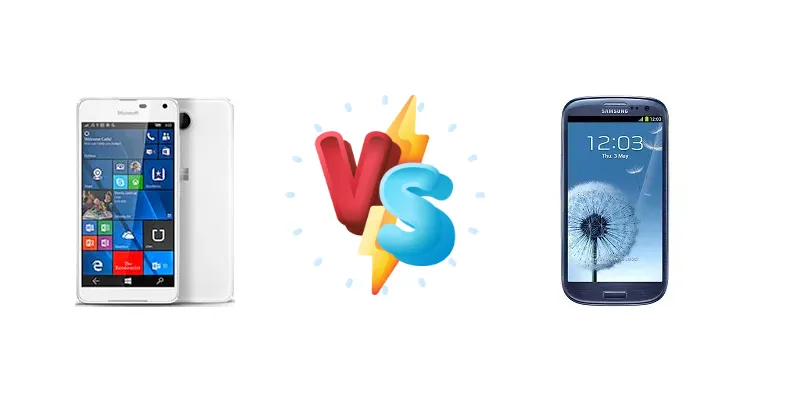
Nostalgia is a powerful thing, and sometimes revisiting older smartphones can be surprisingly insightful. Today, we're pitting two devices from a bygone era against each other: the Microsoft Lumia 650 and the Samsung Galaxy S III. Both were popular in their time, but how do they stack up against each other now?
🏆 Quick Verdict
The Lumia 650 edges out the Galaxy S III thanks to its slightly better battery life and potentially more modern software experience (depending on updates). However, the Galaxy S III boasts a more powerful processor and a more versatile camera with video recording capabilities, making it a close contest.
| Network |
|---|
| 2G bands | GSM 850 / 900 / 1800 / 1900 - SIM 1 & SIM 2 (dual-SIM model only) | GSM 850 / 900 / 1800 / 1900 |
| 3G bands | HSDPA 850 / 900 / 2100 | HSDPA 850 / 900 / 1900 / 2100 |
| 4G bands | 1, 3, 7, 8, 20 | - |
| Speed | HSPA 42.2/5.76 Mbps, LTE Cat4 150/50 Mbps | HSPA 21.1/5.76 Mbps |
| Technology | GSM / HSPA / LTE | GSM / HSPA |
| Launch |
|---|
| Announced | 2016, February. Released 2016, February | 2012, May. Released 2012, May |
| Status | Discontinued | Discontinued |
| Body |
|---|
| Build | Glass front (Gorilla Glass 3), plastic back, aluminum frame | Glass front (Gorilla Glass 2), plastic back, plastic frame |
| Dimensions | 142 x 70.9 x 6.9 mm (5.59 x 2.79 x 0.27 in) | 136.6 x 70.6 x 8.6 mm (5.38 x 2.78 x 0.34 in) |
| SIM | · Nano-SIM· Nano-SIM + Nano-SIM | Micro-SIM |
| Weight | 122 g (4.30 oz) | 133 g (4.69 oz) |
| Display |
|---|
| Protection | Corning Gorilla Glass 3 | Corning Gorilla Glass 2 |
| Resolution | 720 x 1280 pixels, 16:9 ratio (~297 ppi density) | 720 x 1280 pixels, 16:9 ratio (~306 ppi density) |
| Size | 5.0 inches, 67.5 cm2 (~67.1% screen-to-body ratio) | 4.8 inches, 63.5 cm2 (~65.9% screen-to-body ratio) |
| Type | OLED | Super AMOLED |
| | ClearBlack display | - |
| Platform |
|---|
| CPU | Quad-core 1.3 GHz Cortex-A7 | Quad-core 1.4 GHz Cortex-A9 |
| Chipset | Qualcomm MSM8909v2 Snapdragon 212 (28 nm) | Exynos 4412 Quad (32 nm) |
| GPU | Adreno 304 | Mali-400MP4 |
| OS | Microsoft Windows 10 | Android 4.0.4 (Ice Cream Sandwich), 4.3 (Jelly Bean), TouchWiz UI |
| Memory |
|---|
| Card slot | microSDXC (dedicated slot) | microSDXC (dedicated slot) |
| Internal | 16GB 1GB RAM | 16GB 1GB RAM, 32GB 1GB RAM, 64GB 1GB RAM |
| | eMMC 4.5 | - |
| Main Camera |
|---|
| Features | LED flash | LED flash |
| Single | 8 MP, f/2.2, 28mm (wide), 1/4.0", AF | 8 MP, f/2.6, 1/3.0", AF |
| Video | 720p@30fps | 1080p@30fps |
| Selfie camera |
|---|
| Single | 5 MP, f/2.2 | 1.9 MP, f/2.6 |
| Video | 720p | 720p@30fps |
| Sound |
|---|
| 3.5mm jack | Yes | Yes |
| 35mm jack | Yes | Yes |
| Loudspeaker | Yes | Yes |
| Comms |
|---|
| Bluetooth | 4.1, A2DP, LE | 4.0, A2DP, EDR, aptX |
| NFC | Yes | Yes |
| Positioning | GPS, GLONASS, BDS | GPS, A-GPS, GLONASS |
| Radio | FM radio | Stereo FM radio, RDS |
| USB | microUSB 2.0 | microUSB 2.0 (MHL TV-out), OTG |
| WLAN | Wi-Fi 802.11 b/g/n, DLNA, hotspot | Wi-Fi 802.11 a/b/g/n, dual-band, Wi-Fi Direct, DLNA, hotspot |
| Features |
|---|
| Sensors | Accelerometer, proximity | Accelerometer, gyro, proximity, compass, barometer |
| | - | S-Voice natural language commands and dictation |
| Battery |
|---|
| Stand-by | Up to 624 h (3G) | Up to 590 h (2G) / Up to 790 h (3G) |
| Talk time | Up to 16 h (2G) / Up to 13 h (3G) | Up to 21 h 40 min (2G) / Up to 11 h 40 min (3G) |
| Type | Li-Ion 2000 mAh, removable | Removable Li-Ion 2100 mAh battery |
| Misc |
|---|
| Colors | Black, White | Pebble blue, Marble white, Amber brown, Garnet red, Sapphire black, Titanium grey, La Fleur |
| Models | - | GT-I9300, GT-I9300I, SHV-E210S, SHW-M440S |
| Price | About 150 EUR | About 190 EUR |
| SAR | - | 0.55 W/kg (head) 1.49 W/kg (body) |
| SAR EU | - | 0.21 W/kg (head) |
| Tests |
|---|
| Audio quality | - |
Noise -90.3dB / Crosstalk -92.6dB |
| Battery life |
Endurance rating 55h
|
Endurance rating 50h
|
| Camera |
Photo |
Photo / Video |
| Display |
Contrast ratio: Infinite (nominal), 3.77(sunlight) |
Contrast ratio: Infinite (nominal) / 3.419:1 (sunlight) |
| Loudspeaker | - |
Voice 75dB / Noise 66dB / Ring 75dB
|
Microsoft Lumia 650
- Clean Windows experience
- Good sunlight readability
- Slightly better battery life (claimed)
- Durable build quality (typical of Lumia phones)
- Lower performance compared to Galaxy S III
- Limited camera features (no video recording)
- Older software support
- Less vibrant display compared to AMOLED
Samsung I9300 Galaxy S III
- More powerful processor
- Versatile camera with video recording
- Vibrant Super AMOLED display
- More feature-rich Android experience (though older)
- Older battery technology
- Sunlight readability slightly worse than Lumia 650
- Software support is very limited
- Potential security vulnerabilities due to age
Display Comparison
Both phones feature displays with a nominal 'infinite' contrast ratio, but the Lumia 650's sunlight readability (3.77) is marginally better than the Galaxy S III's (3.419:1). The Galaxy S III's display technology (Super AMOLED) generally offers more vibrant colors, while the Lumia 650's LCD might provide more accurate color reproduction. Screen sizes are similar, around 4.3-4.7 inches.
Camera Comparison
The Galaxy S III wins in camera versatility. It offers both photo and video recording capabilities, while the Lumia 650 is primarily focused on still photography. While both cameras are relatively low-resolution by today's standards (likely around 8MP), the Galaxy S III's image processing and additional features might provide slightly better results. The Lumia 650's camera app might offer a cleaner, simpler interface.
Performance
The Samsung Galaxy S III holds a performance advantage. Its Exynos 4412 Quad chipset with Cortex-A9 cores and a slightly faster clock speed (1.4 GHz) generally outperforms the Lumia 650's Snapdragon 212 with Cortex-A7 cores (1.3 GHz). While both are quad-core, the Galaxy S III's architecture is more advanced. Expect smoother multitasking and app loading on the S III.
Battery Life
The Lumia 650 claims a slightly better endurance rating (55h) compared to the Galaxy S III (50h). However, real-world battery performance can vary significantly based on usage patterns and software optimization. Both phones have relatively small batteries by modern standards, so expect a day's use at most.
Buying Guide
The Microsoft Lumia 650 is ideal for users seeking a simple, reliable phone with decent battery life and a clean Windows experience. The Samsung Galaxy S III is a better choice for those who prioritize performance and a more feature-rich Android experience, even if it's older.
Frequently Asked Questions
❓ Are these phones still safe to use?
Due to their age, both phones are vulnerable to security threats. Software updates are unlikely, so use them with caution and avoid sensitive data.
❓ Which phone is easier to find?
Both are difficult to find new. You'll likely find them on the used market, but condition and price will vary greatly.