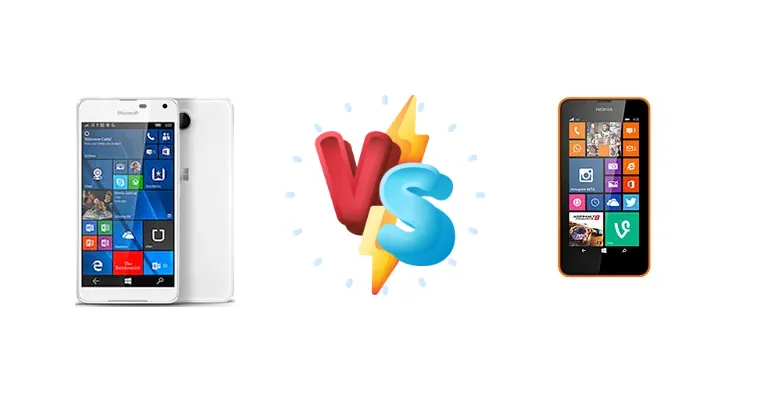
Both the Microsoft Lumia 650 and the Nokia Lumia 635 represent attempts to deliver affordable Windows Phone experiences. Released roughly a year apart, they target similar users but diverge in key areas, particularly battery life and display quality. This comparison dissects these differences to determine which device offers the best value in today's market.
🏆 Quick Verdict
For the average user prioritizing longevity, the Nokia Lumia 635 is the better choice. Its 66-hour endurance rating significantly surpasses the Lumia 650’s 55 hours. While the 650 offers a slightly newer processor, the real-world impact is minimal, making the 635’s superior battery performance more impactful.
| Network |
|---|
| 2G bands | GSM 850 / 900 / 1800 / 1900 - SIM 1 & SIM 2 (dual-SIM model only) | GSM 850 / 900 / 1800 / 1900 |
| 3G bands | HSDPA 850 / 900 / 2100 | HSDPA 850 / 900 / 2100 - RM-974 |
| 4G bands | 1, 3, 7, 8, 20 | 3, 7, 20 - RM-974 |
| Speed | HSPA 42.2/5.76 Mbps, LTE Cat4 150/50 Mbps | HSPA 42.2/5.76 Mbps, LTE Cat3 100/50 Mbps |
| Technology | GSM / HSPA / LTE | GSM / HSPA / LTE |
| | - | 2, 4, 5, 7, 17 - RM-975 |
| Launch |
|---|
| Announced | 2016, February. Released 2016, February | 2014, April. Released 2014, June |
| Status | Discontinued | Discontinued |
| Body |
|---|
| Build | Glass front (Gorilla Glass 3), plastic back, aluminum frame | - |
| Dimensions | 142 x 70.9 x 6.9 mm (5.59 x 2.79 x 0.27 in) | 129.5 x 66.7 x 9.2 mm, 78.5 cc (5.10 x 2.63 x 0.36 in) |
| SIM | · Nano-SIM· Nano-SIM + Nano-SIM | Micro-SIM |
| Weight | 122 g (4.30 oz) | 134 g (4.73 oz) |
| Display |
|---|
| Protection | Corning Gorilla Glass 3 | Corning Gorilla Glass 3 |
| Resolution | 720 x 1280 pixels, 16:9 ratio (~297 ppi density) | 480 x 854 pixels, 16:9 ratio (~221 ppi density) |
| Size | 5.0 inches, 67.5 cm2 (~67.1% screen-to-body ratio) | 4.5 inches, 54.3 cm2 (~62.9% screen-to-body ratio) |
| Type | OLED | IPS LCD |
| | ClearBlack display | ClearBlack display |
| Platform |
|---|
| CPU | Quad-core 1.3 GHz Cortex-A7 | Quad-core 1.2 GHz Cortex-A7 |
| Chipset | Qualcomm MSM8909v2 Snapdragon 212 (28 nm) | Qualcomm Snapdragon 400 (28 nm) |
| GPU | Adreno 304 | Adreno 305 |
| OS | Microsoft Windows 10 | Microsoft Windows Phone 8.1 |
| Memory |
|---|
| Card slot | microSDXC (dedicated slot) | microSDXC (dedicated slot) |
| Internal | 16GB 1GB RAM | 8GB 512MB 8GB 1GB RAM |
| | eMMC 4.5 | eMMC 4.5 |
| Main Camera |
|---|
| Features | LED flash | Panorama |
| Single | 8 MP, f/2.2, 28mm (wide), 1/4.0", AF | 5 MP, 1/4.0", AF |
| Video | 720p@30fps | 720p@30fps |
| Selfie camera |
|---|
| Single | 5 MP, f/2.2 | - |
| Video | 720p | - |
| | - | No |
| Sound |
|---|
| 3.5mm jack | Yes | Yes |
| 35mm jack | Yes | Yes |
| Loudspeaker | Yes | Yes |
| Comms |
|---|
| Bluetooth | 4.1, A2DP, LE | 4.0, A2DP, LE/ aptX after WP8 Denim update |
| NFC | Yes | No |
| Positioning | GPS, GLONASS, BDS | GPS, GLONASS |
| Radio | FM radio | FM radio |
| USB | microUSB 2.0 | microUSB 2.0 |
| WLAN | Wi-Fi 802.11 b/g/n, DLNA, hotspot | Wi-Fi 802.11 b/g/n, DLNA, hotspot |
| Features |
|---|
| Sensors | Accelerometer, proximity | Accelerometer, sensor core |
| Battery |
|---|
| Music play | - | Up to 58 h |
| Stand-by | Up to 624 h (3G) | Up to 648 h |
| Talk time | Up to 16 h (2G) / Up to 13 h (3G) | Up to 12 h (2G) / Up to 14 h (3G) |
| Type | Li-Ion 2000 mAh, removable | Li-Ion 1830 mAh, removable (BL-5H) |
| Misc |
|---|
| Colors | Black, White | Bright Orange, bright green, bright yellow, white, black |
| Price | About 150 EUR | About 110 EUR |
| SAR | - | 0.97 W/kg (head) 0.77 W/kg (body) |
| SAR EU | - | 0.75 W/kg (head) 0.79 W/kg (body) |
| Tests |
|---|
| Battery life |
Endurance rating 55h
|
Endurance rating 66h
|
| Camera |
Photo | - |
| Display |
Contrast ratio: Infinite (nominal), 3.77(sunlight) |
Contrast ratio: 771:1 (nominal), 2.056 (sunlight) |
| Loudspeaker | - |
Voice 68dB / Noise 65dB / Ring 75dB
|
Microsoft Lumia 650
- Slightly newer Snapdragon 212 chipset
- Potentially smoother performance (marginal)
- More modern design (subjective)
- Significantly shorter battery life (55h endurance)
- Lower display contrast in sunlight (3.77 ratio)
- Limited camera details
Nokia Lumia 635
- Superior battery life (66h endurance)
- Better display contrast in sunlight (2.056 ratio)
- Proven Snapdragon 400 platform
- Older chipset (Snapdragon 400)
- Slightly slower processor clock speed (1.2 GHz)
- Limited camera details
Display Comparison
The Nokia Lumia 635 boasts a significantly superior display contrast ratio of 771:1 (nominal) and 2.056 (sunlight) compared to the Lumia 650’s infinite (nominal) but only 3.77 (sunlight) ratio. While 'infinite' nominal contrast sounds impressive, the sunlight readability score reveals the 635’s advantage in outdoor visibility. This suggests the 635’s panel handles bright light more effectively, offering a clearer image in direct sunlight. Both devices share a similar resolution, so the contrast difference is the primary distinguishing factor.
Camera Comparison
Both devices are listed as having a 'Photo' camera, lacking specific details about sensor size or megapixels. Given their budget positioning, it’s safe to assume both cameras offer similar image quality, suitable for casual snapshots but lacking advanced features like optical image stabilization or high-resolution sensors. Without further specifications, a meaningful comparison is impossible; focusing on the core functionality of capturing basic photos is the most realistic expectation.
Performance
Both devices utilize a quad-core Cortex-A7 processor, but the Nokia Lumia 635’s Snapdragon 400 operates at 1.2 GHz, while the Microsoft Lumia 650’s Snapdragon 212 runs at 1.3 GHz. This 100 MHz clock speed difference, coupled with the 212’s slightly newer architecture, suggests a marginal performance improvement for the 650. However, both chipsets are built on a 28nm process, limiting potential gains. The real-world impact on everyday tasks will be minimal for most users, as both phones are designed for basic functionality.
Battery Life
The Nokia Lumia 635 delivers a substantial advantage in battery life, achieving an endurance rating of 66 hours compared to the Lumia 650’s 55 hours. This 11-hour difference translates to a significant benefit for users who rely on their phones throughout the day. While both phones utilize similar 28nm chipsets, the 635’s more efficient power management or slightly less demanding display contributes to its longer runtime. This makes the 635 a clear winner for users prioritizing battery longevity.
Buying Guide
Buy the Microsoft Lumia 650 if you prioritize a slightly newer chipset and are willing to sacrifice battery life for a potentially smoother, though minimally noticeable, experience. Buy the Nokia Lumia 635 if you value extended battery life above all else, making it ideal for users who frequently travel or have limited access to charging.
Frequently Asked Questions
❓ Is the difference in processor speed between the Snapdragon 212 and 400 noticeable in everyday use?
The 100 MHz clock speed difference is unlikely to be noticeable for typical tasks like browsing, social media, and messaging. Both processors are designed for basic smartphone functionality, and the software experience on Windows Phone will likely be the limiting factor, not the CPU.
❓ How much does the lower battery endurance of the Lumia 650 impact real-world usage?
The 11-hour difference in endurance rating translates to a potentially significant reduction in daily usage time. Users who frequently travel, use GPS navigation, or stream media will likely find the Lumia 635’s longer battery life more beneficial.
❓ Given the age of these phones, are software updates still available?
Microsoft officially ended support for Windows Phone 8.1 in January 2019. Therefore, neither the Lumia 650 nor the Lumia 635 receive official software updates. Security vulnerabilities remain unpatched, making these devices less secure for sensitive tasks.