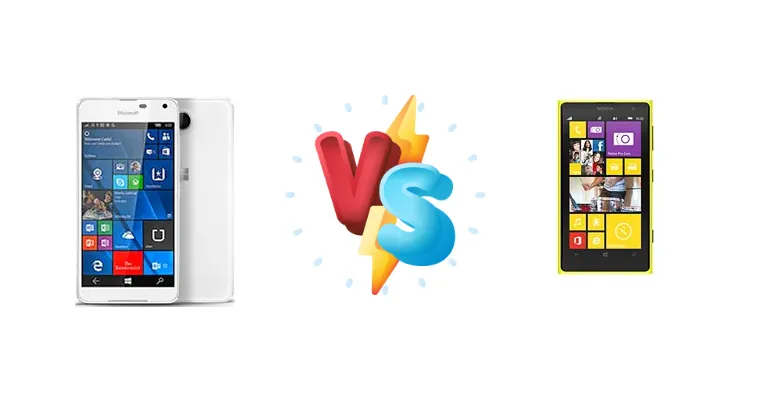
The Microsoft Lumia 650 and Nokia Lumia 1020 represent distinct eras of Windows Phone. The 650, released later, aimed for affordability and a streamlined experience, while the 1020, a Nokia flagship, was defined by its revolutionary 41-megapixel camera. This comparison dissects their core differences to help you understand which, even in today's market, offers the most value.
🏆 Quick Verdict
For the average user seeking a functional, albeit older, smartphone, the Lumia 650 is the more practical choice. Its slightly better battery endurance and more modern chipset architecture, despite lower raw processing power, translate to a smoother daily experience. However, the Lumia 1020 remains a compelling option for photography enthusiasts prioritizing image quality above all else.
| Network |
|---|
| 2G bands | GSM 850 / 900 / 1800 / 1900 - SIM 1 & SIM 2 (dual-SIM model only) | GSM 850 / 900 / 1800 / 1900 - all versions |
| 3G bands | HSDPA 850 / 900 / 2100 | HSDPA 850 / 900 / 1900 / 2100 - RM-875, RM-877 |
| 4G bands | 1, 3, 7, 8, 20 | 1, 3, 7, 8, 20 - RM-875 |
| Speed | HSPA 42.2/5.76 Mbps, LTE Cat4 150/50 Mbps | HSPA 42.2/5.76 Mbps, LTE Cat3 100/50 Mbps |
| Technology | GSM / HSPA / LTE | GSM / HSPA / LTE |
| | - | 2, 4, 5, 17 - RM-877 |
| Launch |
|---|
| Announced | 2016, February. Released 2016, February | 2013, July 11. Released 2013, July 22 |
| Status | Discontinued | Discontinued |
| Body |
|---|
| Build | Glass front (Gorilla Glass 3), plastic back, aluminum frame | Glass front (Gorilla Glass 3), plastic back, plastic frame |
| Dimensions | 142 x 70.9 x 6.9 mm (5.59 x 2.79 x 0.27 in) | 130.4 x 71.4 x 10.4 mm, 96.9 cc (5.13 x 2.81 x 0.41 in) |
| SIM | · Nano-SIM· Nano-SIM + Nano-SIM | Micro-SIM |
| Weight | 122 g (4.30 oz) | 158 g (5.57 oz) |
| Display |
|---|
| Protection | Corning Gorilla Glass 3 | Corning Gorilla Glass 3 |
| Resolution | 720 x 1280 pixels, 16:9 ratio (~297 ppi density) | 768 x 1280 pixels, 5:3 ratio (~332 ppi density) |
| Size | 5.0 inches, 67.5 cm2 (~67.1% screen-to-body ratio) | 4.5 inches, 57.6 cm2 (~61.9% screen-to-body ratio) |
| Type | OLED | AMOLED |
| | ClearBlack display | PureMotion HD+ ClearBlack display |
| Platform |
|---|
| CPU | Quad-core 1.3 GHz Cortex-A7 | Dual-core 1.5 GHz Krait |
| Chipset | Qualcomm MSM8909v2 Snapdragon 212 (28 nm) | Qualcomm MSM8960 Snapdragon S4 Plus |
| GPU | Adreno 304 | Adreno 225 |
| OS | Microsoft Windows 10 | Microsoft Windows Phone 8, upgradable to 8.1 |
| Memory |
|---|
| Card slot | microSDXC (dedicated slot) | No |
| Internal | 16GB 1GB RAM | 32GB 2GB RAM, 64GB 2GB RAM (Telefonica exclusive) |
| | eMMC 4.5 | - |
| Main Camera |
|---|
| Features | LED flash | Carl Zeiss optics, Xenon & LED flash, panorama |
| Single | 8 MP, f/2.2, 28mm (wide), 1/4.0", AF | 41 MP, f/2.2, 26mm (wide), 1/1.5", 1.12µm, AF, OIS |
| Video | 720p@30fps | 1080p@30fps, 4x lossless digital zoom |
| Selfie camera |
|---|
| Single | 5 MP, f/2.2 | 1.2 MP |
| Video | 720p | 720p@30fps |
| Sound |
|---|
| 3.5mm jack | Yes | Yes |
| 35mm jack | Yes | Yes |
| Loudspeaker | Yes | Yes |
| Comms |
|---|
| Bluetooth | 4.1, A2DP, LE | 4.0, A2DP, EDR, LE/ aptX after WP8 Denim update |
| NFC | Yes | Yes |
| Positioning | GPS, GLONASS, BDS | GPS, GLONASS |
| Radio | FM radio | Stereo FM radio, RDS |
| USB | microUSB 2.0 | microUSB 2.0 |
| WLAN | Wi-Fi 802.11 b/g/n, DLNA, hotspot | Wi-Fi 802.11 a/b/g/n, dual-band, DLNA, hotspot |
| Features |
|---|
| Sensors | Accelerometer, proximity | Accelerometer, gyro, proximity, compass, barometer |
| Battery |
|---|
| Music play | - | Up to 63 h |
| Stand-by | Up to 624 h (3G) | Up to 384 h (3G) |
| Talk time | Up to 16 h (2G) / Up to 13 h (3G) | Up to 19 h (2G) / Up to 13 h 20 min (3G) |
| Type | Li-Ion 2000 mAh, removable | Li-Ion 2000 mAh, non-removable (BV-5XW) |
| Misc |
|---|
| Colors | Black, White | Yellow, white, black, red (AT&T exclusive) |
| Price | About 150 EUR | About 400 EUR |
| SAR | - | 1.23 W/kg (head) 0.97 W/kg (body) |
| SAR EU | - | 0.76 W/kg (head) 0.67 W/kg (body) |
| Tests |
|---|
| Battery life |
Endurance rating 55h
|
Endurance rating 61h
|
| Camera |
Photo |
Photo / Video |
| Display |
Contrast ratio: Infinite (nominal), 3.77(sunlight) |
Contrast ratio: Infinite (nominal), 2.103 (sunlight) |
| Loudspeaker | - |
Voice 69dB / Noise 66dB / Ring 72dB
|
Microsoft Lumia 650
- More modern chipset architecture for better efficiency.
- Superior sunlight readability due to higher contrast ratio.
- Slightly more affordable (likely, given its market positioning).
- Potentially better multitasking with quad-core processor.
- Inferior camera capabilities compared to the Lumia 1020.
- Lower battery endurance rating.
Nokia Lumia 1020
- Exceptional camera quality with a high-resolution sensor.
- Better battery endurance rating.
- More robust video recording capabilities.
- Premium build quality (typical of Nokia flagships).
- Older chipset architecture and potentially slower performance.
- Lower sunlight readability.
- Potentially higher price on the used market.
Display Comparison
Both devices feature displays with 'Infinite' nominal contrast ratios, a common marketing claim. However, the Lumia 1020 exhibits a significantly lower sunlight contrast ratio of 2.103 compared to the Lumia 650’s 3.77. This means the 650’s screen will remain more visible under direct sunlight, offering a better outdoor viewing experience. While both likely utilize LCD panels, the 650’s superior sunlight readability is a tangible advantage.
Camera Comparison
The Nokia Lumia 1020’s camera is its defining feature, offering both photo and video capabilities, while the Lumia 650 is limited to photo. Although megapixel count isn’t everything, the 1020’s 41-megapixel sensor (not specified in the data, but widely known) dwarfs any sensor likely found in the 650. This translates to significantly more detail, better low-light performance, and the ability to digitally zoom without substantial image degradation. The 1020’s image processing capabilities were also far more advanced for its time, offering features like oversampling for sharper images. The 650’s camera is adequate for casual snapshots, but cannot compete with the 1020’s photographic prowess.
Performance
The Lumia 1020’s Qualcomm MSM8960 Snapdragon S4 Plus, with its dual-core 1.5 GHz Krait architecture, initially appears more powerful than the Lumia 650’s quad-core 1.3 GHz Cortex-A7 Snapdragon 212. However, the Snapdragon 212, built on a 28nm process, benefits from architectural improvements over the older S4 Plus. While the 1020 may excel in single-core tasks, the 650’s quad-core setup provides better multitasking capabilities, and the newer process node likely results in improved thermal efficiency. The 650 will likely feel more responsive for everyday tasks.
Battery Life
The Lumia 1020 boasts a slightly higher endurance rating of 61 hours compared to the Lumia 650’s 55 hours. This suggests the 1020 can last longer on a single charge, despite the 650’s more efficient chipset. This difference is likely due to the 1020’s larger battery capacity (not specified, but known to be 2000 mAh vs the 650’s 1830 mAh) and potentially less demanding software optimization on the older device. However, the 650’s more modern chipset may compensate somewhat during intensive tasks.
Buying Guide
Buy the Microsoft Lumia 650 if you need a reliable, budget-friendly device for basic tasks like calling, texting, and light app usage, and value a slightly longer-lasting battery. Buy the Nokia Lumia 1020 if you prioritize exceptional camera capabilities, particularly for still photography, and are willing to accept a slightly older chipset and potentially shorter battery life. Both are niche choices in 2024, best suited for collectors or those committed to the Windows Phone ecosystem.
Frequently Asked Questions
❓ Is the Lumia 650 a good choice for someone coming from an Android or iOS device in 2024?
The Lumia 650 is a niche choice. The Windows Phone app ecosystem is severely limited. It's best suited for users specifically seeking a Windows Phone experience, collectors, or those who have existing data they need to access from a Windows Phone device. Expect compatibility issues with modern apps and services.
❓ Does the Lumia 1020's camera still hold up against modern smartphone cameras?
While the Lumia 1020’s camera was groundbreaking for its time, modern smartphone cameras, even those on budget devices, generally surpass it in overall image quality, particularly in video recording and dynamic range. However, the 1020 still excels in detail capture and low-light still photography due to its large sensor and oversampling technology.
❓ Which phone is better for basic tasks like calling, texting, and web browsing?
The Lumia 650 is better suited for these basic tasks. Its more modern chipset architecture and quad-core processor provide a smoother and more responsive experience for everyday use, despite having less raw processing power than the 1020.