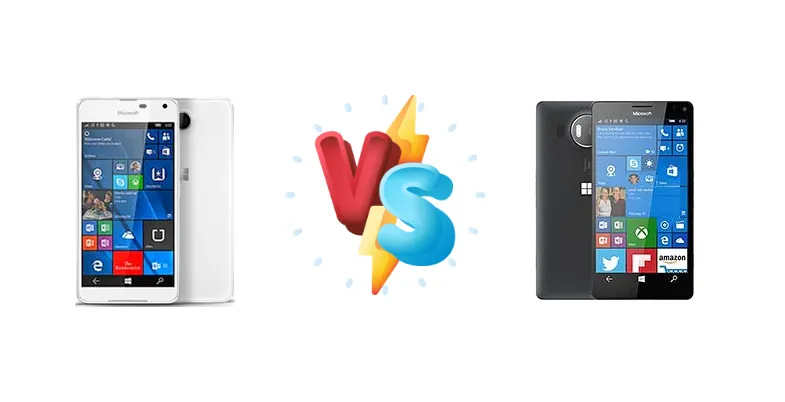
Microsoft's Lumia line offered a unique Windows experience, but with a range of models, choosing the right one can be tricky. Today, we're pitting the budget-friendly Lumia 650 against the flagship Lumia 950 XL to see which phone delivers the best value and performance. Let's dive in!
🏆 Quick Verdict
The Lumia 950 XL is the clear winner, boasting significantly superior performance thanks to its Snapdragon 810 chipset and octa-core processor. While the 650 offers impressive battery life, the 950 XL's faster speeds, better camera, and wireless charging make it the more compelling choice for most users.
| Network |
|---|
| 2G bands | GSM 850 / 900 / 1800 / 1900 - SIM 1 & SIM 2 (dual-SIM model only) | GSM 850 / 900 / 1800 / 1900 - SIM 1 & SIM 2 |
| 3G bands | HSDPA 850 / 900 / 2100 | HSDPA 850 / 900 / 1700(AWS) / 1900 / 2100 |
| 4G bands | 1, 3, 7, 8, 20 | 1, 2, 3, 4, 5, 7, 8, 12, 17, 20, 28, 38, 40 |
| Speed | HSPA 42.2/5.76 Mbps, LTE Cat4 150/50 Mbps | HSPA 42.2/5.76 Mbps, LTE Cat4 150/50 Mbps |
| Technology | GSM / HSPA / LTE | GSM / HSPA / LTE |
| Launch |
|---|
| Announced | 2016, February. Released 2016, February | 2015, October. Released 2015, December |
| Status | Discontinued | Discontinued |
| Body |
|---|
| Build | Glass front (Gorilla Glass 3), plastic back, aluminum frame | - |
| Dimensions | 142 x 70.9 x 6.9 mm (5.59 x 2.79 x 0.27 in) | 151.9 x 78.4 x 8.1 mm (5.98 x 3.09 x 0.32 in) |
| SIM | · Nano-SIM· Nano-SIM + Nano-SIM | Nano-SIM + Nano-SIM |
| Weight | 122 g (4.30 oz) | 165 g (5.82 oz) |
| Display |
|---|
| Protection | Corning Gorilla Glass 3 | Corning Gorilla Glass 4 |
| Resolution | 720 x 1280 pixels, 16:9 ratio (~297 ppi density) | 1440 x 2560 pixels, 16:9 ratio (~515 ppi density) |
| Size | 5.0 inches, 67.5 cm2 (~67.1% screen-to-body ratio) | 5.7 inches, 89.6 cm2 (~75.2% screen-to-body ratio) |
| Type | OLED | AMOLED |
| | ClearBlack display | ClearBlack display |
| Platform |
|---|
| CPU | Quad-core 1.3 GHz Cortex-A7 | Octa-core (4x1.5 GHz Cortex-A53 & 4x2.0 GHz Cortex-A57) |
| Chipset | Qualcomm MSM8909v2 Snapdragon 212 (28 nm) | Qualcomm MSM8994 Snapdragon 810 (20 nm) |
| GPU | Adreno 304 | Adreno 430 |
| OS | Microsoft Windows 10 | Microsoft Windows 10 |
| Memory |
|---|
| Card slot | microSDXC (dedicated slot) | microSDXC (dedicated slot) |
| Internal | 16GB 1GB RAM | 32GB 3GB RAM |
| | eMMC 4.5 | eMMC 5.0 |
| Main Camera |
|---|
| Features | LED flash | Zeiss optics, triple-LED RGB flash, panorama, HDR |
| Single | 8 MP, f/2.2, 28mm (wide), 1/4.0", AF | 20 MP, f/1.9, 26mm (wide), 1/2.4", 1.12µm, AF, OIS |
| Video | 720p@30fps | 4K@30fps, stereo sound rec., 1080p@30/60fps (after SW update) |
| Selfie camera |
|---|
| Single | 5 MP, f/2.2 | 5 MP, f/2.4 |
| Video | 720p | 1080p@30fps |
| Sound |
|---|
| 3.5mm jack | Yes | Yes |
| 35mm jack | Yes | Yes |
| Loudspeaker | Yes | Yes |
| Comms |
|---|
| Bluetooth | 4.1, A2DP, LE | 4.1, A2DP |
| NFC | Yes | Yes |
| Positioning | GPS, GLONASS, BDS | GPS, GLONASS, BDS |
| Radio | FM radio | FM radio |
| USB | microUSB 2.0 | USB Type-C 3.1 |
| WLAN | Wi-Fi 802.11 b/g/n, DLNA, hotspot | Wi-Fi 802.11 a/b/g/n/ac, dual-band, hotspot |
| Features |
|---|
| Sensors | Accelerometer, proximity | Iris scanner, accelerometer, gyro, proximity, compass, barometer, sensor core |
| | - | Microsoft Continuum support |
| Battery |
|---|
| Charging | - | 18W wired
Wireless (Qi) (market dependent) |
| Music play | - | Up to 75 h |
| Stand-by | Up to 624 h (3G) | Up to 288 h (2G) / Up to 288 h (3G) |
| Talk time | Up to 16 h (2G) / Up to 13 h (3G) | Up to 25 h (2G) / Up to 19 h (3G) |
| Type | Li-Ion 2000 mAh, removable | Li-Ion 3340 mAh, removable |
| Misc |
|---|
| Colors | Black, White | Black, White |
| Price | About 150 EUR | About 350 EUR |
| Tests |
|---|
| Audio quality | - |
Noise -91.6dB / Crosstalk -89.3dB |
| Battery life |
Endurance rating 55h
|
Endurance rating 47h
|
| Camera |
Photo | - |
| Display |
Contrast ratio: Infinite (nominal), 3.77(sunlight) |
Contrast ratio: Infinite (nominal), 3.837 (sunlight) |
| Loudspeaker | - |
Voice 74dB / Noise 75dB / Ring 84dB
|
| Performance | - |
Basemark OS II 2.0: 1472Basemark X: 32178 |
Microsoft Lumia 650
- Excellent battery life
- Affordable price
- Durable build quality
- Compact size
- Underpowered processor
- Basic camera
- Outdated software
- Limited storage
Microsoft Lumia 950 XL Dual SIM
- Powerful performance
- Superior camera
- Wireless charging (market dependent)
- Larger display
- Dual SIM support
- Higher price (historically)
- Battery life slightly less than 650
- Older model - software support limited
- Potential for overheating (Snapdragon 810)
Display Comparison
Both Lumias feature displays with a nominal infinite contrast ratio and respectable sunlight readability (3.77-3.837). The 950 XL's screen is slightly larger and likely offers better color accuracy and brightness, though detailed specifications are needed for a definitive comparison. The 650's display is adequate for its price range.
Camera Comparison
While both phones have cameras, the 950 XL's is significantly better. It likely features a higher resolution sensor and more advanced image processing capabilities, resulting in sharper, more detailed photos with better low-light performance. The 650's camera is adequate for basic snapshots but lacks the features and image quality of the 950 XL.
Performance
This is where the 950 XL truly shines. Its Snapdragon 810 chipset and octa-core processor (4x1.5 GHz Cortex-A53 & 4x2.0 GHz Cortex-A57) provide a substantial performance boost over the 650's Snapdragon 212 and quad-core Cortex-A7. Expect smoother multitasking, faster app loading, and a more responsive user experience on the 950 XL.
Battery Life
The Lumia 650 surprisingly holds its own in battery life, boasting an endurance rating of 55 hours. However, the 950 XL's 47-hour rating is still respectable, especially considering its more powerful hardware. The 950 XL also benefits from wireless charging capabilities (market dependent), adding to its convenience.
Buying Guide
The Microsoft Lumia 650 is ideal for users on a tight budget who prioritize long battery life and a simple, reliable smartphone experience. The Lumia 950 XL is best suited for power users who demand high performance, a better camera, and features like wireless charging, even if it comes at a higher price point (considering their age).
Frequently Asked Questions
❓ Are there still software updates for these Lumias?
Microsoft has ended active software support for these devices. However, community-driven updates may still be available for some users.
❓ Which Lumia is better for photography?
The Lumia 950 XL is significantly better for photography due to its superior camera hardware and image processing capabilities.