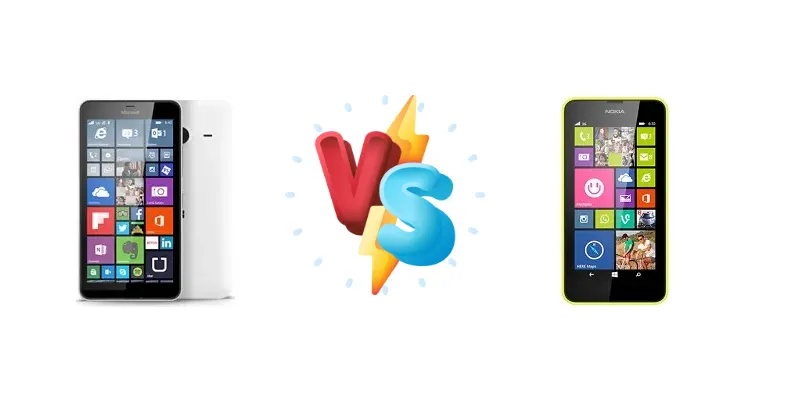
Released within a similar timeframe and targeting the budget-conscious consumer, the Microsoft Lumia 640 XL and the Nokia Lumia 630 represent two distinct approaches to the Windows Phone experience. While both leverage the Qualcomm Snapdragon 400 platform, the 640 XL aims for a larger screen and extended battery life, while the 630 prioritizes a more compact form factor. This comparison dissects the key differences to determine which device offers the best value.
🏆 Quick Verdict
For most users, the Microsoft Lumia 640 XL is the superior choice. Its significantly improved display contrast ratio, coupled with a 16-hour advantage in battery endurance, makes it a more enjoyable and practical daily driver. While both phones share the same processor, the 640 XL’s larger size allows for a better overall experience.
| Network |
|---|
| 2G bands | GSM 850 / 900 / 1800 / 1900 | GSM 850 / 900 / 1800 / 1900 - all versions |
| 3G bands | HSDPA 850 / 900 / 1900 / 2100 | HSDPA 900 / 2100 - RM-976 |
| Speed | HSPA 42.2/5.76 Mbps | HSPA 21.1/5.76 Mbps |
| Technology | GSM / HSPA | GSM / HSPA |
| | - | HSDPA 850 / 900 / 1900 / 2100 - RM-977 |
| Launch |
|---|
| Announced | 2015, March. Released 2015, April | 2014, April. Released 2014, May |
| Status | Discontinued | Discontinued |
| Body |
|---|
| Dimensions | 157.9 x 81.5 x 9 mm (6.22 x 3.21 x 0.35 in) | 129.5 x 66.7 x 9.2 mm, 78.5 cc (5.10 x 2.63 x 0.36 in) |
| SIM | Micro-SIM | Micro-SIM |
| Weight | 171 g (6.03 oz) | 134 g (4.73 oz) |
| Display |
|---|
| Protection | Corning Gorilla Glass 3 | Corning Gorilla Glass 3 |
| Resolution | 720 x 1280 pixels, 16:9 ratio (~259 ppi density) | 480 x 854 pixels, 16:9 ratio (~221 ppi density) |
| Size | 5.7 inches, 88.9 cm2 (~69.1% screen-to-body ratio) | 4.5 inches, 54.3 cm2 (~62.9% screen-to-body ratio) |
| Type | IPS LCD | IPS LCD |
| | ClearBlack display | ClearBlack display |
| Platform |
|---|
| CPU | Quad-core 1.2 GHz Cortex-A7 | Quad-core 1.2 GHz Cortex-A7 |
| Chipset | Qualcomm MSM8226 Snapdragon 400 (28 nm) | Qualcomm Snapdragon 400 (28 nm) |
| GPU | Adreno 305 | Adreno 305 |
| OS | Microsoft Windows Phone 8.1, upgradable to Microsoft Windows 10 | Microsoft Windows Phone 8.1 |
| Memory |
|---|
| Card slot | microSDXC (dedicated slot) | microSDXC (dedicated slot) |
| Internal | 8GB 1GB RAM | 8GB 512MB RAM |
| | eMMC 4.5 | eMMC 4.5 |
| Main Camera |
|---|
| Features | Zeiss optics, LED flash | Panorama |
| Single | 13 MP, f/2.0, 28mm (wide), 1/3.0", AF | 5 MP, 1/4.0", AF |
| Video | 1080p@30fps | 720p@30fps |
| Selfie camera |
|---|
| Single | 5 MP | - |
| Video | 1080p@30fps | - |
| | - | No |
| Sound |
|---|
| 3.5mm jack | Yes | Yes |
| 35mm jack | Yes | Yes |
| Loudspeaker | Yes | Yes |
| Comms |
|---|
| Bluetooth | 4.0, A2DP | 4.0, A2DP, LE/ aptX after WP8 Denim update |
| NFC | Yes | No |
| Positioning | GPS, GLONASS, BDS | GPS, GLONASS |
| Radio | FM radio | FM radio |
| USB | microUSB 2.0 | microUSB 2.0 |
| WLAN | Wi-Fi 802.11 b/g/n, DLNA, hotspot | Wi-Fi 802.11 b/g/n, DLNA, hotspot |
| Features |
|---|
| Sensors | Accelerometer, proximity, compass, sensor core | Accelerometer, sensor core |
| Battery |
|---|
| Music play | - | Up to 58 h |
| Stand-by | Up to 936 h (2G) / Up to 936 h (3G) | Up to 600 h |
| Talk time | Up to 31 h 20 min (2G) / Up to 23 h 40 min (3G) | Up to 16 h 20 min (2G) / Up to 13 h 10 min (3G) |
| Type | Li-Ion 3000 mAh, removable | Li-Ion 1830 mAh, removable (BL-5H) |
| Misc |
|---|
| Colors | Matte cyan, Orange, Black, Matte white, Glossy white | Bright Orange, bright green, bright yellow, white, black |
| Price | About 170 EUR | About 110 EUR |
| SAR | - | 1.52 W/kg (head) 1.25 W/kg (body) |
| SAR EU | - | 1.51 W/kg (head) 1.52 W/kg (body) |
| Tests |
|---|
| Audio quality |
Noise -93.0dB / Crosstalk -94.4dB | - |
| Battery life |
Endurance rating 74h
| Endurance rating 66h |
| Camera | - |
Photo / Video |
| Display |
Contrast ratio: 1119:1 (nominal), 3.065 (sunlight) |
Contrast ratio: 771:1 (nominal), 2.056 (sunlight) |
| Loudspeaker | - |
Voice 68dB / Noise 65dB / Ring 75dB |
Microsoft Lumia 640 XL
- Significantly better display contrast for improved visibility.
- Longer battery life for all-day usage.
- Larger screen size for enhanced media consumption.
- Larger form factor may be less comfortable for one-handed use.
- Potentially higher price point compared to the Lumia 630.
Nokia Lumia 630
- More compact and pocketable design.
- Lower price point, making it a more accessible option.
- Lightweight and easy to handle.
- Inferior display contrast, resulting in washed-out colors.
- Shorter battery life, requiring more frequent charging.
Display Comparison
The Lumia 640 XL boasts a demonstrably superior display experience. Its contrast ratio of 1119:1 (nominal) and a remarkable 3.065:1 in sunlight significantly outperforms the Lumia 630’s 771:1 and 2.056 respectively. This means deeper blacks, brighter whites, and far better visibility outdoors. While both share similar resolutions given their screen sizes, the higher contrast ratio on the 640 XL translates to a more vibrant and readable image, particularly for text and videos. The larger screen size of the 640 XL also contributes to a more immersive viewing experience.
Camera Comparison
Both devices feature a camera capable of photo and video capture, but the provided data offers limited insight into their capabilities. Without sensor size, aperture, or image processing details, a direct comparison is difficult. However, given the Lumia 640 XL’s positioning as a slightly more premium device, it’s plausible it benefits from improved image processing algorithms or a slightly better sensor. The absence of any mention of optical image stabilization (OIS) suggests neither device features this technology, meaning low-light performance will likely be similar and prone to blur.
Performance
Both the Lumia 640 XL and the Lumia 630 are powered by the Qualcomm Snapdragon 400 (28nm) chipset featuring a quad-core 1.2 GHz Cortex-A7 CPU. This means performance will be largely identical for everyday tasks like browsing, social media, and basic app usage. The 28nm manufacturing process, while not cutting-edge, provides reasonable power efficiency. Neither device is a performance powerhouse, but they are adequate for their target market. The lack of RAM specification in the provided data prevents a deeper analysis of multitasking capabilities, but it’s reasonable to assume they are similarly equipped given their positioning.
Battery Life
The Lumia 640 XL delivers a substantial advantage in battery life, achieving an endurance rating of 74 hours compared to the Lumia 630’s 66 hours. This 8-hour difference translates to a noticeable improvement in real-world usage, allowing the 640 XL to comfortably last a full day with moderate to heavy use, while the 630 may require a midday charge for power users. While both utilize the same Snapdragon 400 chipset, the larger physical size of the 640 XL likely accommodates a larger battery capacity, contributing to its superior endurance.
Buying Guide
Buy the Microsoft Lumia 640 XL if you prioritize media consumption, extended battery life for travel or long workdays, and a more visible display in bright sunlight. Buy the Nokia Lumia 630 if you prefer a more pocketable device and are willing to compromise on screen quality and battery endurance for increased portability. Both are excellent options for those committed to the Windows Phone ecosystem, but cater to different usage patterns.
Frequently Asked Questions
❓ Will the Lumia 640 XL’s larger screen significantly impact its portability?
The Lumia 640 XL is undeniably larger than the 630. While it may not be ideal for single-handed operation for all users, the benefits of the larger display and extended battery life often outweigh the portability concerns for those who prioritize media consumption and all-day usage. Consider your typical usage scenarios and hand size when making a decision.
❓ Given both phones use the Snapdragon 400, will I notice a performance difference in gaming?
While both phones share the same processor, the gaming experience will likely be similar. The Snapdragon 400 is capable of handling less demanding games, but don't expect flagship-level performance. The larger size of the 640 XL *might* allow for slightly better thermal management during prolonged gaming sessions, potentially preventing some throttling, but the difference will likely be minimal.
❓ Is the difference in display contrast noticeable in everyday use?
Absolutely. The Lumia 640 XL’s higher contrast ratio translates to a more vibrant and engaging viewing experience. Colors appear richer, blacks are deeper, and text is sharper. This difference is particularly noticeable when viewing photos, videos, or browsing the web, especially in well-lit environments.