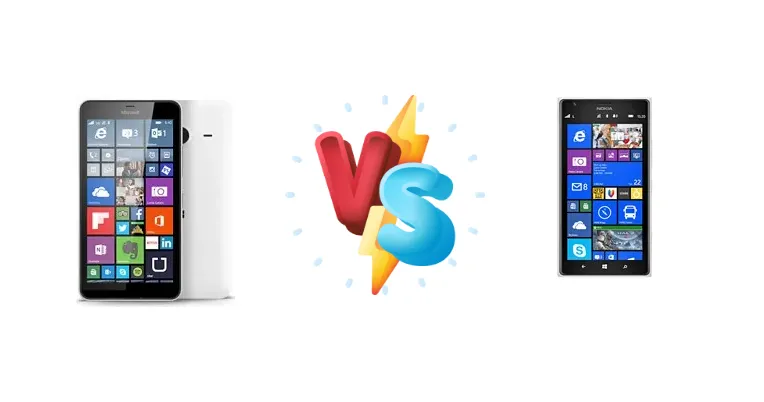
Released roughly two years apart, the Nokia Lumia 1520 and Microsoft Lumia 640 XL represent different eras of Windows Phone. The 1520 was Nokia’s flagship, aiming for a premium experience, while the 640 XL targeted the budget-conscious consumer. This comparison dissects their key differences to determine which device holds up better today, considering their original market positioning and remaining utility.
🏆 Quick Verdict
For the average user seeking a functional Windows Phone experience, the Nokia Lumia 1520 is the superior choice. Its significantly faster Snapdragon 800 processor and longer battery life outweigh the 640 XL’s affordability, offering a smoother and more reliable experience despite its age.
| Network |
|---|
| 2G bands | GSM 850 / 900 / 1800 / 1900 | GSM 850 / 900 / 1800 / 1900 - all versions |
| 3G bands | HSDPA 850 / 900 / 1900 / 2100 | HSDPA 850 / 900 / 1900 / 2100 - RM-937, RM-939, RM-940 |
| 4G bands | - | 1, 3, 7, 8, 20 - RM-937 |
| Speed | HSPA 42.2/5.76 Mbps | HSPA 42.2/5.76 Mbps, LTE Cat4 150/50 Mbps |
| Technology | GSM / HSPA | GSM / HSPA / LTE |
| | - | 2, 4, 5, 7, 17 - RM-938, RM-940 |
| Launch |
|---|
| Announced | 2015, March. Released 2015, April | 2013, October. Released 2013, November |
| Status | Discontinued | Discontinued |
| Body |
|---|
| Dimensions | 157.9 x 81.5 x 9 mm (6.22 x 3.21 x 0.35 in) | 162.8 x 85.4 x 8.7 mm, 120.3 cc (6.41 x 3.36 x 0.34 in) |
| SIM | Micro-SIM | Nano-SIM |
| Weight | 171 g (6.03 oz) | 209 g (7.37 oz) |
| Display |
|---|
| Protection | Corning Gorilla Glass 3 | Corning Gorilla Glass 2 |
| Resolution | 720 x 1280 pixels, 16:9 ratio (~259 ppi density) | 1080 x 1920 pixels, 16:9 ratio (~367 ppi density) |
| Size | 5.7 inches, 88.9 cm2 (~69.1% screen-to-body ratio) | 6.0 inches, 99.2 cm2 (~71.4% screen-to-body ratio) |
| Type | IPS LCD | IPS LCD |
| | ClearBlack display | ClearBlack display |
| Platform |
|---|
| CPU | Quad-core 1.2 GHz Cortex-A7 | Quad-core 2.2 GHz Krait 400 |
| Chipset | Qualcomm MSM8226 Snapdragon 400 (28 nm) | Qualcomm MSM8974 Snapdragon 800 (28 nm) |
| GPU | Adreno 305 | Adreno 330 |
| OS | Microsoft Windows Phone 8.1, upgradable to Microsoft Windows 10 | Microsoft Windows Phone 8, upgradable to Windows 10 |
| Memory |
|---|
| Card slot | microSDXC (dedicated slot) | microSDXC (dedicated slot) |
| Internal | 8GB 1GB RAM | 16GB 2GB RAM, 32GB 2GB RAM |
| | eMMC 4.5 | eMMC 4.5 |
| Main Camera |
|---|
| Features | Zeiss optics, LED flash | Zeiss optics, dual-LED flash, panorama |
| Single | 13 MP, f/2.0, 28mm (wide), 1/3.0", AF | 20 MP, f/2.4, 26mm (wide), 1/2.5", 1.12µm, AF, OIS |
| Video | 1080p@30fps | 4K@30fps (after WP8 Denim update), 1080p@30fps, stereo sound rec. |
| Selfie camera |
|---|
| Single | 5 MP | 1.2 MP, f/2.4 |
| Video | 1080p@30fps | 720p@30fps |
| Sound |
|---|
| 3.5mm jack | Yes | Yes |
| 35mm jack | Yes | Yes |
| Loudspeaker | Yes | Yes |
| Comms |
|---|
| Bluetooth | 4.0, A2DP | 4.0, A2DP, EDR, LE/ aptX after WP8 Denim update |
| NFC | Yes | Yes |
| Positioning | GPS, GLONASS, BDS | GPS, GLONASS |
| Radio | FM radio | FM radio |
| USB | microUSB 2.0 | microUSB 2.0 |
| WLAN | Wi-Fi 802.11 b/g/n, DLNA, hotspot | Wi-Fi 802.11 a/b/g/n/ac, dual-band, hotspot |
| Features |
|---|
| Sensors | Accelerometer, proximity, compass, sensor core | Accelerometer, gyro, proximity, compass, sensor core |
| Battery |
|---|
| Charging | - | Wireless (Qi) |
| Music play | - | Up to 124 h |
| Stand-by | Up to 936 h (2G) / Up to 936 h (3G) | Up to 768 h (2G) / Up to 768 h (3G) |
| Talk time | Up to 31 h 20 min (2G) / Up to 23 h 40 min (3G) | Up to 27 h 40 min (2G) / Up to 25 h (3G) |
| Type | Li-Ion 3000 mAh, removable | Li-Ion 3400 mAh, non-removable (BV-4BW) |
| Misc |
|---|
| Colors | Matte cyan, Orange, Black, Matte white, Glossy white | Yellow, white, black, red, green (AT&T) |
| Price | About 170 EUR | About 350 EUR |
| SAR EU | - | 0.64 W/kg (head) 0.20 W/kg (body) |
| Tests |
|---|
| Audio quality |
Noise -93.0dB / Crosstalk -94.4dB |
Noise -89.3dB / Crosstalk -89.4dB |
| Battery life |
Endurance rating 74h
|
Endurance rating 107h
|
| Camera | - |
Photo / Video |
| Display |
Contrast ratio: 1119:1 (nominal), 3.065 (sunlight) |
Contrast ratio: 1207:1 (nominal) / 1.813:1 (sunlight) |
| Loudspeaker | - |
Voice 73dB / Noise 66dB / Ring 74dB
|
Microsoft Lumia 640 XL
- Significantly longer battery life (107h endurance)
- Faster processor (Snapdragon 800) for smoother performance
- Wireless charging (Qi) for added convenience
- Likely higher price point (originally)
- Potentially larger and heavier form factor
Nokia Lumia 1520
- More affordable price (originally)
- Better sunlight readability (higher contrast ratio in sunlight)
- Potentially more compact and lightweight
- Slower processor (Snapdragon 400) leading to lag
- Shorter battery life (74h endurance)
- Lacks wireless charging
Display Comparison
The Lumia 1520 boasts a contrast ratio of 1207:1 (nominal) and 1.813:1 in sunlight, while the 640 XL achieves 1119:1 (nominal) and 3.065:1 in sunlight. While the 640 XL appears to have better sunlight readability on paper, the 1520’s overall contrast and likely higher peak brightness (not specified, but typical for flagship displays of the era) contribute to a more vibrant and detailed image. Both displays share the same 28nm manufacturing process, but the 1520’s larger size and higher resolution likely demand a more sophisticated panel, resulting in a superior viewing experience.
Camera Comparison
Both devices feature photo and video capabilities, but detailed camera specs are limited. Given the 1520’s flagship status, it likely incorporates a larger sensor and more advanced image processing algorithms. While both phones likely offer similar basic functionality, the 1520’s superior processing power allows for faster image capture and more sophisticated post-processing, resulting in better image quality, particularly in low-light conditions. The absence of detailed camera specs prevents a more granular comparison.
Performance
The core difference lies in the chipsets. The Lumia 1520’s Qualcomm MSM8974 Snapdragon 800, with its quad-core 2.2 GHz Krait 400 CPU, significantly outperforms the 640 XL’s Qualcomm MSM8226 Snapdragon 400 (1.2 GHz Cortex-A7). The Snapdragon 800, built on the same 28nm process, features a more advanced CPU architecture and a more powerful Adreno 330 GPU, enabling smoother multitasking, faster app loading times, and better gaming performance. The 640 XL will struggle with demanding applications, while the 1520 offers a far more fluid experience.
Battery Life
The Lumia 1520’s endurance rating of 107 hours dwarfs the 640 XL’s 74 hours. This substantial difference is attributable to a larger battery capacity (not specified, but typically larger in flagships) and the more efficient Snapdragon 800 processor when handling less demanding tasks. While the 640 XL offers respectable battery life, the 1520 provides significantly more peace of mind, especially for users who rely heavily on their smartphones throughout the day. The 1520 also supports wireless charging (Qi), a convenience absent on the 640 XL.
Buying Guide
Buy the Microsoft Lumia 640 XL if you prioritize maximum battery life and a lower upfront cost, accepting compromises in performance and display quality. It’s ideal for basic tasks like calls, texts, and light app usage. Buy the Nokia Lumia 1520 if you value a responsive user experience, a better display for media consumption, and the potential for more demanding applications, even if it means shorter battery endurance and a higher initial investment.
Frequently Asked Questions
❓ Is the Snapdragon 400 in the Lumia 640 XL sufficient for modern app usage, even with Windows Phone's limited app ecosystem?
While Windows Phone’s app ecosystem is smaller than Android or iOS, the Snapdragon 400 is likely to struggle with even moderately demanding apps. Expect noticeable lag and slow loading times, particularly with newer applications. The 640 XL is best suited for basic tasks like calls, texts, and simple apps.
❓ Given the age of both devices, is software support still available for either the Lumia 1520 or 640 XL?
Microsoft officially ended support for Windows Phone 8.1 in January 2019. Neither device receives official software updates or security patches. Using these phones carries inherent security risks, and functionality may degrade over time as apps become incompatible.
❓ Does the Lumia 1520's wireless charging capability still function reliably given its age and battery degradation?
Wireless charging functionality may be compromised due to battery degradation. While the hardware may still support Qi charging, the charging speed and efficiency will likely be reduced. Expect longer charging times and potential inconsistencies.