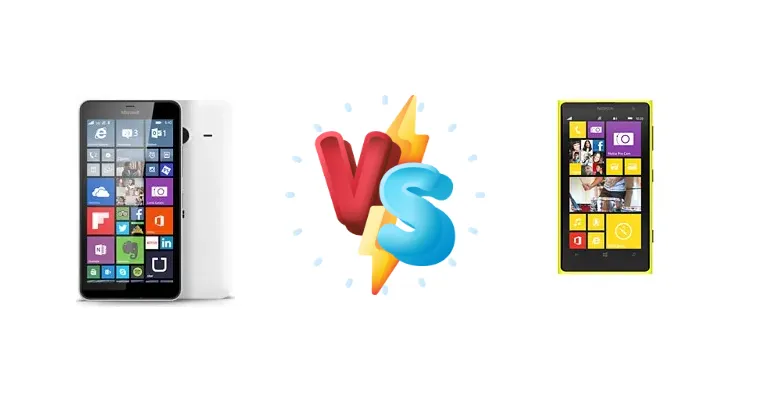
The Microsoft Lumia 640 XL and Nokia Lumia 1020 represent different eras and priorities within the Windows Phone ecosystem. The 640 XL aimed for affordability and endurance, while the 1020 was a photography-focused flagship. This comparison dissects their strengths and weaknesses to determine which device holds up better today.
🏆 Quick Verdict
For the average user seeking a functional and long-lasting Windows Phone experience, the Microsoft Lumia 640 XL is the better choice. Its significantly superior battery endurance (74h vs 61h) and more modern chipset outweigh the Lumia 1020’s camera advantages, which are hampered by its limited battery life.
| Network |
|---|
| 2G bands | GSM 850 / 900 / 1800 / 1900 | GSM 850 / 900 / 1800 / 1900 - all versions |
| 3G bands | HSDPA 850 / 900 / 1900 / 2100 | HSDPA 850 / 900 / 1900 / 2100 - RM-875, RM-877 |
| 4G bands | - | 1, 3, 7, 8, 20 - RM-875 |
| Speed | HSPA 42.2/5.76 Mbps | HSPA 42.2/5.76 Mbps, LTE Cat3 100/50 Mbps |
| Technology | GSM / HSPA | GSM / HSPA / LTE |
| | - | 2, 4, 5, 17 - RM-877 |
| Launch |
|---|
| Announced | 2015, March. Released 2015, April | 2013, July 11. Released 2013, July 22 |
| Status | Discontinued | Discontinued |
| Body |
|---|
| Build | - | Glass front (Gorilla Glass 3), plastic back, plastic frame |
| Dimensions | 157.9 x 81.5 x 9 mm (6.22 x 3.21 x 0.35 in) | 130.4 x 71.4 x 10.4 mm, 96.9 cc (5.13 x 2.81 x 0.41 in) |
| SIM | Micro-SIM | Micro-SIM |
| Weight | 171 g (6.03 oz) | 158 g (5.57 oz) |
| Display |
|---|
| Protection | Corning Gorilla Glass 3 | Corning Gorilla Glass 3 |
| Resolution | 720 x 1280 pixels, 16:9 ratio (~259 ppi density) | 768 x 1280 pixels, 5:3 ratio (~332 ppi density) |
| Size | 5.7 inches, 88.9 cm2 (~69.1% screen-to-body ratio) | 4.5 inches, 57.6 cm2 (~61.9% screen-to-body ratio) |
| Type | IPS LCD | AMOLED |
| | ClearBlack display | PureMotion HD+ ClearBlack display |
| Platform |
|---|
| CPU | Quad-core 1.2 GHz Cortex-A7 | Dual-core 1.5 GHz Krait |
| Chipset | Qualcomm MSM8226 Snapdragon 400 (28 nm) | Qualcomm MSM8960 Snapdragon S4 Plus |
| GPU | Adreno 305 | Adreno 225 |
| OS | Microsoft Windows Phone 8.1, upgradable to Microsoft Windows 10 | Microsoft Windows Phone 8, upgradable to 8.1 |
| Memory |
|---|
| Card slot | microSDXC (dedicated slot) | No |
| Internal | 8GB 1GB RAM | 32GB 2GB RAM, 64GB 2GB RAM (Telefonica exclusive) |
| | eMMC 4.5 | - |
| Main Camera |
|---|
| Features | Zeiss optics, LED flash | Carl Zeiss optics, Xenon & LED flash, panorama |
| Single | 13 MP, f/2.0, 28mm (wide), 1/3.0", AF | 41 MP, f/2.2, 26mm (wide), 1/1.5", 1.12µm, AF, OIS |
| Video | 1080p@30fps | 1080p@30fps, 4x lossless digital zoom |
| Selfie camera |
|---|
| Single | 5 MP | 1.2 MP |
| Video | 1080p@30fps | 720p@30fps |
| Sound |
|---|
| 3.5mm jack | Yes | Yes |
| 35mm jack | Yes | Yes |
| Loudspeaker | Yes | Yes |
| Comms |
|---|
| Bluetooth | 4.0, A2DP | 4.0, A2DP, EDR, LE/ aptX after WP8 Denim update |
| NFC | Yes | Yes |
| Positioning | GPS, GLONASS, BDS | GPS, GLONASS |
| Radio | FM radio | Stereo FM radio, RDS |
| USB | microUSB 2.0 | microUSB 2.0 |
| WLAN | Wi-Fi 802.11 b/g/n, DLNA, hotspot | Wi-Fi 802.11 a/b/g/n, dual-band, DLNA, hotspot |
| Features |
|---|
| Sensors | Accelerometer, proximity, compass, sensor core | Accelerometer, gyro, proximity, compass, barometer |
| Battery |
|---|
| Music play | - | Up to 63 h |
| Stand-by | Up to 936 h (2G) / Up to 936 h (3G) | Up to 384 h (3G) |
| Talk time | Up to 31 h 20 min (2G) / Up to 23 h 40 min (3G) | Up to 19 h (2G) / Up to 13 h 20 min (3G) |
| Type | Li-Ion 3000 mAh, removable | Li-Ion 2000 mAh, non-removable (BV-5XW) |
| Misc |
|---|
| Colors | Matte cyan, Orange, Black, Matte white, Glossy white | Yellow, white, black, red (AT&T exclusive) |
| Price | About 170 EUR | About 400 EUR |
| SAR | - | 1.23 W/kg (head) 0.97 W/kg (body) |
| SAR EU | - | 0.76 W/kg (head) 0.67 W/kg (body) |
| Tests |
|---|
| Audio quality |
Noise -93.0dB / Crosstalk -94.4dB | - |
| Battery life |
Endurance rating 74h
|
Endurance rating 61h
|
| Camera | - |
Photo / Video |
| Display |
Contrast ratio: 1119:1 (nominal), 3.065 (sunlight) |
Contrast ratio: Infinite (nominal), 2.103 (sunlight) |
| Loudspeaker | - |
Voice 69dB / Noise 66dB / Ring 72dB
|
Microsoft Lumia 640 XL
- Significantly longer battery life (74h endurance)
- More modern and efficient processor (Snapdragon 400)
- Better sunlight display contrast (3.065)
- Inferior camera compared to the Lumia 1020
- Likely lower build quality materials
Nokia Lumia 1020
- Exceptional camera with large sensor and OIS
- AMOLED display with potentially richer colors
- Premium build quality (typical of Nokia flagships)
- Significantly shorter battery life (61h endurance)
- Older and less efficient processor (Snapdragon S4 Plus)
- Lower sunlight display contrast (2.103)
Display Comparison
Both devices feature displays with contrasting characteristics. The Lumia 640 XL boasts a nominal contrast ratio of 1119:1, improving to 3.065 in sunlight, suggesting better outdoor visibility. The Lumia 1020, however, claims an 'Infinite' nominal contrast ratio, likely due to its AMOLED technology, but falls to 2.103 in direct sunlight. While the 'infinite' ratio is a marketing term, AMOLED generally offers richer colors and deeper blacks, but the 640 XL’s higher sunlight contrast is a practical advantage for outdoor use.
Camera Comparison
The Nokia Lumia 1020’s defining feature is its camera. While the context data doesn’t specify sensor size or megapixels, the 1020 is renowned for its 41-megapixel sensor and optical image stabilization (OIS). The Lumia 640 XL’s camera is not detailed, but given its market segment, it’s reasonable to assume a significantly smaller sensor and less sophisticated image processing. The 1020’s camera excels in detail capture and low-light performance, but the 640 XL may offer acceptable results in good lighting conditions. The 1020’s OIS is a significant advantage for stable video recording.
Performance
The Lumia 640 XL utilizes the Qualcomm MSM8226 Snapdragon 400 with a quad-core 1.2 GHz Cortex-A7 CPU, built on a 28nm process. The Lumia 1020 features the older Qualcomm MSM8960 Snapdragon S4 Plus, a dual-core 1.5 GHz Krait processor. Despite the lower clock speed, the 640 XL’s quad-core architecture and newer process node likely provide a smoother multitasking experience, especially considering the demands of Windows Phone. The S4 Plus, while capable, is showing its age and will struggle with modern app demands.
Battery Life
Battery life is a clear win for the Lumia 640 XL, achieving an endurance rating of 74 hours compared to the Lumia 1020’s 61 hours. This 13-hour difference translates to a substantial advantage in real-world usage, allowing the 640 XL to comfortably last a full day, even with moderate use. The 1020’s battery life is likely constrained by its more power-hungry processor and AMOLED display, despite having similar capacity.
Buying Guide
Buy the Microsoft Lumia 640 XL if you need a reliable, all-day battery life and a larger display for media consumption. It’s ideal for users who prioritize practicality and affordability. Buy the Nokia Lumia 1020 if you are a photography enthusiast specifically seeking the unique capabilities of its large-sensor camera, and are willing to accept the trade-off of shorter battery life and an older processor.
Frequently Asked Questions
❓ Is the Lumia 1020’s camera still relevant in 2024, considering modern smartphone cameras?
While the Lumia 1020’s camera was groundbreaking for its time, modern smartphone cameras have surpassed its capabilities in many areas, including dynamic range, low-light performance, and video recording. However, the 1020 still produces excellent images in good lighting conditions and offers unique creative control due to its large sensor.
❓ Will the Snapdragon 400 in the Lumia 640 XL struggle with modern Windows Phone apps?
The Snapdragon 400 is a relatively low-end processor, but it should be sufficient for basic Windows Phone functionality and less demanding apps. However, you may experience slowdowns or lag when running multiple apps simultaneously or using resource-intensive applications. The limited app ecosystem of Windows Phone mitigates this somewhat.
❓ Given the battery life difference, how much more screen-on time can I realistically expect from the Lumia 640 XL?
The 13-hour endurance rating difference translates to roughly 2-4 additional hours of screen-on time, depending on usage patterns. The Lumia 640 XL can realistically provide a full day of moderate use, while the Lumia 1020 may require a midday charge.