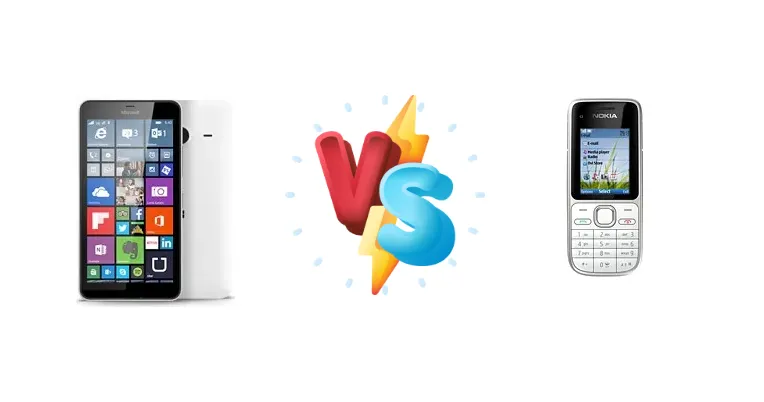
Comparing the Microsoft Lumia 640 XL and the Nokia C2-01 isn't about a direct competition; it's a snapshot of mobile evolution. Released roughly five years apart, these devices represent vastly different eras – the twilight of feature phones versus the rise of affordable smartphones. This comparison explores the technological gulf between them, revealing how far mobile computing has progressed in a short period.
🏆 Quick Verdict
For the vast majority of users today, the Microsoft Lumia 640 XL is the clear choice. Its Snapdragon 400 processor and larger display offer a significantly more versatile experience than the Nokia C2-01. While the C2-01 may appeal to those seeking extreme simplicity and longevity, the Lumia 640 XL provides smartphone functionality at a minimal cost.
| Network |
|---|
| 2G bands | GSM 850 / 900 / 1800 / 1900 | GSM 850 / 900 / 1800 / 1900 |
| 3G bands | HSDPA 850 / 900 / 1900 / 2100 | UMTS 850 / 1900 / 2100 |
| Speed | HSPA 42.2/5.76 Mbps | Yes, 384 kbps |
| Technology | GSM / HSPA | GSM / UMTS |
| | - | UMTS 900 / 2100 / 1900 |
| Launch |
|---|
| Announced | 2015, March. Released 2015, April | 2010, November. Released 2011, March |
| Status | Discontinued | Discontinued |
| Body |
|---|
| Dimensions | 157.9 x 81.5 x 9 mm (6.22 x 3.21 x 0.35 in) | 109.8 x 46.9 x 15.3 mm, 78.8 cc (4.32 x 1.85 x 0.60 in) |
| SIM | Micro-SIM | Mini-SIM |
| Weight | 171 g (6.03 oz) | 89 g (3.14 oz) |
| Display |
|---|
| Protection | Corning Gorilla Glass 3 | - |
| Resolution | 720 x 1280 pixels, 16:9 ratio (~259 ppi density) | 240 x 320 pixels, 4:3 ratio (~200 ppi density) |
| Size | 5.7 inches, 88.9 cm2 (~69.1% screen-to-body ratio) | 2.0 inches, 12.4 cm2 (~24.1% screen-to-body ratio) |
| Type | IPS LCD | TFT, 256K colors |
| | ClearBlack display | - |
| Platform |
|---|
| CPU | Quad-core 1.2 GHz Cortex-A7 | - |
| Chipset | Qualcomm MSM8226 Snapdragon 400 (28 nm) | - |
| GPU | Adreno 305 | - |
| OS | Microsoft Windows Phone 8.1, upgradable to Microsoft Windows 10 | - |
| Memory |
|---|
| Call records | - | Yes |
| Card slot | microSDXC (dedicated slot) | microSDHC (dedicated slot) |
| Internal | 8GB 1GB RAM | 43MB 64MB RAM 128MB ROM |
| Phonebook | - | 2000 entries, Photocall |
| | eMMC 4.5 | - |
| Main Camera |
|---|
| Features | Zeiss optics, LED flash | - |
| Single | 13 MP, f/2.0, 28mm (wide), 1/3.0", AF | 3.15 MP |
| Video | 1080p@30fps | 320p@15fps |
| Selfie camera |
|---|
| Single | 5 MP | - |
| Video | 1080p@30fps | - |
| | - | No |
| Sound |
|---|
| 3.5mm jack | Yes | Yes |
| 35mm jack | Yes | Yes |
| Loudspeaker | Yes | Yes |
| Comms |
|---|
| Bluetooth | 4.0, A2DP | 2.1, A2DP, EDR |
| NFC | Yes | - |
| Positioning | GPS, GLONASS, BDS | No |
| Radio | FM radio | Stereo FM radio, RDS |
| USB | microUSB 2.0 | microUSB 2.0 |
| WLAN | Wi-Fi 802.11 b/g/n, DLNA, hotspot | No |
| Features |
|---|
| Browser | - | WAP 2.0/xHTML, HTML, Adobe Flash Lite |
| Games | - | Yes |
| Java | - | Yes, MIDP 2.1 |
| Messaging | - | SMS, MMS, Email |
| Sensors | Accelerometer, proximity, compass, sensor core | - |
| | - | MP4/H.264 player
MP3/WAV/WMA/eAAC+ player
Organizer
Voice memo/dial/commands
Predictive text input |
| Battery |
|---|
| Music play | - | Up to 34 h |
| Stand-by | Up to 936 h (2G) / Up to 936 h (3G) | Up to 396 h (2G) / Up to 456 h (3G) |
| Talk time | Up to 31 h 20 min (2G) / Up to 23 h 40 min (3G) | Up to 8 h 40 min (2G) / Up to 4 h 30 min (3G) |
| Type | Li-Ion 3000 mAh, removable | Removable Li-Ion 1020 mAh battery (BL-5C) |
| Misc |
|---|
| Colors | Matte cyan, Orange, Black, Matte white, Glossy white | Black, Warm silver, White |
| Price | About 170 EUR | About 70 EUR |
| SAR | - | 1.33 W/kg (head) 0.83 W/kg (body) |
| SAR EU | - | 1.20 W/kg (head) |
| Tests |
|---|
| Audio quality |
Noise -93.0dB / Crosstalk -94.4dB |
Noise -87.3dB / Crosstalk -88.8dB |
| Battery life |
Endurance rating 74h
| - |
| Camera | - |
Photo |
| Display |
Contrast ratio: 1119:1 (nominal), 3.065 (sunlight) | - |
| Loudspeaker | - |
Voice 72dB / Noise 66dB / Ring 79dB |
Microsoft Lumia 640 XL
- Smartphone functionality (apps, internet)
- Superior display contrast and visibility
- More powerful processor for multitasking
- Battery life is shorter than the C2-01
- Older hardware, limited software support
Nokia C2-01
- Exceptional battery life (days or weeks)
- Simple and durable design
- Extremely affordable
- Limited functionality (calls and texts only)
- Basic display quality
- No app support or internet browsing
Display Comparison
The Lumia 640 XL boasts a significantly more advanced display. While specific resolution data is missing, the reported contrast ratios – 1119:1 nominal and 3.065 in sunlight – demonstrate a far superior viewing experience compared to the C2-01’s likely basic LCD. The higher sunlight contrast ratio on the Lumia 640 XL suggests better outdoor visibility, a crucial benefit for users who spend time outside. The C2-01’s display, typical of feature phones, prioritizes power efficiency over image quality.
Camera Comparison
The Nokia C2-01’s camera is listed simply as “Photo,” indicating a basic image capture capability likely with a low-resolution sensor. The Lumia 640 XL, while not a photography powerhouse, offers a more capable camera experience, though specific details are missing. The presence of a camera at all in the Lumia 640 XL opens up possibilities for sharing photos and videos, a feature unavailable on the C2-01. The Lumia 640 XL’s camera, even with limited specs, represents a shift towards mobile photography.
Performance
The Qualcomm MSM8226 Snapdragon 400 in the Lumia 640 XL represents a monumental leap in processing power. Its quad-core 1.2 GHz Cortex-A7 CPU allows for multitasking, app usage, and basic gaming, capabilities entirely absent in the Nokia C2-01. The C2-01 likely utilizes a single-core processor designed solely for call handling and basic menu navigation. The 28nm manufacturing process of the Snapdragon 400, while not cutting-edge today, was a significant improvement in power efficiency at the time of its release, enabling a more responsive user experience.
Battery Life
The Lumia 640 XL achieves an endurance rating of 74 hours, a respectable figure for a smartphone of its era. This suggests a balance between battery capacity and power consumption. The Nokia C2-01, being a feature phone, likely offers significantly longer standby times due to its minimal power requirements. However, the Lumia 640 XL’s battery life is sufficient for a full day of moderate use, while the C2-01’s advantage lies in its ability to last for days or even weeks on a single charge, appealing to users who prioritize longevity over features.
Buying Guide
Buy the Microsoft Lumia 640 XL if you need access to apps, internet browsing, and basic smartphone features like email and social media. It’s ideal for users transitioning from older phones or seeking a secondary device for specific tasks. Buy the Nokia C2-01 if you prioritize extreme battery life, a durable build, and a simple, distraction-free communication experience – essentially, a phone for calls and texts, and nothing more.
Frequently Asked Questions
❓ Is the Lumia 640 XL still usable in 2024, considering its age?
While the Lumia 640 XL is an older device, it can still perform basic smartphone tasks like calls, texts, and web browsing. However, app compatibility may be limited due to the aging Windows Phone operating system. It's best suited for users with very basic needs or as a backup device.
❓ What kind of apps can I expect to run on the Lumia 640 XL?
The Lumia 640 XL runs Windows Phone 8.1, which has a limited app ecosystem compared to Android or iOS. While essential apps like Facebook, WhatsApp, and Microsoft Office are available, many newer apps may not be compatible. The app selection is a significant drawback compared to modern smartphones.
❓ Could the Nokia C2-01 be a good emergency phone?
Absolutely. The Nokia C2-01's exceptional battery life and simple operation make it an ideal emergency phone. It can remain functional for extended periods without needing a charge, providing a reliable communication option in situations where power is unavailable.