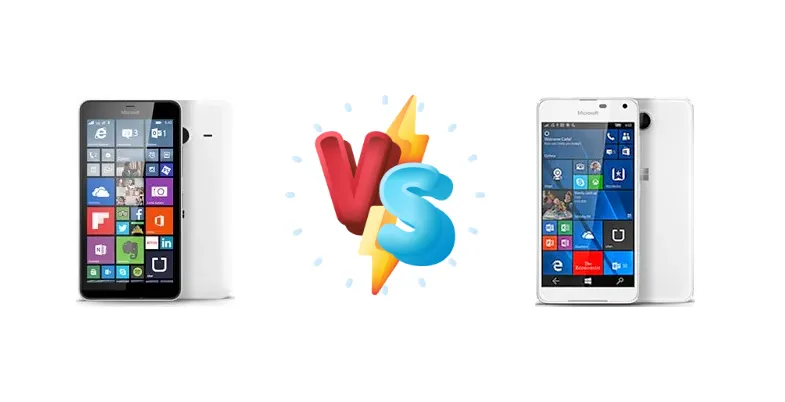
The Microsoft Lumia 640 XL and 650 represent two distinct approaches within Microsoft’s budget Windows Phone lineup. The 640 XL prioritized extended battery life and a larger screen, while the 650 aimed for a more refined design and slightly improved display clarity. This comparison dissects the key differences to determine which device offers the best value in today’s market.
🏆 Quick Verdict
For the average user prioritizing longevity, the Microsoft Lumia 640 XL is the clear winner. Its significantly superior 74-hour endurance rating outweighs the 650’s marginally better display contrast and newer chipset, especially considering the similar processing power. However, the 650’s design may appeal to those seeking a more modern aesthetic.
| Network |
|---|
| 2G bands | GSM 850 / 900 / 1800 / 1900 | GSM 850 / 900 / 1800 / 1900 - SIM 1 & SIM 2 (dual-SIM model only) |
| 3G bands | HSDPA 850 / 900 / 1900 / 2100 | HSDPA 850 / 900 / 2100 |
| 4G bands | - | 1, 3, 7, 8, 20 |
| Speed | HSPA 42.2/5.76 Mbps | HSPA 42.2/5.76 Mbps, LTE Cat4 150/50 Mbps |
| Technology | GSM / HSPA | GSM / HSPA / LTE |
| Launch |
|---|
| Announced | 2015, March. Released 2015, April | 2016, February. Released 2016, February |
| Status | Discontinued | Discontinued |
| Body |
|---|
| Build | - | Glass front (Gorilla Glass 3), plastic back, aluminum frame |
| Dimensions | 157.9 x 81.5 x 9 mm (6.22 x 3.21 x 0.35 in) | 142 x 70.9 x 6.9 mm (5.59 x 2.79 x 0.27 in) |
| SIM | Micro-SIM | · Nano-SIM· Nano-SIM + Nano-SIM |
| Weight | 171 g (6.03 oz) | 122 g (4.30 oz) |
| Display |
|---|
| Protection | Corning Gorilla Glass 3 | Corning Gorilla Glass 3 |
| Resolution | 720 x 1280 pixels, 16:9 ratio (~259 ppi density) | 720 x 1280 pixels, 16:9 ratio (~297 ppi density) |
| Size | 5.7 inches, 88.9 cm2 (~69.1% screen-to-body ratio) | 5.0 inches, 67.5 cm2 (~67.1% screen-to-body ratio) |
| Type | IPS LCD | OLED |
| | ClearBlack display | ClearBlack display |
| Platform |
|---|
| CPU | Quad-core 1.2 GHz Cortex-A7 | Quad-core 1.3 GHz Cortex-A7 |
| Chipset | Qualcomm MSM8226 Snapdragon 400 (28 nm) | Qualcomm MSM8909v2 Snapdragon 212 (28 nm) |
| GPU | Adreno 305 | Adreno 304 |
| OS | Microsoft Windows Phone 8.1, upgradable to Microsoft Windows 10 | Microsoft Windows 10 |
| Memory |
|---|
| Card slot | microSDXC (dedicated slot) | microSDXC (dedicated slot) |
| Internal | 8GB 1GB RAM | 16GB 1GB RAM |
| | eMMC 4.5 | eMMC 4.5 |
| Main Camera |
|---|
| Features | Zeiss optics, LED flash | LED flash |
| Single | 13 MP, f/2.0, 28mm (wide), 1/3.0", AF | 8 MP, f/2.2, 28mm (wide), 1/4.0", AF |
| Video | 1080p@30fps | 720p@30fps |
| Selfie camera |
|---|
| Single | 5 MP | 5 MP, f/2.2 |
| Video | 1080p@30fps | 720p |
| Sound |
|---|
| 3.5mm jack | Yes | Yes |
| 35mm jack | Yes | Yes |
| Loudspeaker | Yes | Yes |
| Comms |
|---|
| Bluetooth | 4.0, A2DP | 4.1, A2DP, LE |
| NFC | Yes | Yes |
| Positioning | GPS, GLONASS, BDS | GPS, GLONASS, BDS |
| Radio | FM radio | FM radio |
| USB | microUSB 2.0 | microUSB 2.0 |
| WLAN | Wi-Fi 802.11 b/g/n, DLNA, hotspot | Wi-Fi 802.11 b/g/n, DLNA, hotspot |
| Features |
|---|
| Sensors | Accelerometer, proximity, compass, sensor core | Accelerometer, proximity |
| Battery |
|---|
| Stand-by | Up to 936 h (2G) / Up to 936 h (3G) | Up to 624 h (3G) |
| Talk time | Up to 31 h 20 min (2G) / Up to 23 h 40 min (3G) | Up to 16 h (2G) / Up to 13 h (3G) |
| Type | Li-Ion 3000 mAh, removable | Li-Ion 2000 mAh, removable |
| Misc |
|---|
| Colors | Matte cyan, Orange, Black, Matte white, Glossy white | Black, White |
| Price | About 170 EUR | About 150 EUR |
| Tests |
|---|
| Audio quality |
Noise -93.0dB / Crosstalk -94.4dB | - |
| Battery life |
Endurance rating 74h
|
Endurance rating 55h
|
| Camera | - |
Photo |
| Display |
Contrast ratio: 1119:1 (nominal), 3.065 (sunlight) |
Contrast ratio: Infinite (nominal), 3.77(sunlight) |
Microsoft Lumia 640 XL
- Exceptional battery life (74h endurance)
- Larger display for better media consumption
- More affordable price point (typically)
- Lower display contrast ratio (1119:1)
- Older Snapdragon 400 chipset
Microsoft Lumia 650
- More modern and compact design
- Higher display contrast ratio ('Infinite')
- Slightly more efficient Snapdragon 212 chipset
- Significantly shorter battery life (55h endurance)
- Smaller display size
- Potentially higher price
Display Comparison
The Lumia 650 boasts an 'Infinite' contrast ratio (nominal), translating to a theoretically perfect black level, compared to the 640 XL’s 1119:1. However, both phones achieve a sunlight contrast ratio of around 3.77, indicating similar real-world visibility under bright conditions. The 640 XL’s larger screen size is a significant advantage for media viewing, while the 650’s potentially better black levels contribute to a more vibrant image, though the difference is likely subtle. Neither device specifies panel technology, but given the price point, both likely utilize IPS LCDs.
Camera Comparison
Both phones are listed with a 'Photo' camera feature, but lack specific details regarding sensor size, aperture, or image stabilization. This suggests both cameras are likely entry-level and perform similarly in good lighting conditions. Without further information, it’s difficult to assess the quality of either camera beyond basic point-and-shoot functionality. The absence of details suggests neither phone is a strong contender for photography enthusiasts.
Performance
Both devices utilize Qualcomm Snapdragon processors built on a 28nm process, but differ in their specific models. The 640 XL features the MSM8226 Snapdragon 400 with a 1.2 GHz quad-core Cortex-A7 CPU, while the 650 has the MSM8909v2 Snapdragon 212 running at 1.3 GHz. The slight CPU clock speed increase in the 650 doesn’t translate to a noticeable performance gain given the similar architecture. Both phones are adequate for basic tasks like calling, texting, and light app usage, but will struggle with demanding games or multitasking. The Snapdragon 212 in the 650 is a slightly more efficient chip, but this benefit is overshadowed by the 640 XL’s larger battery.
Battery Life
The most significant difference lies in battery endurance. The Lumia 640 XL achieves an impressive 74-hour endurance rating, while the 650 manages only 55 hours. This 19-hour difference is substantial and translates to a full day of extra usage for the 640 XL. While the 650’s Snapdragon 212 is more power-efficient, the 640 XL’s larger battery capacity more than compensates for the slightly less efficient processor. Neither phone specifies charging wattage, suggesting slow charging speeds are typical for this class of device.
Buying Guide
Buy the Microsoft Lumia 640 XL if you need a phone that can reliably last through two full days of moderate use, and a larger display for media consumption is a priority. Buy the Microsoft Lumia 650 if you prefer a more compact and aesthetically pleasing design, and are willing to sacrifice battery life for a slightly improved viewing experience in direct sunlight.
Frequently Asked Questions
❓ Is the Snapdragon 212 in the Lumia 650 noticeably faster than the Snapdragon 400 in the 640 XL for everyday tasks?
While the Snapdragon 212 has a slightly higher clock speed, the architectural similarities between the two chips mean the performance difference is minimal in real-world usage. Both phones will handle basic tasks like calling, texting, and browsing adequately, but neither is suited for demanding applications.
❓ Given the battery life difference, how much longer can I realistically expect the Lumia 640 XL to last on a single charge compared to the 650?
The 19-hour endurance difference translates to roughly a full day of additional usage for the Lumia 640 XL. Users can expect to get at least one extra day of moderate use out of the 640 XL before needing to recharge, making it ideal for travel or situations where access to power is limited.
❓ Does the 'Infinite' contrast ratio on the Lumia 650’s display actually make a significant difference in viewing experience?
The 'Infinite' contrast ratio is a nominal value and doesn't necessarily translate to a dramatically better viewing experience. While it suggests deeper blacks, both phones have similar sunlight contrast ratios, indicating comparable visibility outdoors. The difference will be most noticeable in dark rooms, but may still be subtle.