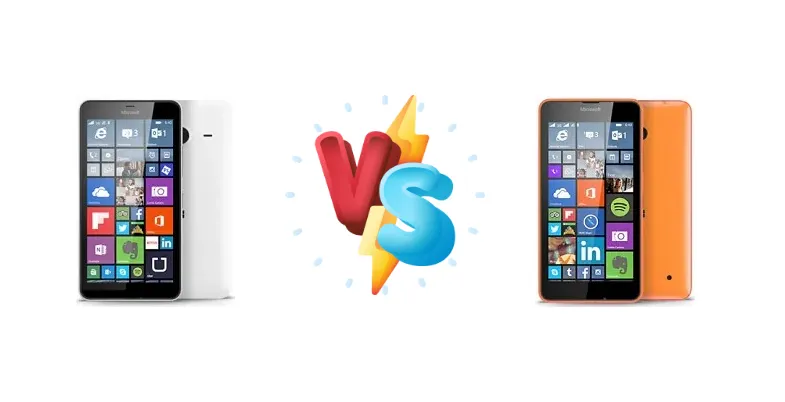
Released around the same time, the Microsoft Lumia 640 XL and 640 Dual SIM represent Microsoft’s attempt to capture the budget smartphone market. While sharing a similar core experience, subtle differences in display clarity and battery endurance separate these two devices. This comparison dives deep into those nuances to help you determine which Lumia best suits your needs.
🏆 Quick Verdict
For most users, the Microsoft Lumia 640 Dual SIM offers a slightly better overall experience. Its marginally superior battery life (76 hours vs 74) and improved display contrast in sunlight (2.563 vs 3.065) provide a more consistently usable experience, despite the XL's larger screen.
| Network |
|---|
| 2G bands | GSM 850 / 900 / 1800 / 1900 | GSM 850 / 900 / 1800 / 1900 - SIM 1 & SIM 2 |
| 3G bands | HSDPA 850 / 900 / 1900 / 2100 | HSDPA 850 / 900 / 1900 / 2100 |
| Speed | HSPA 42.2/5.76 Mbps | HSPA 42.2/5.76 Mbps |
| Technology | GSM / HSPA | GSM / HSPA |
| Launch |
|---|
| Announced | 2015, March. Released 2015, April | 2015, March. Released 2015, April |
| Status | Discontinued | Discontinued |
| Body |
|---|
| Dimensions | 157.9 x 81.5 x 9 mm (6.22 x 3.21 x 0.35 in) | 141.3 x 72.2 x 8.8 mm (5.56 x 2.84 x 0.35 in) |
| SIM | Micro-SIM | Dual SIM (Micro-SIM, dual stand-by) |
| Weight | 171 g (6.03 oz) | 145 g (5.11 oz) |
| Display |
|---|
| Protection | Corning Gorilla Glass 3 | Corning Gorilla Glass 3 |
| Resolution | 720 x 1280 pixels, 16:9 ratio (~259 ppi density) | 720 x 1280 pixels, 16:9 ratio (~294 ppi density) |
| Size | 5.7 inches, 88.9 cm2 (~69.1% screen-to-body ratio) | 5.0 inches, 68.9 cm2 (~67.6% screen-to-body ratio) |
| Type | IPS LCD | IPS LCD |
| | ClearBlack display | ClearBlack display |
| Platform |
|---|
| CPU | Quad-core 1.2 GHz Cortex-A7 | Quad-core 1.2 GHz Cortex-A7 |
| Chipset | Qualcomm MSM8226 Snapdragon 400 (28 nm) | Qualcomm MSM8926 Snapdragon 400 (28 nm) |
| GPU | Adreno 305 | Adreno 305 |
| OS | Microsoft Windows Phone 8.1, upgradable to Microsoft Windows 10 | Microsoft Windows Phone 8.1, upgradable to Microsoft Windows 10 |
| Memory |
|---|
| Card slot | microSDXC (dedicated slot) | microSDXC (dedicated slot) |
| Internal | 8GB 1GB RAM | 8GB 1GB RAM |
| | eMMC 4.5 | eMMC 4.5 |
| Main Camera |
|---|
| Features | Zeiss optics, LED flash | LED flash |
| Single | 13 MP, f/2.0, 28mm (wide), 1/3.0", AF | 8 MP, f/2.2, 28mm (wide), 1/4.0", AF |
| Video | 1080p@30fps | 1080p@30fps |
| Selfie camera |
|---|
| Single | 5 MP | 1 MP |
| Video | 1080p@30fps | 720p |
| Sound |
|---|
| 3.5mm jack | Yes | Yes |
| 35mm jack | Yes | Yes |
| Loudspeaker | Yes | Yes |
| Comms |
|---|
| Bluetooth | 4.0, A2DP | 4.0, A2DP |
| NFC | Yes | No |
| Positioning | GPS, GLONASS, BDS | GPS, GLONASS, BDS |
| Radio | FM radio | FM radio |
| USB | microUSB 2.0 | microUSB 2.0 |
| WLAN | Wi-Fi 802.11 b/g/n, DLNA, hotspot | Wi-Fi 802.11 b/g/n, DLNA, hotspot |
| Features |
|---|
| Sensors | Accelerometer, proximity, compass, sensor core | Accelerometer, proximity, compass |
| Battery |
|---|
| Stand-by | Up to 936 h (2G) / Up to 936 h (3G) | Up to 840 h (2G) / Up to 840 h (3G) |
| Talk time | Up to 31 h 20 min (2G) / Up to 23 h 40 min (3G) | Up to 27 h 30 min (2G) / Up to 20 h 30 min (3G) |
| Type | Li-Ion 3000 mAh, removable | Li-Ion 2500 mAh, removable |
| Misc |
|---|
| Colors | Matte cyan, Orange, Black, Matte white, Glossy white | Glossy cyan, Orange, White, Matte black |
| Price | About 170 EUR | About 170 EUR |
| Tests |
|---|
| Audio quality |
Noise -93.0dB / Crosstalk -94.4dB |
Noise -93.1dB / Crosstalk -93.2dB |
| Battery life |
Endurance rating 74h
|
Endurance rating 76h
|
| Display |
Contrast ratio: 1119:1 (nominal), 3.065 (sunlight) |
Contrast ratio: 1034 (nominal), 2.563 (sunlight) |
| Loudspeaker | - |
Voice 70dB / Noise 65dB / Ring 75dB
|
Microsoft Lumia 640 XL
- Larger display for enhanced media consumption
- Slightly better nominal contrast ratio for indoor viewing
- More screen real estate for multitasking
- Slightly lower battery endurance
- Lower sunlight contrast ratio
- Lower pixel density due to larger screen size
Microsoft Lumia 640 Dual SIM
- Dual SIM support for added convenience
- Better sunlight contrast ratio for outdoor visibility
- Slightly longer battery life
- Smaller display size
- Lower nominal contrast ratio
- Less screen space for multitasking
Display Comparison
Both the Lumia 640 XL and 640 Dual SIM utilize similar display technology, but key differences emerge when examining contrast ratios. The 640 XL boasts a nominal contrast ratio of 1119:1, improving to 3.065:1 in direct sunlight. Conversely, the 640 Dual SIM achieves 1034:1 nominal contrast, dropping to 2.563:1 in sunlight. This means the 640 XL offers deeper blacks and more vibrant colors indoors, but the 640 Dual SIM maintains better visibility under bright outdoor conditions. While both share the same resolution, the XL’s larger screen size results in a lower pixel density, potentially impacting sharpness.
Camera Comparison
Unfortunately, detailed camera specifications are unavailable for either device. Given their market segment, it’s reasonable to assume both feature similar camera setups, likely with a primary sensor around 8MP. Image quality will likely be adequate for casual snapshots but shouldn’t be expected to compete with higher-end smartphones. The absence of optical image stabilization (OIS) suggests that low-light performance will be limited on both models.
Performance
Both devices are powered by the Qualcomm MSM8226 Snapdragon 400 (28nm) chipset, featuring a quad-core 1.2 GHz Cortex-A7 CPU. This indicates virtually identical performance in day-to-day tasks like app launching and web browsing. The 28nm manufacturing process, while older, is adequate for the intended use case of these phones. There's no significant difference in GPU performance either, meaning gaming experiences will be comparable. Thermal management is unlikely to be a concern given the low-power nature of the chipset.
Battery Life
The Lumia 640 Dual SIM edges out the 640 XL in battery endurance, achieving a rating of 76 hours compared to the XL’s 74 hours. This difference, while seemingly small, can translate to a noticeable improvement in real-world usage, particularly for users who heavily rely on their smartphones throughout the day. The 28nm Snapdragon 400 chipset contributes to relatively efficient power consumption on both devices. Charging speeds are likely similar, given the lack of fast charging support on either model.
Buying Guide
Buy the Microsoft Lumia 640 XL if you prioritize a larger display for media consumption and don't mind a slightly shorter battery life. It's ideal for users who frequently watch videos or browse the web. Buy the Microsoft Lumia 640 Dual SIM if you need the flexibility of dual SIM support and value a slightly brighter, more visible screen outdoors, alongside a bit more endurance between charges. This is the better choice for travelers or those managing multiple phone numbers.
Frequently Asked Questions
❓ Will the Snapdragon 400 struggle with modern apps on either the Lumia 640 XL or 640 Dual SIM?
While the Snapdragon 400 is an older chipset, it's sufficient for basic smartphone tasks like calling, texting, web browsing, and social media. However, demanding apps or graphically intensive games may experience slowdowns or require reduced settings. Both phones were designed for a lighter app ecosystem, so performance will be acceptable for their intended use.
❓ Is the dual SIM functionality on the Lumia 640 Dual SIM truly useful, or is it a niche feature?
The dual SIM functionality is highly valuable for travelers who want to use a local SIM card alongside their primary number, or for individuals who need to separate work and personal calls. It eliminates the need to swap SIM cards frequently, offering significant convenience. It's not a niche feature for those who benefit from this flexibility.
❓ Given the age of these devices, should I be concerned about software updates or security patches?
Both the Lumia 640 XL and 640 Dual SIM are no longer officially supported by Microsoft with software updates. This means they may be vulnerable to security threats. Using these devices requires caution regarding app downloads and website visits, and it's advisable to avoid storing sensitive information on them.