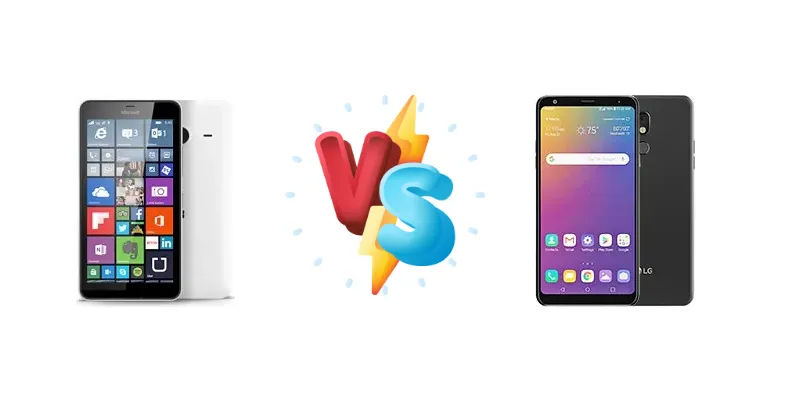
The Microsoft Lumia 640 XL and the LG Stylo 5 represent different eras of the budget smartphone landscape. The Lumia, running Windows Phone, is an older device now largely relegated to legacy use, while the Stylo 5 offers a current Android experience. This comparison examines whether the newer hardware of the Stylo 5 can overcome the Lumia’s established endurance and contrast.
🏆 Quick Verdict
For the average user in 2024, the LG Stylo 5 is the better choice. While the Lumia 640 XL boasts impressive battery endurance for its age, the Stylo 5’s more efficient Snapdragon 450 chipset, faster charging, and modern software support outweigh the Lumia’s strengths. The Lumia is only relevant for those specifically needing Windows Phone.
| Network |
|---|
| 2G bands | GSM 850 / 900 / 1800 / 1900 | GSM 850 / 900 / 1800 / 1900 |
| 3G bands | HSDPA 850 / 900 / 1900 / 2100 | HSDPA 850 / 1700(AWS) / 1900 |
| 4G bands | - | 2, 4, 5, 12, 14, 29, 30, 66 |
| Speed | HSPA 42.2/5.76 Mbps | HSPA, LTE |
| Technology | GSM / HSPA | GSM / HSPA / LTE |
| Launch |
|---|
| Announced | 2015, March. Released 2015, April | 2019, June. Released 2019, June |
| Status | Discontinued | Discontinued |
| Body |
|---|
| Build | - | Glass front (Gorilla Glass 5), aluminum back, aluminum frame |
| Dimensions | 157.9 x 81.5 x 9 mm (6.22 x 3.21 x 0.35 in) | 160 x 77.7 x 8.4 mm (6.30 x 3.06 x 0.33 in) |
| SIM | Micro-SIM | Nano-SIM |
| Weight | 171 g (6.03 oz) | 179 g (6.31 oz) |
| | - | Stylus |
| Display |
|---|
| Protection | Corning Gorilla Glass 3 | Corning Gorilla Glass 5 |
| Resolution | 720 x 1280 pixels, 16:9 ratio (~259 ppi density) | 1080 x 2160 pixels, 18:9 ratio (~390 ppi density) |
| Size | 5.7 inches, 88.9 cm2 (~69.1% screen-to-body ratio) | 6.2 inches, 99.2 cm2 (~79.8% screen-to-body ratio) |
| Type | IPS LCD | IPS LCD |
| | ClearBlack display | - |
| Platform |
|---|
| CPU | Quad-core 1.2 GHz Cortex-A7 | Octa-core 1.8 GHz Cortex-A53 |
| Chipset | Qualcomm MSM8226 Snapdragon 400 (28 nm) | Qualcomm SDM450 Snapdragon 450 (14 nm) |
| GPU | Adreno 305 | Adreno 506 |
| OS | Microsoft Windows Phone 8.1, upgradable to Microsoft Windows 10 | Android 9.0 (Pie) |
| Memory |
|---|
| Card slot | microSDXC (dedicated slot) | microSDXC (dedicated slot) |
| Internal | 8GB 1GB RAM | 32GB 3GB RAM |
| | eMMC 4.5 | eMMC 5.1 |
| Main Camera |
|---|
| Features | Zeiss optics, LED flash | LED flash, panorama, HDR |
| Single | 13 MP, f/2.0, 28mm (wide), 1/3.0", AF | 13 MP, PDAF |
| Video | 1080p@30fps | 1080p@30fps |
| Selfie camera |
|---|
| Dual | - | 16 MP, f/2.0, 26mm (wide), 1/3.06", 1.0µm
8 MP |
| Single | 5 MP | 5 MP |
| Video | 1080p@30fps | 1080p@30fps |
| Sound |
|---|
| 3.5mm jack | Yes | Yes |
| 35mm jack | Yes | Yes |
| Loudspeaker | Yes | Yes |
| Comms |
|---|
| Bluetooth | 4.0, A2DP | 4.2, A2DP, LE |
| NFC | Yes | No |
| Positioning | GPS, GLONASS, BDS | GPS |
| Radio | FM radio | No |
| USB | microUSB 2.0 | USB Type-C 2.0 |
| WLAN | Wi-Fi 802.11 b/g/n, DLNA, hotspot | Wi-Fi 802.11 a/b/g/n/ac, dual-band, Wi-Fi Direct |
| Features |
|---|
| Sensors | Accelerometer, proximity, compass, sensor core | Fingerprint (rear-mounted), accelerometer, proximity |
| Battery |
|---|
| Charging | - | 20W wired |
| Stand-by | Up to 936 h (2G) / Up to 936 h (3G) | - |
| Talk time | Up to 31 h 20 min (2G) / Up to 23 h 40 min (3G) | - |
| Type | Li-Ion 3000 mAh, removable | Li-Ion 3500 mAh, non-removable |
| Misc |
|---|
| Colors | Matte cyan, Orange, Black, Matte white, Glossy white | Blonde Rose, Platinum Gray |
| Models | - | LM-Q720 |
| Price | About 170 EUR | About 200 EUR |
| Tests |
|---|
| Audio quality |
Noise -93.0dB / Crosstalk -94.4dB |
Noise-93.5dB / Crosstalk -92.0dB |
| Battery life |
Endurance rating 74h
|
Endurance rating 79h
|
| Camera | - |
Photo / Video |
| Display |
Contrast ratio: 1119:1 (nominal), 3.065 (sunlight) |
Contrast ratio: 1485 (nominal), 3.218 (sunlight) |
| Loudspeaker | - |
Voice 62dB / Noise 69dB / Ring 70dB
|
| Performance | - |
GeekBench: 4695 (v4.4)
GFXBench: 6fps (ES 3.1 onscreen) |
Microsoft Lumia 640 XL
- Excellent battery endurance (74h)
- High contrast ratio for outdoor visibility
- Large display size
- Outdated Windows Phone OS
- Slow Snapdragon 400 processor
- Limited app availability
LG Stylo 5
- Modern Android operating system
- Faster Snapdragon 450 processor
- 20W fast charging support
- Slightly better display contrast
- Battery life only marginally better than Lumia
- Camera quality likely average for its price point
- Build quality may feel less premium
Display Comparison
Both devices offer large displays suitable for media consumption, but differ significantly in contrast. The Lumia 640 XL achieves a nominal contrast ratio of 1119:1, improving to 3.065:1 in sunlight, suggesting good outdoor visibility. The LG Stylo 5, however, surpasses this with a nominal contrast of 1485:1 and a sunlight contrast of 3.218:1, indicating a slightly more vibrant and readable experience in bright conditions. While neither display is expected to have high color accuracy, the Stylo 5’s higher contrast provides a more visually appealing image.
Camera Comparison
Context data for the cameras is limited. However, given the market positioning of both devices, it’s safe to assume neither boasts a flagship-level camera system. The LG Stylo 5 likely benefits from more advanced image processing capabilities inherent in its newer chipset. While both likely feature basic photo and video functionality, the Stylo 5’s newer sensor and software are expected to produce more detailed and accurate images, especially in challenging lighting conditions. We can assume the Lumia's camera is significantly dated.
Performance
The performance gap between these devices is substantial. The Lumia 640 XL’s Qualcomm MSM8226 Snapdragon 400, with its quad-core 1.2 GHz Cortex-A7 CPU, is significantly outmatched by the LG Stylo 5’s Qualcomm SDM450 Snapdragon 450. The Stylo 5’s octa-core 1.8 GHz Cortex-A53 CPU, built on a more efficient 14nm process compared to the Lumia’s 28nm, delivers noticeably faster application loading times and smoother multitasking. The architectural improvements in the Cortex-A53 cores also contribute to a better overall user experience. The older Snapdragon 400 will struggle with modern app demands.
Battery Life
The Lumia 640 XL’s endurance rating of 74 hours is impressive for its time, indicating excellent battery life under typical usage. However, the LG Stylo 5 matches this with an endurance rating of 79 hours, despite having a battery capacity not specified in the provided data. This suggests the Snapdragon 450’s 14nm process is significantly more power-efficient. Furthermore, the Stylo 5 supports 20W wired charging, allowing for a much faster 0-100% charge time compared to the Lumia, which likely relies on slower charging standards.
Buying Guide
Buy the Microsoft Lumia 640 XL if you specifically require a Windows Phone device and prioritize maximum talk time and a high contrast display in direct sunlight. Buy the LG Stylo 5 if you prefer a modern Android experience, faster performance for everyday tasks, and the convenience of 20W fast charging. The Stylo 5 is the practical choice for most users.
Frequently Asked Questions
❓ Is the LG Stylo 5’s Snapdragon 450 capable of handling modern mobile games?
While the Snapdragon 450 isn’t a gaming powerhouse, it can handle many popular mobile games at medium settings. Demanding titles may require lower graphics settings to maintain a smooth frame rate. The Lumia 640 XL’s Snapdragon 400 would struggle significantly with most modern games.
❓ Can I still download apps on the Microsoft Lumia 640 XL in 2024?
App support for Windows Phone is extremely limited in 2024. Many popular apps are no longer updated or available for download. While some core apps remain, the app ecosystem is a major drawback of choosing the Lumia 640 XL.
❓ How does the power efficiency of the Snapdragon 450 impact daily usage on the LG Stylo 5?
The Snapdragon 450’s 14nm process significantly improves power efficiency compared to the Lumia 640 XL’s 28nm Snapdragon 400. This translates to longer battery life during typical usage, such as browsing, social media, and video streaming, even with similar battery capacities.