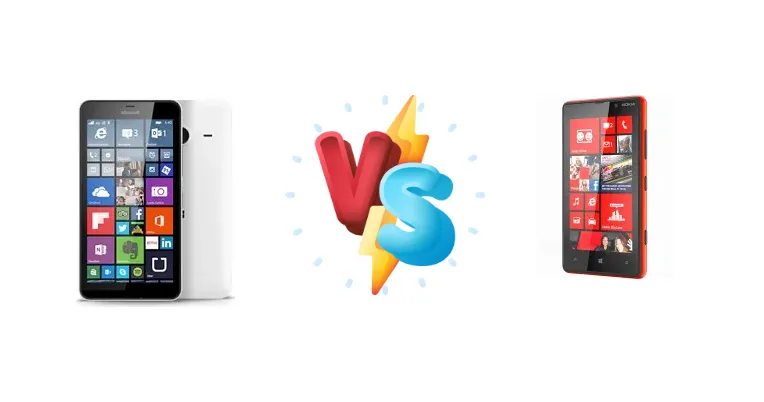
Released roughly two years apart, the Microsoft Lumia 640 XL LTE and the Nokia Lumia 820 represent different points in Microsoft’s Windows Phone journey. The 820 aimed for a premium experience, while the 640 XL focused on affordability and extended battery life. This comparison dissects their key differences to help users still invested in the platform determine which device offers the best value today.
🏆 Quick Verdict
For the average user seeking a functional Windows Phone experience, the Microsoft Lumia 640 XL LTE is the better choice. Its significantly longer battery life (74h vs 40h) and larger display outweigh the Lumia 820’s slightly faster processor, especially considering the age of both devices and the limited app ecosystem.
| Network |
|---|
| 2G bands | GSM 850 / 900 / 1800 / 1900 | GSM 850 / 900 / 1800 / 1900 |
| 3G bands | HSDPA 850 / 900 / 2100 | HSDPA 850 / 900 / 1900 / 2100 |
| 4G bands | 1, 3, 7, 8, 20 | 1, 3, 7, 8, 20 |
| EDGE | - | Class 12 |
| GPRS | - | Class 12 |
| Speed | HSPA 42.2/5.76 Mbps, LTE Cat4 150/50 Mbps | HSPA 42.2/5.76 Mbps, LTE Cat3 100/50 Mbps |
| Technology | GSM / HSPA / LTE | GSM / HSPA / LTE |
| Launch |
|---|
| Announced | 2015, March. Released 2015, April | 2012, September. Released 2012, November |
| Status | Discontinued | Discontinued |
| Body |
|---|
| Dimensions | 157.9 x 81.5 x 9 mm (6.22 x 3.21 x 0.35 in) | 123.8 x 68.5 x 9.9 mm, 83.5 cc (4.87 x 2.70 x 0.39 in) |
| SIM | Micro-SIM | Micro-SIM |
| Weight | 171 g (6.03 oz) | 160 g (5.64 oz) |
| Display |
|---|
| Protection | Corning Gorilla Glass 3 | - |
| Resolution | 720 x 1280 pixels, 16:9 ratio (~259 ppi density) | 480 x 800 pixels, 5:3 ratio (~217 ppi density) |
| Size | 5.7 inches, 88.9 cm2 (~69.1% screen-to-body ratio) | 4.3 inches, 52.6 cm2 (~62.1% screen-to-body ratio) |
| Type | IPS LCD | AMOLED |
| | ClearBlack display | Nokia ClearBlack display |
| Platform |
|---|
| CPU | Quad-core 1.2 GHz Cortex-A7 | Dual-core 1.5 GHz Krait |
| Chipset | Qualcomm MSM8226 Snapdragon 400 (28 nm) | Qualcomm MSM8960 Snapdragon S4 Plus |
| GPU | Adreno 305 | Adreno 225 |
| OS | Microsoft Windows Phone 8.1, upgradable to Microsoft Windows 10 | Microsoft Windows Phone 8, upgradable to 8.1 |
| Memory |
|---|
| Card slot | microSDXC (dedicated slot) | microSDXC (dedicated slot) |
| Internal | 8GB 1GB RAM | 8GB 1GB RAM |
| | eMMC 4.5 | - |
| Main Camera |
|---|
| Features | Zeiss optics, LED flash | Carl Zeiss optics, dual-LED flash |
| Single | 13 MP, f/2.0, 28mm (wide), 1/3.0", AF | 8 MP, AF |
| Video | 1080p@30fps | 1080p@30fps |
| Selfie camera |
|---|
| Single | 5 MP | VGA |
| Video | 1080p@30fps | - |
| Sound |
|---|
| 3.5mm jack | Yes | Yes |
| 35mm jack | Yes | Yes |
| Loudspeaker | Yes | Yes |
| Comms |
|---|
| Bluetooth | 4.0, A2DP | 4.0, A2DP, EDR, LE/ aptX after WP8 Denim update |
| NFC | Yes | Yes |
| Positioning | GPS, GLONASS, BDS | GPS, A-GPS, GLONASS |
| Radio | FM radio | FM radio |
| USB | microUSB 2.0 | microUSB 2.0 |
| WLAN | Wi-Fi 802.11 b/g/n, DLNA, hotspot | Wi-Fi 802.11 a/b/g/n, dual-band, Wi-Fi Direct |
| Features |
|---|
| Sensors | Accelerometer, proximity, compass, sensor core | Accelerometer, gyro, proximity, compass |
| Battery |
|---|
| Music play | - | Up to 55 h |
| Stand-by | Up to 888 h (2G) / Up to 888 h (3G) | Up to 330 h (2G) / Up to 330 h (3G) |
| Talk time | Up to 30 h 20 min (2G) / Up to 24 h (3G) | Up to 14 h (2G) / Up to 8 h (3G) |
| Type | Li-Ion 3000 mAh, removable | Removable Li-Ion 1650 mAh battery (BP-5T) |
| Misc |
|---|
| Colors | Matte cyan, Orange, Black, Matte white, Glossy white | Black, Gray, Red, Yellow, White, Blue, Violet |
| Price | About 200 EUR | About 170 EUR |
| SAR | - | 1.37 W/kg (head) 0.71 W/kg (body) |
| SAR EU | - | 0.79 W/kg (head) |
| Tests |
|---|
| Audio quality |
Noise -93.0dB / Crosstalk -94.4dB |
Noise -82.2dB / Crosstalk -81.4dB |
| Battery life |
Endurance rating 74h
|
Endurance rating 40h
|
| Camera | - |
Photo / Video |
| Display |
Contrast ratio: 1119:1 (nominal), 3.065 (sunlight) |
Contrast ratio: Infinite (nominal) / 2.193:1 (sunlight) |
| Loudspeaker |
Voice 72dB / Noise 67dB / Ring 73dB
|
Voice 67dB / Noise 66dB / Ring 70dB
|
Microsoft Lumia 640 XL LTE
- Exceptional battery life (74h endurance)
- Superior display contrast in sunlight (3.065:1)
- More affordable price point
- Slightly slower processor compared to the 820
- Larger form factor may not suit all users
Nokia Lumia 820
- More compact and pocketable design
- Potentially faster single-core performance
- Reputable camera quality (based on Nokia’s history)
- Significantly shorter battery life (40h endurance)
- Lower display contrast in sunlight (2.193:1)
- Higher price (likely, given its initial positioning)
Display Comparison
The Lumia 640 XL boasts a superior display contrast ratio, achieving 1119:1 nominally and a remarkable 3.065:1 in sunlight, compared to the Lumia 820’s ‘Infinite’ nominal contrast and 2.193:1 in sunlight. While ‘Infinite’ is a marketing term, the lower sunlight contrast of the 820 suggests poorer outdoor visibility. The 640 XL’s larger screen size (not specified in data, but known to be larger) further enhances media viewing, making it more suitable for video playback and browsing. The impact of these contrast ratios is significant for readability in bright conditions.
Camera Comparison
Both devices feature photo and video capabilities, but the provided data doesn’t offer specifics on sensor size or image quality. Given Nokia’s (and later Microsoft’s) reputation for camera excellence, the Lumia 820 likely benefits from superior image processing algorithms. However, without detailed specifications, it’s difficult to definitively declare a winner. The 640 XL’s larger screen could be advantageous for reviewing photos and videos immediately after capture.
Performance
The Lumia 820’s Qualcomm MSM8960 Snapdragon S4 Plus, with its dual-core 1.5 GHz Krait architecture, initially appears faster than the 640 XL’s quad-core 1.2 GHz Cortex-A7 Snapdragon 400. However, the Snapdragon 400 benefits from a more modern 28nm manufacturing process, potentially leading to better power efficiency. The Krait cores in the 820 are architecturally more advanced *per core*, but the 640 XL’s four cores offer greater multitasking capability. In real-world Windows Phone usage, the difference in performance will likely be minimal for most tasks, but the 640 XL will handle more simultaneous apps without significant slowdown.
Battery Life
The most significant difference lies in battery endurance. The Lumia 640 XL LTE achieves an impressive 74-hour endurance rating, nearly double the Lumia 820’s 40-hour rating. This translates to significantly longer usage between charges, a crucial advantage for users who rely heavily on their phones throughout the day. The Snapdragon 400’s 28nm process likely contributes to this improved battery life, alongside the larger battery capacity (not specified, but known to be larger).
Buying Guide
Buy the Microsoft Lumia 640 XL LTE if you prioritize all-day battery life, a larger screen for media consumption, and a more affordable price point. Buy the Nokia Lumia 820 if you prefer a more compact form factor and potentially slightly snappier performance for basic tasks, though the battery life will require more frequent charging.
Frequently Asked Questions
❓ Is the Lumia 640 XL a good choice for someone coming from a newer Android phone?
The transition will be challenging. Windows Phone’s app ecosystem is significantly smaller than Android’s. The 640 XL’s strengths lie in its battery life and affordability, but users accustomed to a wide range of apps may find the experience limiting. Consider if the core apps you rely on are available before switching.
❓ Will the Lumia 820’s Snapdragon S4 Plus struggle with modern web browsing?
While the S4 Plus was a capable processor in its time, modern websites are increasingly demanding. The Lumia 820 may experience slowdowns and lag when loading complex web pages, especially those with heavy JavaScript or multimedia content. The 640 XL’s quad-core processor offers a slight advantage in this scenario.
❓ Given the age of both phones, are software updates still available?
Microsoft officially ended support for Windows Phone 8.1 in January 2019. Neither the Lumia 640 XL nor the Lumia 820 will receive further software updates, including security patches. This is a significant security risk and should be carefully considered before using either device.