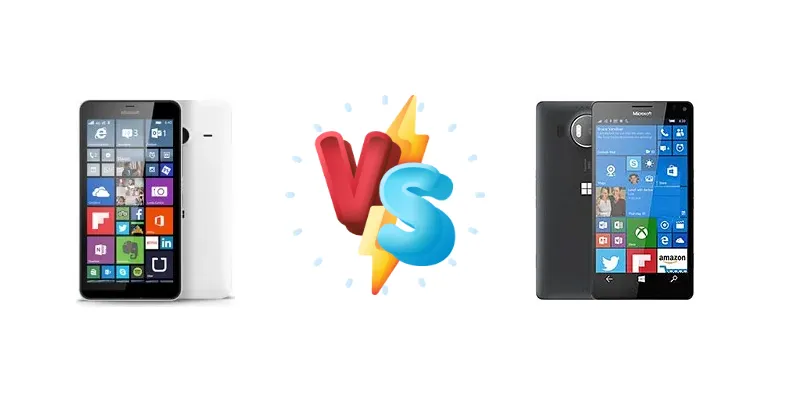
The Microsoft Lumia 640 XL LTE and 950 XL represent distinct eras in Microsoft’s mobile ambitions. The 640 XL aimed for affordability and long battery life, while the 950 XL was a late attempt at a true flagship, boasting a powerful processor and advanced features. This comparison dissects their differences to help you decide which, if either, holds value today.
🏆 Quick Verdict
For the average user seeking a functional, long-lasting device, the Lumia 640 XL LTE emerges as the more practical choice. Its significantly superior endurance rating (74h vs 62h) and lower price point outweigh the 950 XL’s performance advantages, especially considering the limited app ecosystem for Windows 10 Mobile.
| Network |
|---|
| 2G bands | GSM 850 / 900 / 1800 / 1900 | GSM 850 / 900 / 1800 / 1900 |
| 3G bands | HSDPA 850 / 900 / 2100 | HSDPA 850 / 900 / 1700(AWS) / 1900 / 2100 |
| 4G bands | 1, 3, 7, 8, 20 | 1, 2, 3, 4, 5, 7, 8, 12, 20, 28, 38, 40 - EMEA |
| Speed | HSPA 42.2/5.76 Mbps, LTE Cat4 150/50 Mbps | HSPA 42.2/5.76 Mbps, LTE Cat6 300/50 Mbps |
| Technology | GSM / HSPA / LTE | GSM / HSPA / LTE |
| | - | 1, 2, 3, 4, 5, 7, 8, 12, 17, 20, 28, 38, 40, 41 - USA |
| Launch |
|---|
| Announced | 2015, March. Released 2015, April | 2015, October. Released 2015, November |
| Status | Discontinued | Discontinued |
| Body |
|---|
| Dimensions | 157.9 x 81.5 x 9 mm (6.22 x 3.21 x 0.35 in) | 151.9 x 78.4 x 8.1 mm (5.98 x 3.09 x 0.32 in) |
| SIM | Micro-SIM | Nano-SIM |
| Weight | 171 g (6.03 oz) | 165 g (5.82 oz) |
| Display |
|---|
| Protection | Corning Gorilla Glass 3 | Corning Gorilla Glass 4 |
| Resolution | 720 x 1280 pixels, 16:9 ratio (~259 ppi density) | 1440 x 2560 pixels, 16:9 ratio (~518 ppi density) |
| Size | 5.7 inches, 88.9 cm2 (~69.1% screen-to-body ratio) | 5.7 inches, 88.5 cm2 (~74.3% screen-to-body ratio) |
| Type | IPS LCD | AMOLED |
| | ClearBlack display | ClearBlack display |
| Platform |
|---|
| CPU | Quad-core 1.2 GHz Cortex-A7 | Octa-core (4x1.5 GHz Cortex-A53 & 4x2.0 GHz Cortex-A57) |
| Chipset | Qualcomm MSM8226 Snapdragon 400 (28 nm) | Qualcomm MSM8994 Snapdragon 810 (20 nm) |
| GPU | Adreno 305 | Adreno 430 |
| OS | Microsoft Windows Phone 8.1, upgradable to Microsoft Windows 10 | Microsoft Windows 10 |
| Memory |
|---|
| Card slot | microSDXC (dedicated slot) | microSDXC (dedicated slot) |
| Internal | 8GB 1GB RAM | 32GB 3GB RAM |
| | eMMC 4.5 | eMMC 5.0 |
| Main Camera |
|---|
| Features | Zeiss optics, LED flash | Zeiss optics, triple-LED RGB flash, panorama, HDR |
| Single | 13 MP, f/2.0, 28mm (wide), 1/3.0", AF | 20 MP, f/1.9, 26mm (wide), 1/2.4", 1.12µm, AF, OIS |
| Video | 1080p@30fps | 4K@30fps, stereo sound rec., 1080p@30/60fps (after SW update) |
| Selfie camera |
|---|
| Single | 5 MP | 5 MP, f/2.4 |
| Video | 1080p@30fps | 1080p@30fps |
| Sound |
|---|
| 3.5mm jack | Yes | Yes |
| 35mm jack | Yes | Yes |
| Loudspeaker | Yes | Yes |
| Comms |
|---|
| Bluetooth | 4.0, A2DP | 4.1, A2DP |
| NFC | Yes | Yes |
| Positioning | GPS, GLONASS, BDS | GPS, GLONASS, BDS |
| Radio | FM radio | FM radio |
| USB | microUSB 2.0 | USB Type-C 3.1 |
| WLAN | Wi-Fi 802.11 b/g/n, DLNA, hotspot | Wi-Fi 802.11 a/b/g/n/ac, dual-band, hotspot |
| Features |
|---|
| Sensors | Accelerometer, proximity, compass, sensor core | Iris scanner, accelerometer, gyro, proximity, compass, barometer, sensor core |
| | - | Microsoft Continuum support |
| Battery |
|---|
| Charging | - | 18W wired
Wireless (Qi) (market dependent) |
| Music play | - | Up to 75 h |
| Stand-by | Up to 888 h (2G) / Up to 888 h (3G) | Up to 288 h (2G) / Up to 288 h (3G) |
| Talk time | Up to 30 h 20 min (2G) / Up to 24 h (3G) | Up to 25 h (2G) / Up to 19 h (3G) |
| Type | Li-Ion 3000 mAh, removable | Li-Ion 3340 mAh, removable |
| Misc |
|---|
| Colors | Matte cyan, Orange, Black, Matte white, Glossy white | Black, White |
| Price | About 200 EUR | About 350 EUR |
| Tests |
|---|
| Audio quality |
Noise -93.0dB / Crosstalk -94.4dB |
Noise -91.6dB / Crosstalk -89.3dB |
| Battery life |
Endurance rating 74h
|
Endurance rating 62h
|
| Camera | - |
Photo / Video |
| Display |
Contrast ratio: 1119:1 (nominal), 3.065 (sunlight) |
Contrast ratio: Infinite (nominal), 3.837 (sunlight) |
| Loudspeaker |
Voice 72dB / Noise 67dB / Ring 73dB
|
Voice 74dB / Noise 75dB / Ring 84dB
|
| Performance | - |
Basemark OS II 2.0: 1472Basemark X: 32178 |
Microsoft Lumia 640 XL LTE
- Exceptional battery life (74h endurance)
- More affordable price point
- Large display for media consumption
- Significantly weaker processor
- Lower display contrast ratio
- Basic camera capabilities
Microsoft Lumia 950 XL
- Powerful Snapdragon 810 processor
- Superior OLED display with infinite contrast
- Fast 18W charging and Qi wireless charging
- Shorter battery life (62h endurance)
- Higher price
- Potential for thermal throttling
Display Comparison
Both devices feature displays with a sunlight contrast ratio of 3.837:1, suggesting similar outdoor visibility. However, the Lumia 950 XL boasts an 'Infinite' nominal contrast ratio, indicating a superior OLED panel compared to the 640 XL’s LCD. This translates to deeper blacks and more vibrant colors on the 950 XL. While both share the same sunlight readability, the 950 XL’s OLED technology provides a more visually immersive experience. The 640 XL’s 1119:1 nominal contrast ratio, while respectable, pales in comparison.
Camera Comparison
Both phones are listed as having 'Photo / Video' capabilities, but the 950 XL’s camera system is expected to be far superior. While specific sensor details are missing, the 950 XL, as a flagship, likely features a larger sensor, optical image stabilization (OIS), and more advanced image processing algorithms. The 640 XL’s camera is adequate for casual snapshots, but the 950 XL is designed for more serious photography. The absence of detailed camera specs for both devices makes a precise comparison difficult, but the 950 XL’s positioning suggests a clear advantage.
Performance
The performance gap between these devices is substantial. The Lumia 950 XL’s Qualcomm MSM8994 Snapdragon 810, built on a 20nm process, features an octa-core CPU (4x1.5 GHz Cortex-A53 & 4x2.0 GHz Cortex-A57) and a more powerful GPU. This is a significant upgrade over the 640 XL’s Snapdragon 400 (MSM8226) with its quad-core 1.2 GHz Cortex-A7 CPU. The 20nm fabrication process of the 810 also contributes to better thermal efficiency, though the 810 was known to throttle under sustained load. The 640 XL is suitable for basic tasks, while the 950 XL can handle more demanding applications and multitasking.
Battery Life
The Lumia 640 XL LTE holds a significant advantage in battery endurance, achieving a rating of 74 hours compared to the 950 XL’s 62 hours. This difference is despite the 950 XL offering 18W wired charging and Qi wireless charging (market dependent), features absent on the 640 XL. The Snapdragon 810’s higher power consumption, combined with the OLED display, contributes to the 950 XL’s lower endurance. While the 950 XL charges faster, the 640 XL will last considerably longer on a single charge.
Buying Guide
Buy the Microsoft Lumia 640 XL LTE if you prioritize exceptional battery life, a large display for media consumption, and a budget-friendly price. It’s ideal for users who need a reliable communication device and aren’t demanding mobile gamers or photographers. Buy the Microsoft Lumia 950 XL if you absolutely require the fastest possible performance from a Windows Phone, need wireless charging, and are willing to accept shorter battery life and a higher price. It caters to power users who want to maximize the capabilities of the platform.
Frequently Asked Questions
❓ Is the Snapdragon 810 in the Lumia 950 XL prone to overheating?
The Snapdragon 810 was known to experience thermal throttling under sustained heavy loads, such as prolonged gaming or video recording. While the 950 XL included cooling solutions, users may still encounter performance drops during intensive tasks. The 640 XL’s Snapdragon 400 is less powerful but also generates less heat, avoiding this issue.
❓ Does the Lumia 950 XL's wireless charging significantly improve the user experience?
The Lumia 950 XL supports Qi wireless charging, offering a convenient way to top up the battery without needing to plug in a cable. However, the shorter battery life of the 950 XL means you'll be charging it more frequently, making wireless charging more useful. The 640 XL lacks this feature, relying solely on micro-USB charging.
❓ Given the limited app support for Windows 10 Mobile, is either of these phones still worth buying in 2024?
The app ecosystem for Windows 10 Mobile is severely limited. Both phones are best suited for users who primarily rely on core functionality like calling, texting, and basic productivity apps. If you require a wide range of modern apps, neither phone is a good choice. However, for a dedicated Windows Phone experience, the 640 XL offers better value due to its longer battery life.