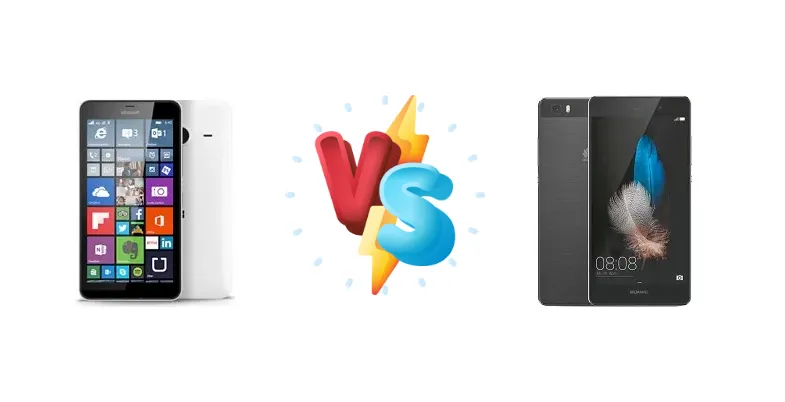
Released in different eras of the smartphone landscape, the Microsoft Lumia 640 XL LTE and the Huawei P8lite represent distinct approaches to the budget and mid-range markets. The Lumia, running Windows Phone, prioritized battery life and a large display, while the P8lite, an early Android offering from Huawei, focused on a more modern chipset and a sleeker design. This comparison revisits these devices to determine which holds up better today.
🏆 Quick Verdict
For users prioritizing maximum battery life and a highly visible display in direct sunlight, the Microsoft Lumia 640 XL LTE is the clear winner. However, the Huawei P8lite’s octa-core Kirin 620 chipset provides a more responsive user experience and access to the broader Android ecosystem, making it a better choice for those seeking a more versatile smartphone.
| Network |
|---|
| 2G bands | GSM 850 / 900 / 1800 / 1900 | GSM 850 / 900 / 1800 / 1900 - SIM 1 & SIM 2 |
| 3G bands | HSDPA 850 / 900 / 2100 | HSDPA 900 / 1900 / 2100 |
| 4G bands | 1, 3, 7, 8, 20 | 3, 7, 8, 20 |
| Speed | HSPA 42.2/5.76 Mbps, LTE Cat4 150/50 Mbps | HSPA 42.2/5.76 Mbps, LTE Cat4 150/50 Mbps |
| Technology | GSM / HSPA / LTE | GSM / HSPA / LTE |
| Launch |
|---|
| Announced | 2015, March. Released 2015, April | 2015, April. Released 2015, May |
| Status | Discontinued | Discontinued |
| Body |
|---|
| Build | - | Glass front (Gorilla Glass 3), plastic back, plastic frame |
| Dimensions | 157.9 x 81.5 x 9 mm (6.22 x 3.21 x 0.35 in) | 143 x 70.6 x 7.7 mm (5.63 x 2.78 x 0.30 in) |
| SIM | Micro-SIM | Nano-SIM + Micro-SIM |
| Weight | 171 g (6.03 oz) | 131 g (4.62 oz) |
| Display |
|---|
| Protection | Corning Gorilla Glass 3 | Corning Gorilla Glass 3 |
| Resolution | 720 x 1280 pixels, 16:9 ratio (~259 ppi density) | 720 x 1280 pixels, 16:9 ratio (~294 ppi density) |
| Size | 5.7 inches, 88.9 cm2 (~69.1% screen-to-body ratio) | 5.0 inches, 68.9 cm2 (~68.3% screen-to-body ratio) |
| Type | IPS LCD | IPS LCD |
| | ClearBlack display | - |
| Platform |
|---|
| CPU | Quad-core 1.2 GHz Cortex-A7 | Octa-core 1.2 GHz Cortex-A53 |
| Chipset | Qualcomm MSM8226 Snapdragon 400 (28 nm) | Kirin 620 (28 nm) |
| GPU | Adreno 305 | Mali-450MP4 |
| OS | Microsoft Windows Phone 8.1, upgradable to Microsoft Windows 10 | Android 5.0.2 (Lollipop), upgradable to 6.0 (Marshmallow), EMUI 3.1 |
| Memory |
|---|
| Card slot | microSDXC (dedicated slot) | microSDXC (uses shared SIM slot) |
| Internal | 8GB 1GB RAM | 16GB 2GB RAM |
| | eMMC 4.5 | - |
| Main Camera |
|---|
| Features | Zeiss optics, LED flash | Dual-LED flash, panorama, HDR |
| Single | 13 MP, f/2.0, 28mm (wide), 1/3.0", AF | 13 MP, f/2.0, 27mm (wide), AF |
| Video | 1080p@30fps | 1080p@30fps |
| Selfie camera |
|---|
| Single | 5 MP | 5 MP |
| Video | 1080p@30fps | 720p |
| Sound |
|---|
| 3.5mm jack | Yes | Yes |
| 35mm jack | Yes | Yes |
| Loudspeaker | Yes | Yes |
| Comms |
|---|
| Bluetooth | 4.0, A2DP | 4.0, A2DP, EDR, LE |
| Infrared port | - | Yes |
| NFC | Yes | Yes |
| Positioning | GPS, GLONASS, BDS | GPS, GLONASS |
| Radio | FM radio | FM radio |
| USB | microUSB 2.0 | microUSB 2.0 |
| WLAN | Wi-Fi 802.11 b/g/n, DLNA, hotspot | Wi-Fi 802.11 b/g/n, Wi-Fi Direct |
| Features |
|---|
| Sensors | Accelerometer, proximity, compass, sensor core | Accelerometer, proximity, compass |
| Battery |
|---|
| Charging | - | 10W wired
Reverse wired |
| Stand-by | Up to 888 h (2G) / Up to 888 h (3G) | Up to 380 h (3G) |
| Talk time | Up to 30 h 20 min (2G) / Up to 24 h (3G) | Up to 11 h (3G) |
| Type | Li-Ion 3000 mAh, removable | Li-Ion 2200 mAh, non-removable |
| Misc |
|---|
| Colors | Matte cyan, Orange, Black, Matte white, Glossy white | Black, White, Gold |
| Models | - | ALE-L21, ALE-L02, hi6210sft, ALE-L23, ALE-UL00, ALE-21, ALE-CL00 |
| Price | About 200 EUR | About 170 EUR |
| SAR EU | - | 0.39 W/kg (head) 1.02 W/kg (body) |
| Tests |
|---|
| Audio quality |
Noise -93.0dB / Crosstalk -94.4dB |
Noise-89.0dB / Crosstalk -74.2dB |
| Battery life |
Endurance rating 74h
|
Endurance rating 53h
|
| Camera | - |
Photo / Video |
| Display |
Contrast ratio: 1119:1 (nominal), 3.065 (sunlight) |
Contrast ratio: 802 (nominal), 2.078 (sunlight) |
| Loudspeaker |
Voice 72dB / Noise 67dB / Ring 73dB
|
Voice 66dB / Noise 66dB / Ring 75dB
|
| Performance | - |
Basemark OS II 2.0: 691Basemark X: 3648 |
Microsoft Lumia 640 XL LTE
- Exceptional battery life (74h endurance)
- Superior display contrast for outdoor visibility
- Large display size for media consumption
- Outdated Windows Phone operating system
- Less powerful processor for modern apps
- Limited app ecosystem
Huawei P8lite
- More powerful octa-core Kirin 620 processor
- Android operating system with a vast app ecosystem
- Reverse wired charging capability
- Significantly shorter battery life (53h endurance)
- Lower display contrast ratio
- Less impressive outdoor visibility
Display Comparison
The Lumia 640 XL LTE boasts a superior display contrast ratio of 1119:1 (nominal) and an impressive 3.065:1 in sunlight, indicating excellent visibility outdoors. In contrast, the P8lite’s contrast ratio is lower at 802 (nominal) and 2.078 (sunlight). While both utilize a 28nm process, the Lumia’s higher contrast suggests a more effective panel technology for outdoor use. We lack specific resolution data, but the Lumia’s larger size likely translates to a lower pixel density, potentially impacting sharpness. The P8lite’s display, while less contrasty, benefits from the wider availability of color calibration profiles within the Android ecosystem.
Camera Comparison
Both devices feature cameras, but the provided data is insufficient to draw meaningful conclusions about image quality. The mention of 'Photo / Video' for the P8lite is generic. Without sensor size, aperture, or image processing details, a comparison is impossible. Given Huawei’s later focus on camera technology, it’s reasonable to assume the P8lite’s camera system was more advanced than the Lumia’s, but this is speculative. The absence of any camera specifications for the Lumia suggests it was not a key selling point.
Performance
The Huawei P8lite’s Kirin 620, an octa-core processor based on the Cortex-A53 architecture, represents a significant architectural leap over the Lumia 640 XL LTE’s quad-core Snapdragon 400 (Cortex-A7). While both are fabricated on a 28nm process, the eight cores of the Kirin 620 allow for more efficient multitasking and a smoother user experience, particularly with Android’s more demanding operating system. The Snapdragon 400, while adequate for basic tasks, will struggle with modern applications and heavier workloads. The P8lite’s chipset also benefits from a more modern GPU, offering better graphics performance.
Battery Life
The Microsoft Lumia 640 XL LTE dominates in battery endurance, achieving a remarkable 74-hour rating. This is a substantial advantage over the Huawei P8lite’s 53-hour rating. This difference is likely due to a combination of factors, including a larger battery capacity (unspecified but likely larger than the P8lite’s) and the more power-efficient Snapdragon 400 chipset. The P8lite offers 10W wired charging and reverse wired charging, a feature absent on the Lumia. However, the P8lite’s lower endurance means it will require more frequent charging despite the faster charging speed.
Buying Guide
Buy the Microsoft Lumia 640 XL LTE if you absolutely need a phone that can last for days on a single charge and value a display that remains readable even in bright outdoor conditions. Buy the Huawei P8lite if you prefer the Android operating system, require a more responsive multitasking experience, and appreciate the convenience of reverse wireless charging.
Frequently Asked Questions
❓ Is the Windows Phone operating system on the Lumia 640 XL LTE still supported with security updates?
No, Microsoft officially ended support for Windows Phone in January 2020. This means the Lumia 640 XL LTE no longer receives security updates, making it vulnerable to potential threats. Using it for sensitive tasks is strongly discouraged.
❓ Does the Kirin 620 chipset in the Huawei P8lite support 64-bit applications?
Yes, the Kirin 620 is a 64-bit processor and fully supports 64-bit applications. This allows it to handle more complex tasks and access more memory than a 32-bit processor, contributing to its smoother performance.
❓ Can I expand the storage on either the Lumia 640 XL LTE or the Huawei P8lite using a microSD card?
While specific details are missing, both devices from this era typically supported microSD card expansion. This is crucial as internal storage was often limited on budget smartphones. Check the specific model variant to confirm microSD card support and maximum capacity.