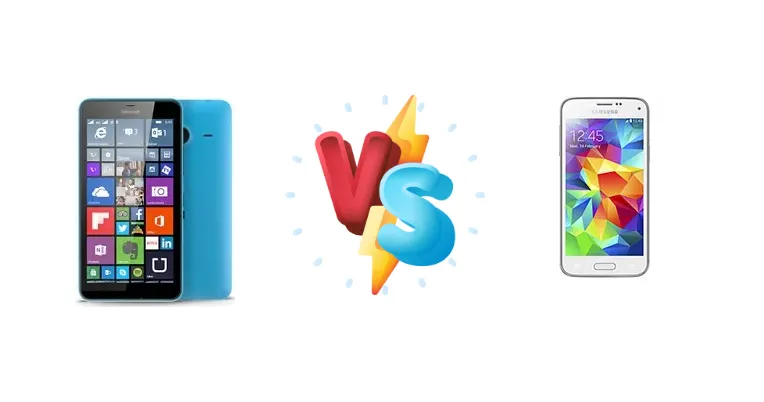
Released around the same time, the Microsoft Lumia 640 XL LTE Dual SIM and the Samsung Galaxy S5 mini represent different approaches to the mid-range smartphone market. The Lumia prioritized battery life and a large display, while the S5 mini aimed for a more compact form factor and Samsung’s established Android experience. This comparison dissects their strengths and weaknesses to determine which offers the best value today.
🏆 Quick Verdict
For the average user prioritizing longevity and outdoor visibility, the Microsoft Lumia 640 XL LTE Dual SIM emerges as the better choice. Its significantly superior endurance rating (74h vs 72h) and higher sunlight contrast ratio (3.065 vs 3.174) provide a more reliable experience, especially for power users and those frequently outdoors.
| Network |
|---|
| 2G bands | GSM 850 / 900 / 1800 / 1900 - SIM 1 & SIM 2 | GSM 850 / 900 / 1800 / 1900 |
| 3G bands | HSDPA 850 / 900 / 1700 / 1900 / 2100 | HSDPA 850 / 900 / 1900 / 2100 |
| 4G bands | 1, 2, 3, 4, 5, 7, 8, 12, 17, 20, 28, 38, 40 | 1, 3, 5, 7, 8, 20 - G800F |
| Speed | HSPA 42.2/5.76 Mbps, LTE Cat4 150/50 Mbps | HSPA 42.2(LTE)/21.1(3G)/5.76 Mbps, LTE Cat4 150/50 Mbps |
| Technology | GSM / HSPA / LTE | GSM / HSPA / LTE |
| | - | 1, 3, 7, 28 - G800Y |
| Launch |
|---|
| Announced | 2015, March. Released 2015, April | 2014, June. Released 2014, July |
| Status | Discontinued | Discontinued |
| Body |
|---|
| Dimensions | 157.9 x 81.5 x 9 mm (6.22 x 3.21 x 0.35 in) | 131.1 x 64.8 x 9.1 mm (5.16 x 2.55 x 0.36 in) |
| SIM | Dual SIM (Micro-SIM, dual stand-by) | Micro-SIM |
| Weight | 171 g (6.03 oz) | 120 g (4.23 oz) |
| | - | IP67 dust/water resistant (up to 1m for 30 min) |
| Display |
|---|
| Protection | Corning Gorilla Glass 3 | - |
| Resolution | 720 x 1280 pixels, 16:9 ratio (~259 ppi density) | 720 x 1280 pixels, 16:9 ratio (~326 ppi density) |
| Size | 5.7 inches, 88.9 cm2 (~69.1% screen-to-body ratio) | 4.5 inches, 55.8 cm2 (~65.7% screen-to-body ratio) |
| Type | IPS LCD | Super AMOLED |
| | ClearBlack display | - |
| Platform |
|---|
| CPU | Quad-core 1.2 GHz Cortex-A7 | Quad-core 1.4 GHz Cortex-A7 |
| Chipset | Qualcomm MSM8226 Snapdragon 400 (28 nm) | Exynos 3470 Quad |
| GPU | Adreno 305 | Mali-400MP4 |
| OS | Microsoft Windows Phone 8.1, upgradable to Microsoft Windows 10 | Android 4.4.2 (KitKat), upgradable to 5.1.1 (Lollipop), TouchWiz UI |
| Memory |
|---|
| Card slot | microSDXC (dedicated slot) | microSDXC (dedicated slot) |
| Internal | 8GB 1GB RAM | 16GB 1.5GB RAM |
| | eMMC 4.5 | - |
| Main Camera |
|---|
| Features | Zeiss optics, LED flash | LED flash, HDR, panorama |
| Single | 13 MP, f/2.0, 28mm (wide), 1/3.0", AF | 8 MP, f/2.4, 31mm (standard), AF |
| Video | 1080p@30fps | 1080p@30fps |
| Selfie camera |
|---|
| Single | 5 MP | 2.1 MP |
| Video | 1080p@30fps | 1080p@30fps |
| Sound |
|---|
| 3.5mm jack | Yes | Yes |
| 35mm jack | Yes | Yes |
| Loudspeaker | Yes | Yes |
| Comms |
|---|
| Bluetooth | 4.0, A2DP | 4.0, A2DP, EDR, LE, aptX |
| Infrared port | - | Yes |
| NFC | Yes | Yes (LTE model only) |
| Positioning | GPS, GLONASS, BDS | GPS, GLONASS |
| Radio | FM radio | No |
| USB | microUSB 2.0 | microUSB 2.0 |
| WLAN | Wi-Fi 802.11 b/g/n, DLNA, hotspot | Wi-Fi 802.11 a/b/g/n, dual-band, Wi-Fi Direct, hotspot |
| Features |
|---|
| Sensors | Accelerometer, proximity, compass, sensor core | Fingerprint (front-mounted), accelerometer, gyro, proximity, compass, heart rate |
| Battery |
|---|
| Music play | - | Up to 47 h |
| Stand-by | Up to 936 h (2G) / Up to 936 h (3G) | - |
| Talk time | Up to 31 h 20 min (2G) / Up to 23 h 40 min (3G) | Up to 10 h (3G) |
| Type | Li-Ion 3000 mAh, removable | Li-Ion 2100 mAh, removable |
| Misc |
|---|
| Colors | Matte cyan, Orange, Black, Matte white, Glossy white | Charcoal Black, Shimmery White, Electric Blue and Copper Gold |
| Models | - | SM-G800H, SM-G800F, SM-G800M, SM-G800Y |
| Price | About 200 EUR | About 220 EUR |
| SAR | - | 0.63 W/kg (head) 0.82 W/kg (body) |
| SAR EU | - | 0.97 W/kg (head) 0.56 W/kg (body) |
| Tests |
|---|
| Audio quality |
Noise -93.0dB / Crosstalk -94.4dB |
Noise -92.6dB / Crosstalk -94.0dB |
| Battery life |
Endurance rating 74h
|
Endurance rating 72h
|
| Camera | - |
Photo / Video |
| Display |
Contrast ratio: 1119:1 (nominal), 3.065 (sunlight) |
Contrast ratio: Infinite (nominal), 3.174 (sunlight) |
| Loudspeaker |
Voice 72dB / Noise 67dB / Ring 73dB
|
Voice 73dB / Noise 67dB / Ring 78dB
|
| Performance | - |
Basemark X: 2665 |
Microsoft Lumia 640 XL LTE Dual SIM
- Superior battery life (74h endurance)
- Larger display for better media viewing
- Dual SIM support for added flexibility
- Lower nominal display contrast ratio
- Slightly slower processor than the S5 mini
Samsung Galaxy S5 mini
- More compact and pocketable design
- Higher display contrast ratio for vibrant colors
- Established Android ecosystem and Samsung features
- Shorter battery life (72h endurance)
- Potentially slower performance in demanding tasks
Display Comparison
Both devices feature displays optimized for outdoor use, boasting similar sunlight contrast ratios around 3.1. However, the Lumia 640 XL’s nominal contrast ratio of 1119:1 is considerably lower than the Galaxy S5 mini’s ‘Infinite’ contrast ratio, suggesting a superior black level and potentially more vibrant colors on the Samsung. While both are likely LCD panels, the S5 mini’s higher contrast implies better panel quality. The Lumia’s larger screen size is a benefit for media consumption, but the S5 mini’s smaller footprint will appeal to those prioritizing portability.
Camera Comparison
Context data for both cameras is limited to 'Photo / Video'. Given the era, both likely feature 8MP primary sensors. Samsung typically focused on image processing to enhance photos, while Lumia cameras were known for their accurate color reproduction. Without detailed sensor size or aperture information, it’s difficult to declare a clear winner. The S5 mini may have offered more camera features through Samsung’s software, but the Lumia’s image quality was often praised for its natural look.
Performance
The Samsung Galaxy S5 mini’s Exynos 3470, clocked at 1.4 GHz, offers a slight CPU performance advantage over the Lumia 640 XL’s 1.2 GHz Snapdragon 400. Both utilize a quad-core Cortex-A7 architecture, meaning the difference isn’t massive. However, the Exynos chip’s architecture may offer slightly better multi-tasking capabilities. Neither phone is a performance powerhouse by today’s standards, but the S5 mini will likely feel a bit snappier in everyday tasks. Both devices are limited by their age and the relatively slow LPDDR2 RAM likely used in both.
Battery Life
The Lumia 640 XL’s endurance rating of 74 hours edges out the Galaxy S5 mini’s 72 hours. This difference, while seemingly small, translates to a noticeable advantage in real-world usage, particularly for users who heavily utilize their phones throughout the day. The Snapdragon 400, built on a 28nm process, is relatively power-efficient. While charging speeds aren’t specified, the Lumia’s larger battery capacity provides a buffer against battery drain.
Buying Guide
Buy the Microsoft Lumia 640 XL LTE Dual SIM if you need extended battery life, a larger screen for media consumption, and the flexibility of dual SIM support. It’s ideal for travelers or those managing multiple phone numbers. Buy the Samsung Galaxy S5 mini if you prefer a more compact device that fits comfortably in one hand and value the established Android ecosystem and Samsung’s feature set, despite the slightly shorter battery life.
Frequently Asked Questions
❓ Does the Exynos 3470 in the Galaxy S5 mini tend to overheat during prolonged use?
The Exynos 3470 is not known for significant overheating issues. However, given its age and the phone's internal design, sustained gaming or video recording could lead to some thermal throttling, reducing performance slightly. The Snapdragon 400 in the Lumia 640 XL is similarly prone to throttling under heavy load.
❓ Is the dual SIM functionality on the Lumia 640 XL useful for international travel?
Yes, the dual SIM capability is particularly beneficial for international travel. You can use one SIM for your home network and another local SIM to avoid roaming charges, saving you money on calls and data.
❓ How does the Windows Phone operating system on the Lumia 640 XL compare to Android on the Galaxy S5 mini in terms of app availability?
App availability was a significant drawback of Windows Phone. While essential apps were available, the selection was considerably smaller than Android’s. This is a crucial consideration, as many modern apps may not be compatible with the Lumia 640 XL.