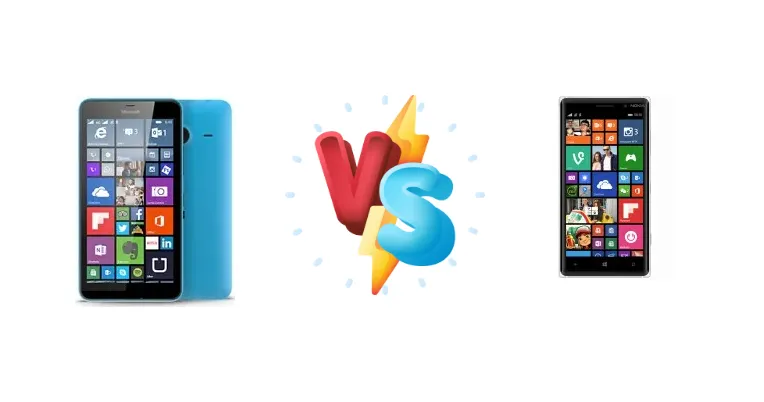
Released within a similar timeframe, the Microsoft Lumia 640 XL LTE Dual SIM and the Nokia Lumia 830 represent different approaches to the Windows Phone experience. The 640 XL prioritized affordability and battery life, while the 830 aimed for a more premium feel with features like wireless charging. This comparison dissects their specifications to determine which device offers the best value today.
🏆 Quick Verdict
For the average user prioritizing longevity and screen visibility in bright conditions, the Microsoft Lumia 640 XL LTE Dual SIM is the better choice. Its significantly longer 74-hour endurance rating and superior sunlight contrast (3.065) outweigh the Lumia 830’s wireless charging convenience.
| Network |
|---|
| 2G bands | GSM 850 / 900 / 1800 / 1900 - SIM 1 & SIM 2 | GSM 850 / 900 / 1800 / 1900 |
| 3G bands | HSDPA 850 / 900 / 1700 / 1900 / 2100 | HSDPA 850 / 900 / 1900 / 2100 |
| 4G bands | 1, 2, 3, 4, 5, 7, 8, 12, 17, 20, 28, 38, 40 | 1, 3, 7, 8, 20 |
| Speed | HSPA 42.2/5.76 Mbps, LTE Cat4 150/50 Mbps | HSPA 42.2/5.76 Mbps, LTE Cat4 150/50 Mbps |
| Technology | GSM / HSPA / LTE | GSM / HSPA / LTE |
| | - | 2, 4, 5, 17 - AT&T |
| Launch |
|---|
| Announced | 2015, March. Released 2015, April | 2014, September. Released 2014, September |
| Status | Discontinued | Discontinued |
| Body |
|---|
| Dimensions | 157.9 x 81.5 x 9 mm (6.22 x 3.21 x 0.35 in) | 139.4 x 70.7 x 8.5 mm (5.49 x 2.78 x 0.33 in) |
| SIM | Dual SIM (Micro-SIM, dual stand-by) | Nano-SIM |
| Weight | 171 g (6.03 oz) | 150 g (5.29 oz) |
| Display |
|---|
| Protection | Corning Gorilla Glass 3 | Corning Gorilla Glass 3 |
| Resolution | 720 x 1280 pixels, 16:9 ratio (~259 ppi density) | 720 x 1280 pixels, 16:9 ratio (~294 ppi density) |
| Size | 5.7 inches, 88.9 cm2 (~69.1% screen-to-body ratio) | 5.0 inches, 68.9 cm2 (~69.9% screen-to-body ratio) |
| Type | IPS LCD | IPS LCD |
| | ClearBlack display | ClearBlack display |
| Platform |
|---|
| CPU | Quad-core 1.2 GHz Cortex-A7 | Quad-core 1.2 GHz Cortex-A7 |
| Chipset | Qualcomm MSM8226 Snapdragon 400 (28 nm) | Qualcomm Snapdragon 400 (28 nm) |
| GPU | Adreno 305 | Adreno 305 |
| OS | Microsoft Windows Phone 8.1, upgradable to Microsoft Windows 10 | Microsoft Windows Phone 8.1, upgradable to Microsoft Windows 10 |
| Memory |
|---|
| Card slot | microSDXC (dedicated slot) | microSDXC (dedicated slot) |
| Internal | 8GB 1GB RAM | 16GB 1GB RAM |
| | eMMC 4.5 | eMMC 4.5 |
| Main Camera |
|---|
| Features | Zeiss optics, LED flash | Zeiss optics, LED flash, panorama |
| Single | 13 MP, f/2.0, 28mm (wide), 1/3.0", AF | 10 MP, f/2.2, 26mm (wide), 1/3.4", AF, OIS |
| Video | 1080p@30fps | 1080p@30fps, stereo sound rec. |
| Selfie camera |
|---|
| Single | 5 MP | 0.9 MP |
| Video | 1080p@30fps | 720p |
| Sound |
|---|
| 3.5mm jack | Yes | Yes |
| 35mm jack | Yes | Yes |
| Loudspeaker | Yes | Yes |
| Comms |
|---|
| Bluetooth | 4.0, A2DP | 4.0, A2DP, EDR, LE, aptX |
| NFC | Yes | Yes |
| Positioning | GPS, GLONASS, BDS | GPS, GLONASS, BDS |
| Radio | FM radio | FM radio |
| USB | microUSB 2.0 | microUSB 2.0 |
| WLAN | Wi-Fi 802.11 b/g/n, DLNA, hotspot | Wi-Fi 802.11 a/b/g/n, dual-band, DLNA, hotspot |
| Features |
|---|
| Sensors | Accelerometer, proximity, compass, sensor core | Accelerometer, gyro, proximity, compass |
| Battery |
|---|
| Charging | - | Wireless (Qi) |
| Music play | - | Up to 78 h |
| Stand-by | Up to 936 h (2G) / Up to 936 h (3G) | Up to 528 h |
| Talk time | Up to 31 h 20 min (2G) / Up to 23 h 40 min (3G) | Up to 12 h 54 min (2G) / Up to 14 h 48 min (3G) |
| Type | Li-Ion 3000 mAh, removable | Li-Ion 2200 mAh, removable (BV-L4A) |
| Misc |
|---|
| Colors | Matte cyan, Orange, Black, Matte white, Glossy white | Orange, green, white, black, gold |
| Price | About 200 EUR | About 330 EUR |
| SAR | - | 0.87 W/kg (head) 0.83 W/kg (body) |
| SAR EU | - | 0.46 W/kg (head) 0.59 W/kg (body) |
| Tests |
|---|
| Audio quality |
Noise -93.0dB / Crosstalk -94.4dB |
Noise -89.7dB / Crosstalk -91.6dB |
| Battery life |
Endurance rating 74h
|
Endurance rating 68h
|
| Camera | - |
Photo / Video |
| Display |
Contrast ratio: 1119:1 (nominal), 3.065 (sunlight) |
Contrast ratio: 1078 (nominal), 1887 (sunlight) |
| Loudspeaker |
Voice 72dB / Noise 67dB / Ring 73dB
|
Voice 65dB / Noise 66dB / Ring 78dB
|
Microsoft Lumia 640 XL LTE Dual SIM
- Significantly longer battery life (74h endurance)
- Superior sunlight display contrast (3.065)
- Dual SIM capability for added flexibility
- Limited camera information suggests potentially lower image quality
- Lacks wireless charging convenience
Nokia Lumia 830
- Wireless charging (Qi standard) for convenient power-ups
- Slightly better nominal display contrast (1078:1)
- Potentially more refined camera experience (speculation)
- Shorter battery life (68h endurance)
- Lower sunlight display contrast (1.887)
Display Comparison
Both the Lumia 640 XL and 830 utilize similar display technology, but differ in performance. The 640 XL boasts a sunlight contrast ratio of 3.065, a substantial improvement over the 830’s 1.887. This means text and images will remain far more legible under direct sunlight. While both have a nominal contrast ratio around 1100:1, the 640 XL’s higher peak contrast provides a more vibrant viewing experience in challenging lighting conditions. We lack data on pixel density or panel type, but given the price points, both likely employ IPS LCDs.
Camera Comparison
Both phones feature a camera, but detailed specifications are limited. The context data only confirms 'Photo / Video' capabilities for the Lumia 830. Without sensor size, aperture, or image processing details, a direct comparison is difficult. The absence of specific camera features on the 640 XL suggests it may not offer the same level of photographic refinement as the 830, but this is an assumption. The lack of information on features like optical image stabilization (OIS) prevents a meaningful assessment of low-light performance.
Performance
Both devices are powered by the Qualcomm Snapdragon 400 (28nm) chipset with a quad-core 1.2 GHz Cortex-A7 CPU. This indicates similar processing power for everyday tasks like browsing, social media, and basic app usage. The 28nm manufacturing process suggests comparable thermal efficiency, meaning neither phone is likely to suffer significant throttling during sustained workloads. However, the 640 XL’s larger size *could* allow for slightly better passive cooling, though this is speculative without thermal testing data. RAM specifications are missing, but are likely similar, impacting multitasking capabilities.
Battery Life
The most significant difference lies in battery endurance. The Lumia 640 XL achieves a 74-hour endurance rating, compared to the 830’s 68 hours. This 8-hour advantage translates to a noticeable difference in real-world usage, particularly for users who frequently travel or have limited access to charging. The Lumia 830 compensates with wireless charging (Qi standard), offering a convenient alternative to traditional cable connections. However, wireless charging is generally slower than wired charging, and the 640 XL’s longer battery life may negate the need for frequent top-ups.
Buying Guide
Buy the Microsoft Lumia 640 XL LTE Dual SIM if you need extended battery life for travel or heavy usage, and if you frequently use your phone outdoors in sunlight. Buy the Nokia Lumia 830 if you value wireless charging convenience and a slightly better nominal display contrast ratio, and are willing to trade off battery endurance.
Frequently Asked Questions
❓ Is the Lumia 640 XL’s larger screen size a detriment to one-handed use?
The 640 XL’s larger display (size unspecified) may make it challenging to operate comfortably with one hand, particularly for users with smaller hands. The 830, being a more compact device, offers better one-handed usability, but at the cost of screen real estate and battery life.
❓ Does the Lumia 830’s wireless charging significantly impact charging speed?
Wireless charging, while convenient, is generally slower than wired charging. The Lumia 830’s wireless charging capability (Qi standard) will likely result in longer charging times compared to using a wired charger with the 640 XL. However, the convenience may outweigh the speed difference for some users.
❓ Given the age of these devices, are software updates still available?
Both devices ran Windows Phone 8.1, and support has officially ended. While some unofficial methods may exist, users should not expect to receive further operating system or security updates, posing a potential security risk.