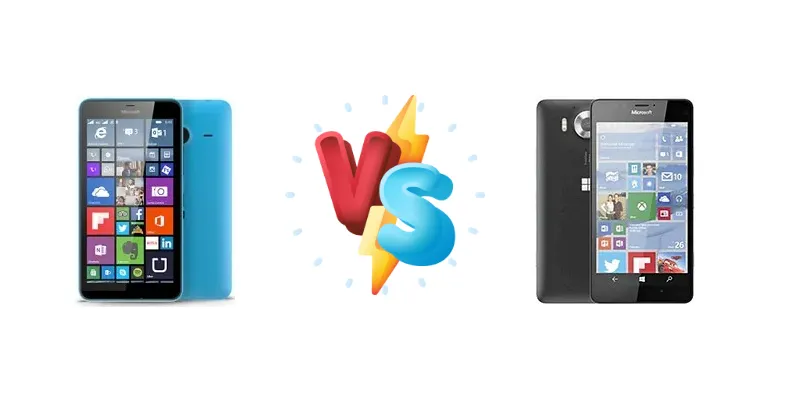
Released in different eras of Microsoft's mobile ambitions, the Lumia 950 represented a late push for a flagship Windows Phone experience, while the Lumia 640 XL focused on affordability and essential features. This comparison dissects the core differences between these two devices, focusing on how their hardware choices impact real-world usability.
🏆 Quick Verdict
For the average user prioritizing performance and camera capabilities, the Lumia 950 is the clear winner. Its Snapdragon 808 chipset and superior display contrast offer a significantly smoother and more visually appealing experience. However, the Lumia 640 XL remains a viable option for those prioritizing extended battery life and dual-SIM functionality on a tight budget.
| Network |
|---|
| 2G bands | GSM 850 / 900 / 1800 / 1900 - SIM 1 & SIM 2 | GSM 850 / 900 / 1800 / 1900 |
| 3G bands | HSDPA 850 / 900 / 1700 / 1900 / 2100 | HSDPA 850 / 900 / 1700(AWS) / 1900 / 2100 |
| 4G bands | 1, 2, 3, 4, 5, 7, 8, 12, 17, 20, 28, 38, 40 | 1, 2, 3, 4, 5, 7, 8, 12, 17, 20, 28, 38, 40 - EMEA |
| Speed | HSPA 42.2/5.76 Mbps, LTE Cat4 150/50 Mbps | HSPA 42.2/5.76 Mbps, LTE Cat6 300/50 Mbps |
| Technology | GSM / HSPA / LTE | GSM / HSPA / LTE |
| | - | 1, 2, 3, 4, 5, 7, 8, 12, 17, 20, 28, 38, 40, 41 - USA |
| Launch |
|---|
| Announced | 2015, March. Released 2015, April | 2015, October. Released 2015, November |
| Status | Discontinued | Discontinued |
| Body |
|---|
| Dimensions | 157.9 x 81.5 x 9 mm (6.22 x 3.21 x 0.35 in) | 145 x 73.2 x 8.2 mm (5.71 x 2.88 x 0.32 in) |
| SIM | Dual SIM (Micro-SIM, dual stand-by) | Nano-SIM |
| Weight | 171 g (6.03 oz) | 150 g (5.29 oz) |
| Display |
|---|
| Protection | Corning Gorilla Glass 3 | Corning Gorilla Glass 3 |
| Resolution | 720 x 1280 pixels, 16:9 ratio (~259 ppi density) | 1440 x 2560 pixels, 16:9 ratio (~564 ppi density) |
| Size | 5.7 inches, 88.9 cm2 (~69.1% screen-to-body ratio) | 5.2 inches, 74.8 cm2 (~70.5% screen-to-body ratio) |
| Type | IPS LCD | AMOLED |
| | ClearBlack display | ClearBlack display |
| Platform |
|---|
| CPU | Quad-core 1.2 GHz Cortex-A7 | Hexa-core (4x1.4 GHz Cortex-A53 & 2x1.8 GHz Cortex-A57) |
| Chipset | Qualcomm MSM8226 Snapdragon 400 (28 nm) | Qualcomm MSM8992 Snapdragon 808 (20 nm) |
| GPU | Adreno 305 | Adreno 418 |
| OS | Microsoft Windows Phone 8.1, upgradable to Microsoft Windows 10 | Microsoft Windows 10 |
| Memory |
|---|
| Card slot | microSDXC (dedicated slot) | microSDXC (dedicated slot) |
| Internal | 8GB 1GB RAM | 32GB 3GB RAM |
| | eMMC 4.5 | eMMC 5.0 |
| Main Camera |
|---|
| Features | Zeiss optics, LED flash | Zeiss optics, triple-LED RGB flash, panorama, HDR |
| Single | 13 MP, f/2.0, 28mm (wide), 1/3.0", AF | 20 MP, f/1.9, 26mm (wide), 1/2.4", 1.12µm, AF, OIS |
| Video | 1080p@30fps | 4K@30fps, stereo sound rec., 1080p@30/60fps (after SW update) |
| Selfie camera |
|---|
| Single | 5 MP | 5 MP, f/2.4 |
| Video | 1080p@30fps | 1080p@30fps |
| Sound |
|---|
| 3.5mm jack | Yes | Yes |
| 35mm jack | Yes | Yes |
| Loudspeaker | Yes | Yes |
| Comms |
|---|
| Bluetooth | 4.0, A2DP | 4.1, A2DP |
| NFC | Yes | Yes |
| Positioning | GPS, GLONASS, BDS | GPS, GLONASS, BDS |
| Radio | FM radio | FM radio |
| USB | microUSB 2.0 | USB Type-C 3.1 |
| WLAN | Wi-Fi 802.11 b/g/n, DLNA, hotspot | Wi-Fi 802.11 a/b/g/n/ac, dual-band, hotspot |
| Features |
|---|
| Sensors | Accelerometer, proximity, compass, sensor core | Iris scanner, accelerometer, gyro, proximity, compass, barometer, sensor core |
| | - | Microsoft Continuum support |
| Battery |
|---|
| Charging | - | 18W wired
Wireless (Qi) (market dependent) |
| Music play | - | Up to 67 h |
| Stand-by | Up to 936 h (2G) / Up to 936 h (3G) | Up to 288 h (2G) / Up to 288 h (3G) |
| Talk time | Up to 31 h 20 min (2G) / Up to 23 h 40 min (3G) | Up to 23 h (2G) / Up to 18 h (3G) |
| Type | Li-Ion 3000 mAh, removable | Li-Ion 3000 mAh, removable |
| Misc |
|---|
| Colors | Matte cyan, Orange, Black, Matte white, Glossy white | Black, White |
| Price | About 200 EUR | About 280 EUR |
| Tests |
|---|
| Audio quality |
Noise -93.0dB / Crosstalk -94.4dB |
Noise -91.3dB / Crosstalk -91.6dB |
| Battery life |
Endurance rating 74h
|
Endurance rating 48h
|
| Camera | - |
Photo / Video |
| Display |
Contrast ratio: 1119:1 (nominal), 3.065 (sunlight) |
Contrast ratio: Infinite (nominal), 3512 (sunlight) |
| Loudspeaker |
Voice 72dB / Noise 67dB / Ring 73dB
|
Voice 71dB / Noise 73dB / Ring 77dB
|
| Performance | - |
Basemark OS II 2.0: 1281Basemark X: 26330 |
Microsoft Lumia 640 XL LTE Dual SIM
- Exceptional battery life (74h endurance)
- Dual SIM support for added convenience
- Affordable price point
- Slow processor for demanding tasks
- Lower display contrast compared to the 950
Microsoft Lumia 950
- Powerful Snapdragon 808 processor
- Superior display contrast and quality
- Faster charging (18W wired, Qi wireless)
- Shorter battery life (48h endurance)
- Higher price compared to the 640 XL
Display Comparison
The Lumia 950 boasts a significantly superior display experience. While both phones share a similar sunlight contrast ratio of 3512:1, the 950’s ‘Infinite’ nominal contrast ratio indicates a true black level, likely due to an AMOLED panel (not explicitly stated in the data, but highly probable given the specs). This translates to richer colors and deeper blacks. The 640 XL’s 1119:1 nominal contrast suggests an IPS LCD, which, while still acceptable, lacks the vibrancy of an AMOLED. Both displays offer good visibility in direct sunlight, but the 950’s superior contrast will provide a more immersive viewing experience.
Camera Comparison
Both devices are listed as having 'Photo / Video' capabilities, but the Lumia 950 is expected to deliver a far superior imaging experience. While specific sensor details are missing, the 950, as a flagship, likely features a larger sensor and more advanced image processing algorithms. The 640 XL’s camera, while functional, will likely produce lower-quality images, especially in low-light conditions. The 950’s chipset also includes an ISP (Image Signal Processor) capable of handling more complex image processing tasks, resulting in better dynamic range and detail.
Performance
The performance gap between these devices is substantial. The Lumia 950’s Snapdragon 808, a hexa-core processor built on a 20nm process, is a significant upgrade over the 640 XL’s Snapdragon 400. The 808’s combination of four Cortex-A53 cores for efficiency and two Cortex-A57 cores for performance allows for smoother multitasking, faster app loading times, and better gaming performance. The 28nm Snapdragon 400 in the 640 XL, with its quad-core Cortex-A7, is adequate for basic tasks but will struggle with demanding applications. The 950’s more advanced chipset also benefits from improved GPU performance, making it a better choice for graphics-intensive games.
Battery Life
The Lumia 640 XL’s endurance rating of 74 hours significantly surpasses the Lumia 950’s 48 hours. This is a direct result of the 640 XL’s more efficient processor and likely a larger battery capacity (not specified in the data). However, the Lumia 950 compensates with 18W wired charging and optional Qi wireless charging, allowing for faster and more convenient replenishment. While the 950’s battery life is shorter, its faster charging capabilities mitigate this disadvantage to some extent.
Buying Guide
Buy the Microsoft Lumia 640 XL LTE Dual SIM if you need a reliable, long-lasting phone for basic communication, enjoy the convenience of dual SIMs, and prioritize battery life over raw performance. Buy the Microsoft Lumia 950 if you prefer a faster, more responsive experience, demand a better camera for photos and videos, and appreciate features like wireless charging and a higher-quality display.
Frequently Asked Questions
❓ Does the Snapdragon 400 in the Lumia 640 XL struggle with modern app performance?
Yes, the Snapdragon 400 is a relatively old and low-end processor. While it can handle basic tasks like calling, texting, and web browsing, it will likely exhibit noticeable lag and slowdowns when running more demanding apps or multitasking heavily. Expect longer loading times and a less responsive user experience.
❓ Is the lack of specific camera specs on the Lumia 950 a concern?
While the exact sensor size and megapixels aren't listed, the Lumia 950's flagship positioning and the Snapdragon 808's advanced ISP strongly suggest a high-quality camera system. It's safe to assume it will outperform the 640 XL in most scenarios, particularly in low-light conditions and with dynamic range.
❓ How significant is the difference in charging speed between the two devices?
The Lumia 950's 18W wired charging and optional Qi wireless charging provide a substantial advantage over the 640 XL, which likely supports only slower charging speeds. This means you can replenish the 950's battery much faster, minimizing downtime.