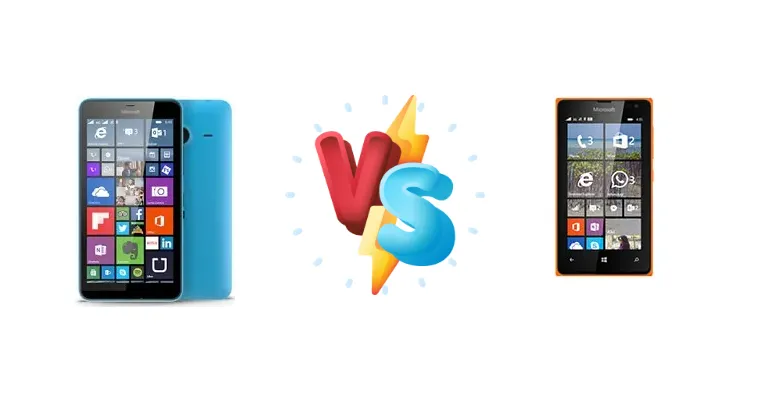
The Microsoft Lumia 640 XL and 435 represent a bygone era of Windows Phone, but remain relevant for those seeking ultra-affordable, dual-SIM capable devices. This comparison dissects the core differences between these two models, focusing on where the 640 XL’s larger size and more powerful chipset translate into a superior user experience, and whether the 435’s lower price justifies its compromises.
🏆 Quick Verdict
For the average user, the Microsoft Lumia 640 XL LTE Dual SIM is the better choice. Its significantly longer 74-hour endurance rating and more capable Snapdragon 400 processor provide a smoother, more reliable experience, justifying the likely price premium over the 64-hour endurance Lumia 435.
| Network |
|---|
| 2G bands | GSM 850 / 900 / 1800 / 1900 - SIM 1 & SIM 2 | GSM 850 / 900 / 1800 / 1900 - SIM 1 & SIM 2 |
| 3G bands | HSDPA 850 / 900 / 1700 / 1900 / 2100 | HSDPA 900 / 2100 |
| 4G bands | 1, 2, 3, 4, 5, 7, 8, 12, 17, 20, 28, 38, 40 | - |
| Speed | HSPA 42.2/5.76 Mbps, LTE Cat4 150/50 Mbps | HSPA 42.2/5.76 Mbps |
| Technology | GSM / HSPA / LTE | GSM / HSPA |
| Launch |
|---|
| Announced | 2015, March. Released 2015, April | 2015, January. Released 2015, February |
| Status | Discontinued | Discontinued |
| Body |
|---|
| Dimensions | 157.9 x 81.5 x 9 mm (6.22 x 3.21 x 0.35 in) | 118.1 x 64.7 x 11.7 mm (4.65 x 2.55 x 0.46 in) |
| SIM | Dual SIM (Micro-SIM, dual stand-by) | Dual SIM (Micro-SIM, dual stand-by) |
| Weight | 171 g (6.03 oz) | 134.1 g (4.73 oz) |
| Display |
|---|
| Protection | Corning Gorilla Glass 3 | - |
| Resolution | 720 x 1280 pixels, 16:9 ratio (~259 ppi density) | 480 x 800 pixels, 5:3 ratio (~233 ppi density) |
| Size | 5.7 inches, 88.9 cm2 (~69.1% screen-to-body ratio) | 4.0 inches, 45.5 cm2 (~59.6% screen-to-body ratio) |
| Type | IPS LCD | IPS LCD, |
| | ClearBlack display | - |
| Platform |
|---|
| CPU | Quad-core 1.2 GHz Cortex-A7 | Dual-core 1.2 GHz Cortex-A7 |
| Chipset | Qualcomm MSM8226 Snapdragon 400 (28 nm) | Qualcomm MSM8210 Snapdragon 200 (28 nm) |
| GPU | Adreno 305 | Adreno 302 |
| OS | Microsoft Windows Phone 8.1, upgradable to Microsoft Windows 10 | Microsoft Windows Phone 8.1, upgradable to Windows 10 |
| Memory |
|---|
| Card slot | microSDXC (dedicated slot) | microSDXC (dedicated slot) |
| Internal | 8GB 1GB RAM | 8GB 1GB RAM |
| | eMMC 4.5 | eMMC 4.5 |
| Main Camera |
|---|
| Features | Zeiss optics, LED flash | - |
| Single | 13 MP, f/2.0, 28mm (wide), 1/3.0", AF | 2 MP, f/2.7, 36mm (standard), 1/5.0" |
| Video | 1080p@30fps | 480p@30fps |
| Selfie camera |
|---|
| Single | 5 MP | VGA |
| Video | 1080p@30fps | 480p |
| Sound |
|---|
| 3.5mm jack | Yes | Yes |
| 35mm jack | Yes | Yes |
| Loudspeaker | Yes | Yes |
| Comms |
|---|
| Bluetooth | 4.0, A2DP | 4.0, A2DP |
| NFC | Yes | No |
| Positioning | GPS, GLONASS, BDS | A-GPS, GLONASS |
| Radio | FM radio | FM radio, RDS |
| USB | microUSB 2.0 | microUSB 2.0 |
| WLAN | Wi-Fi 802.11 b/g/n, DLNA, hotspot | Wi-Fi 802.11 b/g/n, hotspot |
| Features |
|---|
| Sensors | Accelerometer, proximity, compass, sensor core | Accelerometer, proximity |
| Battery |
|---|
| Music play | - | Up to 64 h |
| Stand-by | Up to 936 h (2G) / Up to 936 h (3G) | Up to 504 h (2G) / Up to 504 h (3G) |
| Talk time | Up to 31 h 20 min (2G) / Up to 23 h 40 min (3G) | Up to 21 h (2G) / Up to 11 h 45 min (3G) |
| Type | Li-Ion 3000 mAh, removable | Li-Ion 1560 mAh, removable |
| Misc |
|---|
| Colors | Matte cyan, Orange, Black, Matte white, Glossy white | Black, White, Green, Orange |
| Price | About 200 EUR | About 70 EUR |
| SAR | - | 1.05 W/kg (head) 0.57 W/kg (body) |
| SAR EU | - | 0.58 W/kg (head) 0.54 W/kg (body) |
| Tests |
|---|
| Audio quality |
Noise -93.0dB / Crosstalk -94.4dB | - |
| Battery life |
Endurance rating 74h
| Endurance rating 64h |
| Display |
Contrast ratio: 1119:1 (nominal), 3.065 (sunlight) | - |
| Loudspeaker |
Voice 72dB / Noise 67dB / Ring 73dB
| - |
Microsoft Lumia 640 XL LTE Dual SIM
- Longer battery life (74h endurance)
- More powerful Snapdragon 400 processor
- Better display contrast for outdoor visibility
- Likely higher price point
- Larger size may not suit all users
Microsoft Lumia 435 Dual SIM
- More affordable price
- Compact and lightweight design
- Dual SIM functionality
- Shorter battery life (64h endurance)
- Less powerful Snapdragon 200 processor
- Potentially poorer display visibility
Display Comparison
The Lumia 640 XL boasts a larger display, but the key difference lies in contrast. The 640 XL achieves a nominal contrast ratio of 1119:1, improving to a significantly better 3.065:1 in sunlight. This suggests superior outdoor visibility compared to the 435, which lacks published contrast data, implying a lower value. While both likely utilize IPS LCD technology, the 640 XL’s larger screen real estate and improved contrast make it more suitable for media consumption and outdoor use. We can infer that the 435's display is more likely to wash out in direct sunlight.
Camera Comparison
Neither device is a photography powerhouse, but the 640 XL likely offers a slightly better experience due to its more powerful ISP within the Snapdragon 400. While specific camera specs are not provided, the 640 XL’s processing capabilities will likely result in better image quality, particularly in low-light conditions. The 435’s Snapdragon 200 has a less capable image signal processor, potentially leading to more noise and less detail in photos. Focusing on the core processing power, the 640 XL will likely handle image processing faster.
Performance
The core performance disparity stems from the chipsets: the 640 XL utilizes the Qualcomm MSM8226 Snapdragon 400 with a quad-core 1.2 GHz Cortex-A7 CPU, while the 435 is equipped with the MSM8210 Snapdragon 200 featuring a dual-core 1.2 GHz Cortex-A7 CPU. While both are Cortex-A7 based, the Snapdragon 400’s additional cores provide a substantial advantage in multitasking and handling more demanding applications. The 400’s architecture, though still 28nm, is more efficient, contributing to the 640 XL’s longer battery life. Users will notice a difference in app loading times and overall system responsiveness, favoring the 640 XL.
Battery Life
Battery life is a significant differentiator. The Lumia 640 XL achieves an endurance rating of 74 hours, compared to the 435’s 64 hours. This 10-hour advantage translates to a noticeable difference in real-world usage, allowing the 640 XL to last longer between charges. While both phones utilize a 28nm process, the Snapdragon 400’s improved efficiency, combined with a potentially larger battery capacity (not specified in the data), contributes to the extended endurance. This makes the 640 XL a better choice for users who rely heavily on their phone throughout the day.
Buying Guide
Buy the Microsoft Lumia 640 XL LTE Dual SIM if you prioritize battery life, smoother multitasking, and a more responsive user experience, even if it means spending a bit more. It’s ideal for users who frequently use their phone for navigation, media consumption, or light productivity. Buy the Microsoft Lumia 435 Dual SIM if your primary concern is absolute affordability and you only need a phone for basic tasks like calls, texts, and occasional light browsing. It’s a good option for first-time smartphone users or as a reliable backup device.
Frequently Asked Questions
❓ Will the Lumia 435 struggle with modern app performance, even for basic tasks?
The Snapdragon 200 in the Lumia 435 is a very basic processor. While it can handle calls, texts, and light browsing, you may experience noticeable lag and slowdowns when running multiple apps or using more demanding applications. It's best suited for users with minimal smartphone needs.
❓ How much of a difference will the battery life improvement of the 640 XL make in daily use?
The 10-hour endurance difference translates to a noticeable improvement. Users of the 640 XL can expect to get through a full day of moderate use without needing to recharge, whereas the 435 might require a top-up in the late afternoon or evening, especially with active usage like navigation or media streaming.
❓ Are either of these phones likely to receive software updates at this point?
Given that Microsoft has discontinued support for Windows Phone, it's highly unlikely that either device will receive any further software updates. Both phones are running older versions of the operating system and will not benefit from security patches or new features.