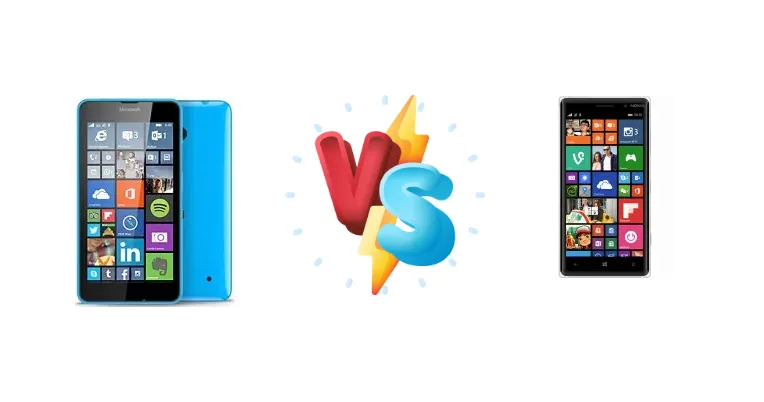
Released within a similar timeframe and targeting the budget-conscious Windows Phone user, the Microsoft Lumia 640 LTE and Nokia Lumia 830 represent different approaches to affordability. The 640 prioritizes extended battery life, while the 830 offers a more refined display and the convenience of wireless charging. This comparison dissects their key differences to determine which device delivers the best value.
🏆 Quick Verdict
For the average user, the Nokia Lumia 830 is the better choice. While both share the same Snapdragon 400 chipset, the 830’s significantly superior display contrast ratio – 1887 in sunlight versus the 640’s 2563 – makes it more usable outdoors, and the addition of Qi wireless charging adds a layer of convenience.
| Network |
|---|
| 2G bands | GSM 850 / 900 / 1800 / 1900 | GSM 850 / 900 / 1800 / 1900 |
| 3G bands | HSDPA 850 / 900 / 2100 | HSDPA 850 / 900 / 1900 / 2100 |
| 4G bands | 1, 3, 7, 8, 20 | 1, 3, 7, 8, 20 |
| Speed | HSPA 42.2/5.76 Mbps, LTE Cat4 150/50 Mbps | HSPA 42.2/5.76 Mbps, LTE Cat4 150/50 Mbps |
| Technology | GSM / HSPA / LTE | GSM / HSPA / LTE |
| | 1, 2, 4, 5, 7, 12, 17 - T-Mobile | 2, 4, 5, 17 - AT&T |
| Launch |
|---|
| Announced | 2015, March. Released 2015, April | 2014, September. Released 2014, September |
| Status | Discontinued | Discontinued |
| Body |
|---|
| Dimensions | 141.3 x 72.2 x 8.8 mm (5.56 x 2.84 x 0.35 in) | 139.4 x 70.7 x 8.5 mm (5.49 x 2.78 x 0.33 in) |
| SIM | Micro-SIM | Nano-SIM |
| Weight | 145 g (5.11 oz) | 150 g (5.29 oz) |
| Display |
|---|
| Protection | Corning Gorilla Glass 3 | Corning Gorilla Glass 3 |
| Resolution | 720 x 1280 pixels, 16:9 ratio (~294 ppi density) | 720 x 1280 pixels, 16:9 ratio (~294 ppi density) |
| Size | 5.0 inches, 68.9 cm2 (~67.6% screen-to-body ratio) | 5.0 inches, 68.9 cm2 (~69.9% screen-to-body ratio) |
| Type | IPS LCD | IPS LCD |
| | ClearBlack display | ClearBlack display |
| Platform |
|---|
| CPU | Quad-core 1.2 GHz Cortex-A7 | Quad-core 1.2 GHz Cortex-A7 |
| Chipset | Qualcomm MSM8926 Snapdragon 400 (28 nm) | Qualcomm Snapdragon 400 (28 nm) |
| GPU | Adreno 305 | Adreno 305 |
| OS | Microsoft Windows Phone 8.1, upgradable to Microsoft Windows 10 | Microsoft Windows Phone 8.1, upgradable to Microsoft Windows 10 |
| Memory |
|---|
| Card slot | microSDXC (dedicated slot) | microSDXC (dedicated slot) |
| Internal | 8GB 1GB RAM | 16GB 1GB RAM |
| | eMMC 4.5 | eMMC 4.5 |
| Main Camera |
|---|
| Features | LED flash | Zeiss optics, LED flash, panorama |
| Single | 8 MP, f/2.2, 28mm (wide), 1/4.0", AF | 10 MP, f/2.2, 26mm (wide), 1/3.4", AF, OIS |
| Video | 1080p@30fps | 1080p@30fps, stereo sound rec. |
| Selfie camera |
|---|
| Single | 1 MP | 0.9 MP |
| Video | 720p | 720p |
| Sound |
|---|
| 3.5mm jack | Yes | Yes |
| 35mm jack | Yes | Yes |
| Loudspeaker | Yes | Yes |
| Comms |
|---|
| Bluetooth | 4.0, A2DP | 4.0, A2DP, EDR, LE, aptX |
| NFC | Yes | Yes |
| Positioning | GPS, GLONASS, BDS | GPS, GLONASS, BDS |
| Radio | FM radio | FM radio |
| USB | microUSB 2.0 | microUSB 2.0 |
| WLAN | Wi-Fi 802.11 b/g/n, DLNA, hotspot | Wi-Fi 802.11 a/b/g/n, dual-band, DLNA, hotspot |
| Features |
|---|
| Sensors | Accelerometer, proximity, compass | Accelerometer, gyro, proximity, compass |
| Battery |
|---|
| Charging | - | Wireless (Qi) |
| Music play | - | Up to 78 h |
| Stand-by | Up to 864 h (2G) / Up to 864 h (3G) | Up to 528 h |
| Talk time | Up to 26 h 30 min (2G) / Up to 17 h 30 min (3G) | Up to 12 h 54 min (2G) / Up to 14 h 48 min (3G) |
| Type | Li-Ion 2500 mAh, removable | Li-Ion 2200 mAh, removable (BV-L4A) |
| Misc |
|---|
| Colors | Glossy cyan, Orange, White, Matte black | Orange, green, white, black, gold |
| Price | About 120 EUR | About 330 EUR |
| SAR | - | 0.87 W/kg (head) 0.83 W/kg (body) |
| SAR EU | - | 0.46 W/kg (head) 0.59 W/kg (body) |
| Tests |
|---|
| Audio quality |
Noise -93.1dB / Crosstalk -93.2dB |
Noise -89.7dB / Crosstalk -91.6dB |
| Battery life |
Endurance rating 76h
|
Endurance rating 68h
|
| Camera |
Photo / Video |
Photo / Video |
| Display |
Contrast ratio: 1034 (nominal), 2.563 (sunlight) |
Contrast ratio: 1078 (nominal), 1887 (sunlight) |
| Loudspeaker |
Voice 70dB / Noise 65dB / Ring 75dB
|
Voice 65dB / Noise 66dB / Ring 78dB
|
Microsoft Lumia 640 LTE
- Longer battery life (76h endurance)
- More affordable price point (likely)
- Solid performance for basic tasks
- Inferior display contrast, especially in sunlight
- Lacks wireless charging
- Potentially less refined camera software
Nokia Lumia 830
- Superior display contrast (1887 sunlight)
- Convenient Qi wireless charging
- Potentially better camera software
- Shorter battery life (68h endurance)
- Likely a higher price than the 640 LTE
- Similar performance to the 640 LTE
Display Comparison
The Nokia Lumia 830 boasts a clear advantage in display quality. While both feature similar nominal contrast ratios (1078 vs 1034), the 830’s sunlight contrast ratio of 1887 is substantially higher than the 640 LTE’s 2563. This means the 830’s screen remains far more legible under direct sunlight, a critical factor for outdoor use. Both displays utilize similar technology, but the 830’s panel is demonstrably better optimized for outdoor visibility.
Camera Comparison
Both devices are listed as having 'Photo / Video' capabilities, but detailed camera specifications are absent. Given the market positioning, it’s reasonable to assume both feature similar camera sensors and image processing. However, the Lumia 830, being positioned slightly higher, likely benefits from slightly better software optimization and potentially a marginally larger sensor. Without specific megapixel counts or aperture information, a definitive camera comparison is impossible, but the 830 likely holds a slight edge.
Performance
Both the Lumia 640 LTE and 830 are powered by the Qualcomm Snapdragon 400 (MSM8926) chipset with a quad-core 1.2 GHz Cortex-A7 CPU. This means performance will be nearly identical for everyday tasks like browsing, social media, and basic app usage. The 28nm manufacturing process is consistent across both devices, suggesting similar thermal characteristics and throttling behavior under sustained load. Neither phone is a performance powerhouse, but they are adequate for their target market.
Battery Life
The Microsoft Lumia 640 LTE excels in battery life, achieving an endurance rating of 76 hours compared to the Lumia 830’s 68 hours. This 8-hour difference translates to a noticeable advantage for users who prioritize longevity. However, the Lumia 830 compensates with the inclusion of Qi wireless charging, offering a convenient alternative to traditional cable-based charging. The 640 LTE lacks this feature, relying solely on micro-USB.
Buying Guide
Buy the Microsoft Lumia 640 LTE if you prioritize maximum battery endurance and are frequently away from power outlets. Its 76-hour endurance rating provides a tangible advantage for users who heavily rely on their phone throughout the day. Buy the Nokia Lumia 830 if you value a better viewing experience, especially in bright conditions, and appreciate the convenience of wireless charging. The improved display contrast and Qi support justify the slight trade-off in battery life for users who consume media or work outdoors.
Frequently Asked Questions
❓ Is the difference in sunlight readability between the Lumia 640 LTE and 830 noticeable in everyday use?
Yes, the Lumia 830’s significantly higher sunlight contrast ratio (1887) makes a tangible difference when using the phone outdoors. The screen remains much more visible under direct sunlight, reducing the need to find shade or increase brightness, which further impacts battery life. The 640 LTE’s lower contrast ratio (2563) will struggle in similar conditions.
❓ Does the lack of wireless charging on the Lumia 640 LTE significantly impact the user experience?
For users accustomed to the convenience of wireless charging, the absence of Qi support on the 640 LTE is a drawback. However, for those who primarily charge their phones overnight or don’t mind using a micro-USB cable, it’s unlikely to be a major issue. The 640 LTE’s longer battery life partially mitigates this limitation.
❓ Given they both use the Snapdragon 400, will I notice a performance difference between the two phones when running apps?
No, you are unlikely to notice a significant performance difference when running standard apps on either the Lumia 640 LTE or the 830. Both devices utilize the same chipset and CPU, resulting in comparable performance for everyday tasks like browsing, social media, and email. Any perceived differences would likely be attributable to software optimization rather than hardware.