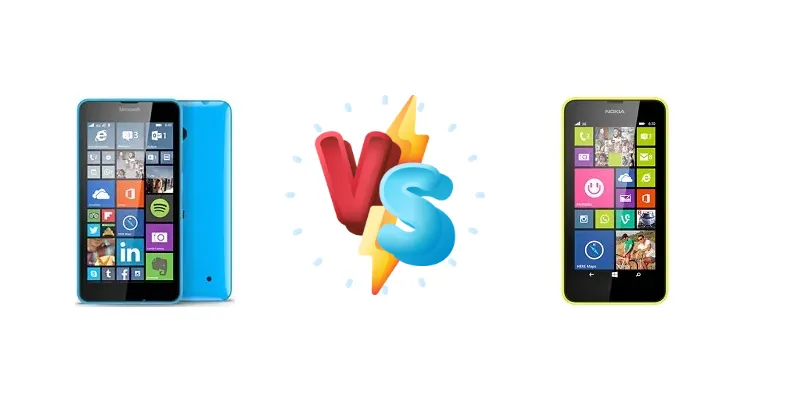
The Lumia 640 LTE and Nokia Lumia 630 were popular budget Windows Phone options. Both offered a decent experience for their price point, but which one truly delivered more? This comprehensive comparison dives deep into their specs, performance, and features to help you decide which was the better choice.
🏆 Quick Verdict
The Microsoft Lumia 640 LTE edges out the Nokia Lumia 630 thanks to its superior sunlight readability and slightly longer battery life. While both are budget devices, the 640 LTE offers a marginally better overall experience, making it the preferred choice for most users.
| Network |
|---|
| 2G bands | GSM 850 / 900 / 1800 / 1900 | GSM 850 / 900 / 1800 / 1900 - all versions |
| 3G bands | HSDPA 850 / 900 / 2100 | HSDPA 900 / 2100 - RM-976 |
| 4G bands | 1, 3, 7, 8, 20 | - |
| Speed | HSPA 42.2/5.76 Mbps, LTE Cat4 150/50 Mbps | HSPA 21.1/5.76 Mbps |
| Technology | GSM / HSPA / LTE | GSM / HSPA |
| | 1, 2, 4, 5, 7, 12, 17 - T-Mobile | HSDPA 850 / 900 / 1900 / 2100 - RM-977 |
| Launch |
|---|
| Announced | 2015, March. Released 2015, April | 2014, April. Released 2014, May |
| Status | Discontinued | Discontinued |
| Body |
|---|
| Dimensions | 141.3 x 72.2 x 8.8 mm (5.56 x 2.84 x 0.35 in) | 129.5 x 66.7 x 9.2 mm, 78.5 cc (5.10 x 2.63 x 0.36 in) |
| SIM | Micro-SIM | Micro-SIM |
| Weight | 145 g (5.11 oz) | 134 g (4.73 oz) |
| Display |
|---|
| Protection | Corning Gorilla Glass 3 | Corning Gorilla Glass 3 |
| Resolution | 720 x 1280 pixels, 16:9 ratio (~294 ppi density) | 480 x 854 pixels, 16:9 ratio (~221 ppi density) |
| Size | 5.0 inches, 68.9 cm2 (~67.6% screen-to-body ratio) | 4.5 inches, 54.3 cm2 (~62.9% screen-to-body ratio) |
| Type | IPS LCD | IPS LCD |
| | ClearBlack display | ClearBlack display |
| Platform |
|---|
| CPU | Quad-core 1.2 GHz Cortex-A7 | Quad-core 1.2 GHz Cortex-A7 |
| Chipset | Qualcomm MSM8926 Snapdragon 400 (28 nm) | Qualcomm Snapdragon 400 (28 nm) |
| GPU | Adreno 305 | Adreno 305 |
| OS | Microsoft Windows Phone 8.1, upgradable to Microsoft Windows 10 | Microsoft Windows Phone 8.1 |
| Memory |
|---|
| Card slot | microSDXC (dedicated slot) | microSDXC (dedicated slot) |
| Internal | 8GB 1GB RAM | 8GB 512MB RAM |
| | eMMC 4.5 | eMMC 4.5 |
| Main Camera |
|---|
| Features | LED flash | Panorama |
| Single | 8 MP, f/2.2, 28mm (wide), 1/4.0", AF | 5 MP, 1/4.0", AF |
| Video | 1080p@30fps | 720p@30fps |
| Selfie camera |
|---|
| Single | 1 MP | - |
| Video | 720p | - |
| | - | No |
| Sound |
|---|
| 3.5mm jack | Yes | Yes |
| 35mm jack | Yes | Yes |
| Loudspeaker | Yes | Yes |
| Comms |
|---|
| Bluetooth | 4.0, A2DP | 4.0, A2DP, LE/ aptX after WP8 Denim update |
| NFC | Yes | No |
| Positioning | GPS, GLONASS, BDS | GPS, GLONASS |
| Radio | FM radio | FM radio |
| USB | microUSB 2.0 | microUSB 2.0 |
| WLAN | Wi-Fi 802.11 b/g/n, DLNA, hotspot | Wi-Fi 802.11 b/g/n, DLNA, hotspot |
| Features |
|---|
| Sensors | Accelerometer, proximity, compass | Accelerometer, sensor core |
| Battery |
|---|
| Music play | - | Up to 58 h |
| Stand-by | Up to 864 h (2G) / Up to 864 h (3G) | Up to 600 h |
| Talk time | Up to 26 h 30 min (2G) / Up to 17 h 30 min (3G) | Up to 16 h 20 min (2G) / Up to 13 h 10 min (3G) |
| Type | Li-Ion 2500 mAh, removable | Li-Ion 1830 mAh, removable (BL-5H) |
| Misc |
|---|
| Colors | Glossy cyan, Orange, White, Matte black | Bright Orange, bright green, bright yellow, white, black |
| Price | About 120 EUR | About 110 EUR |
| SAR | - | 1.52 W/kg (head) 1.25 W/kg (body) |
| SAR EU | - | 1.51 W/kg (head) 1.52 W/kg (body) |
| Tests |
|---|
| Audio quality |
Noise -93.1dB / Crosstalk -93.2dB | - |
| Battery life |
Endurance rating 76h
| Endurance rating 66h |
| Camera |
Photo / Video |
Photo / Video |
| Display |
Contrast ratio: 1034 (nominal), 2.563 (sunlight) |
Contrast ratio: 771:1 (nominal), 2.056 (sunlight) |
| Loudspeaker |
Voice 70dB / Noise 65dB / Ring 75dB
|
Voice 68dB / Noise 65dB / Ring 75dB |
Microsoft Lumia 640 LTE
- Better sunlight readability
- Longer battery life
- Higher resolution camera (typically)
- Slightly more premium feel
- Can be slightly more expensive than the 630
- Still a dated Windows Phone experience
Nokia Lumia 630
- More affordable
- Decent performance for basic tasks
- Compact and lightweight
- Lower contrast display
- Shorter battery life
- Lower resolution camera
- Limited software updates
Display Comparison
Both phones feature a 5-inch IPS LCD display with a resolution of 1280 x 720 pixels. However, the Lumia 640 LTE boasts a significantly higher contrast ratio (1034:1 nominal, 2.563 in sunlight) compared to the Lumia 630 (771:1 nominal, 2.056 in sunlight). This translates to noticeably better visibility in bright conditions and richer colors on the 640 LTE.
Camera Comparison
The Lumia 640 LTE typically features an 8MP rear camera with autofocus and LED flash, while the Lumia 630 has a 5MP rear camera. While both offer basic photo and video capabilities, the 640 LTE's higher resolution sensor generally produces better image quality, especially in well-lit conditions. Both lack front-facing cameras.
Performance
Both devices are powered by a Qualcomm Snapdragon 400 (28 nm) chipset and a Quad-core 1.2 GHz Cortex-A7 CPU. Performance will be similar for everyday tasks like browsing and social media. Don't expect blazing-fast speeds or demanding gaming capabilities from either phone.
Battery Life
The Lumia 640 LTE has an endurance rating of 76 hours, while the Lumia 630 clocks in at 66 hours. This difference, while not massive, suggests the 640 LTE offers slightly better battery efficiency, potentially due to minor hardware or software optimizations.
Buying Guide
The Microsoft Lumia 640 LTE is ideal for users prioritizing better outdoor visibility and slightly extended battery life. The Nokia Lumia 630 is a good option for those seeking a very affordable Windows Phone and are less concerned with peak display performance or absolute battery endurance.
Frequently Asked Questions
❓ Are these phones still worth buying?
Given their age and the end of Windows Phone support, neither phone is recommended for new purchases. However, if you already own one and are familiar with the platform, they can still be used for basic tasks.
❓ What operating system do these phones run?
Both phones originally ran Windows Phone 8.1 and received updates to Windows 10 Mobile. However, Microsoft has ended support for these operating systems.