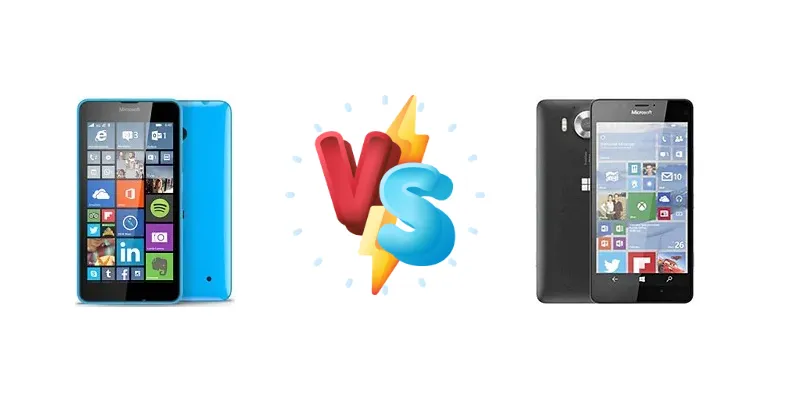
The Microsoft Lumia 640 LTE and Lumia 950 represent opposite ends of the Windows Phone spectrum. The 640 LTE aimed for affordability and long battery life, while the 950 was a late attempt at a premium flagship experience. This comparison dissects their key differences to determine which device best suits your needs in a post-Microsoft mobile world.
🏆 Quick Verdict
For the average user seeking a functional and long-lasting device, the Lumia 640 LTE emerges as the more practical choice. Its significantly superior battery endurance and lower price point outweigh the Lumia 950’s performance advantages, especially considering the limited software support for both.
| Network |
|---|
| 2G bands | GSM 850 / 900 / 1800 / 1900 | GSM 850 / 900 / 1800 / 1900 |
| 3G bands | HSDPA 850 / 900 / 2100 | HSDPA 850 / 900 / 1700(AWS) / 1900 / 2100 |
| 4G bands | 1, 3, 7, 8, 20 | 1, 2, 3, 4, 5, 7, 8, 12, 17, 20, 28, 38, 40 - EMEA |
| Speed | HSPA 42.2/5.76 Mbps, LTE Cat4 150/50 Mbps | HSPA 42.2/5.76 Mbps, LTE Cat6 300/50 Mbps |
| Technology | GSM / HSPA / LTE | GSM / HSPA / LTE |
| | 1, 2, 4, 5, 7, 12, 17 - T-Mobile | 1, 2, 3, 4, 5, 7, 8, 12, 17, 20, 28, 38, 40, 41 - USA |
| Launch |
|---|
| Announced | 2015, March. Released 2015, April | 2015, October. Released 2015, November |
| Status | Discontinued | Discontinued |
| Body |
|---|
| Dimensions | 141.3 x 72.2 x 8.8 mm (5.56 x 2.84 x 0.35 in) | 145 x 73.2 x 8.2 mm (5.71 x 2.88 x 0.32 in) |
| SIM | Micro-SIM | Nano-SIM |
| Weight | 145 g (5.11 oz) | 150 g (5.29 oz) |
| Display |
|---|
| Protection | Corning Gorilla Glass 3 | Corning Gorilla Glass 3 |
| Resolution | 720 x 1280 pixels, 16:9 ratio (~294 ppi density) | 1440 x 2560 pixels, 16:9 ratio (~564 ppi density) |
| Size | 5.0 inches, 68.9 cm2 (~67.6% screen-to-body ratio) | 5.2 inches, 74.8 cm2 (~70.5% screen-to-body ratio) |
| Type | IPS LCD | AMOLED |
| | ClearBlack display | ClearBlack display |
| Platform |
|---|
| CPU | Quad-core 1.2 GHz Cortex-A7 | Hexa-core (4x1.4 GHz Cortex-A53 & 2x1.8 GHz Cortex-A57) |
| Chipset | Qualcomm MSM8926 Snapdragon 400 (28 nm) | Qualcomm MSM8992 Snapdragon 808 (20 nm) |
| GPU | Adreno 305 | Adreno 418 |
| OS | Microsoft Windows Phone 8.1, upgradable to Microsoft Windows 10 | Microsoft Windows 10 |
| Memory |
|---|
| Card slot | microSDXC (dedicated slot) | microSDXC (dedicated slot) |
| Internal | 8GB 1GB RAM | 32GB 3GB RAM |
| | eMMC 4.5 | eMMC 5.0 |
| Main Camera |
|---|
| Features | LED flash | Zeiss optics, triple-LED RGB flash, panorama, HDR |
| Single | 8 MP, f/2.2, 28mm (wide), 1/4.0", AF | 20 MP, f/1.9, 26mm (wide), 1/2.4", 1.12µm, AF, OIS |
| Video | 1080p@30fps | 4K@30fps, stereo sound rec., 1080p@30/60fps (after SW update) |
| Selfie camera |
|---|
| Single | 1 MP | 5 MP, f/2.4 |
| Video | 720p | 1080p@30fps |
| Sound |
|---|
| 3.5mm jack | Yes | Yes |
| 35mm jack | Yes | Yes |
| Loudspeaker | Yes | Yes |
| Comms |
|---|
| Bluetooth | 4.0, A2DP | 4.1, A2DP |
| NFC | Yes | Yes |
| Positioning | GPS, GLONASS, BDS | GPS, GLONASS, BDS |
| Radio | FM radio | FM radio |
| USB | microUSB 2.0 | USB Type-C 3.1 |
| WLAN | Wi-Fi 802.11 b/g/n, DLNA, hotspot | Wi-Fi 802.11 a/b/g/n/ac, dual-band, hotspot |
| Features |
|---|
| Sensors | Accelerometer, proximity, compass | Iris scanner, accelerometer, gyro, proximity, compass, barometer, sensor core |
| | - | Microsoft Continuum support |
| Battery |
|---|
| Charging | - | 18W wired
Wireless (Qi) (market dependent) |
| Music play | - | Up to 67 h |
| Stand-by | Up to 864 h (2G) / Up to 864 h (3G) | Up to 288 h (2G) / Up to 288 h (3G) |
| Talk time | Up to 26 h 30 min (2G) / Up to 17 h 30 min (3G) | Up to 23 h (2G) / Up to 18 h (3G) |
| Type | Li-Ion 2500 mAh, removable | Li-Ion 3000 mAh, removable |
| Misc |
|---|
| Colors | Glossy cyan, Orange, White, Matte black | Black, White |
| Price | About 120 EUR | About 280 EUR |
| Tests |
|---|
| Audio quality |
Noise -93.1dB / Crosstalk -93.2dB |
Noise -91.3dB / Crosstalk -91.6dB |
| Battery life |
Endurance rating 76h
|
Endurance rating 48h
|
| Camera |
Photo / Video |
Photo / Video |
| Display |
Contrast ratio: 1034 (nominal), 2.563 (sunlight) |
Contrast ratio: Infinite (nominal), 3512 (sunlight) |
| Loudspeaker |
Voice 70dB / Noise 65dB / Ring 75dB
|
Voice 71dB / Noise 73dB / Ring 77dB
|
| Performance | - |
Basemark OS II 2.0: 1281Basemark X: 26330 |
Microsoft Lumia 640 LTE
- Exceptional battery life (76h endurance)
- More affordable price point
- Reliable for basic smartphone tasks
- Significantly slower performance
- Inferior display quality
- Less capable camera
Microsoft Lumia 950
- Powerful Snapdragon 808 processor
- Superior display with infinite contrast
- More advanced camera system
- Poor battery life (48h endurance)
- Higher price
- Potential for thermal throttling
Display Comparison
The Lumia 950 boasts a vastly superior display experience. While both phones offer contrast ratios for sunlight readability (2.563 for the 640 LTE vs. 3512 for the 950), the 950’s ‘Infinite’ nominal contrast ratio indicates a true black level, likely an AMOLED panel, offering richer colors and deeper blacks. This is a significant upgrade over the 640 LTE’s LCD. The 950’s display is better suited for viewing photos and videos, while the 640 LTE’s display is adequate for basic tasks.
Camera Comparison
Both devices feature photo and video capabilities, but the Lumia 950 is expected to offer a more refined experience. While specific sensor details are missing, the 950’s flagship positioning suggests a larger sensor and more advanced image processing algorithms. The 640 LTE’s camera is likely sufficient for casual snapshots, but the 950 will excel in low-light conditions and offer greater detail and dynamic range. The absence of details on lens apertures makes a precise comparison difficult, but the 950 is the clear winner based on its overall positioning.
Performance
The chipset difference is stark. The Lumia 640 LTE’s Qualcomm MSM8926 Snapdragon 400, with its quad-core 1.2 GHz Cortex-A7 CPU, is designed for efficiency, not speed. The Lumia 950’s Qualcomm MSM8992 Snapdragon 808, featuring a hexa-core configuration (4x1.4 GHz Cortex-A53 & 2x1.8 GHz Cortex-A57), delivers significantly more processing power. The 950’s 20nm manufacturing process also contributes to better thermal management compared to the 640 LTE’s 28nm process, reducing the likelihood of throttling during sustained workloads. This translates to smoother multitasking and faster app loading times on the 950.
Battery Life
Battery life is where the Lumia 640 LTE truly shines. Its endurance rating of 76 hours is almost double that of the Lumia 950’s 48 hours. This difference is likely due to the more efficient Snapdragon 400 chipset and the lower power demands of the 640 LTE’s display. While the Lumia 950 offers 18W wired charging and potentially wireless (Qi) charging, these features can’t compensate for the significantly shorter battery life. The 640 LTE is the clear choice for users who prioritize longevity between charges.
Buying Guide
Buy the Microsoft Lumia 640 LTE if you prioritize extended battery life, affordability, and a reliable, albeit basic, smartphone experience. It’s ideal for users who primarily need calling, texting, and light app usage. Buy the Microsoft Lumia 950 if you value performance for demanding apps, a superior display for media consumption, and a more capable camera system, understanding that this comes at the cost of significantly reduced battery endurance and a higher price.
Frequently Asked Questions
❓ Given the limited Windows Phone software support, is either of these phones still viable as a daily driver in 2024?
Both phones face significant limitations due to the discontinued support for Windows Phone. While basic functionality may still be available, app compatibility and security updates are major concerns. The Lumia 640 LTE’s lower price makes it a less risky investment for experimentation, but neither is recommended as a primary device.
❓ Does the Snapdragon 808 in the Lumia 950 offer a noticeable gaming experience compared to the Snapdragon 400?
Yes, the Snapdragon 808 provides a substantially improved gaming experience. Its hexa-core CPU and more powerful GPU can handle more demanding games with higher frame rates and better graphics settings. However, even with the 808, the limited software ecosystem and lack of updates may hinder the overall gaming experience.
❓ Is the difference in charging speed between the Lumia 640 LTE and 950 significant enough to sway a purchasing decision?
While the Lumia 950’s 18W charging is faster than the 640 LTE’s likely slower charging, the difference is less impactful than the massive disparity in battery life. The 640 LTE’s longer endurance means you’ll need to charge it less frequently, mitigating the benefit of faster charging on the 950.