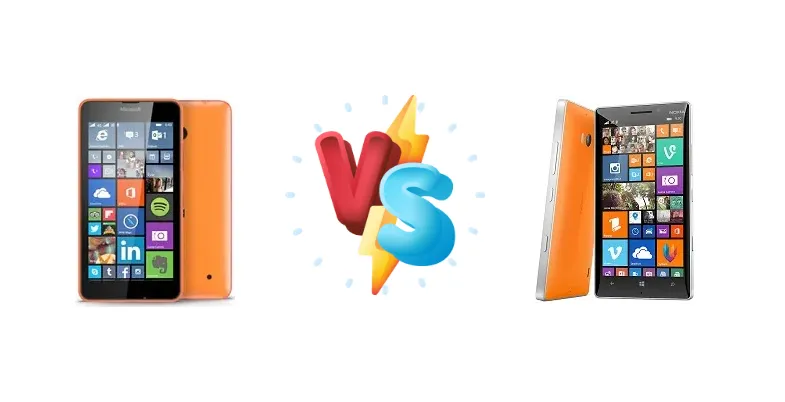
Released in different eras of the Lumia lineup, the Nokia Lumia 930 represented a premium Windows Phone experience, while the Microsoft Lumia 640 LTE focused on affordability and practicality. This comparison dissects their key differences, helping you understand which device best suits your needs in the current landscape.
🏆 Quick Verdict
For the average user seeking a balance of features and value, the Nokia Lumia 930 emerges as the stronger choice. Its significantly more powerful Snapdragon 800 processor and superior display contrast deliver a smoother, more visually appealing experience, despite the Lumia 640 LTE’s longer battery endurance.
| Network |
|---|
| 2G bands | GSM 850 / 900 / 1800 / 1900 - SIM 1 & SIM 2 | GSM 850 / 900 / 1800 / 1900 |
| 3G bands | HSDPA 850 / 900 / 1700 / 1900 / 2100 | HSDPA 850 / 900 / 1900 / 2100 |
| 4G bands | 1, 2, 3, 4, 5, 7, 8, 12, 17, 20, 28, 38, 40 | 1, 3, 7, 8, 20 |
| Speed | HSPA 42.2/5.76 Mbps, LTE Cat4 150/50 Mbps | HSPA 42.2/5.76 Mbps, LTE Cat4 150/50 Mbps |
| Technology | GSM / HSPA / LTE | GSM / HSPA / LTE |
| Launch |
|---|
| Announced | 2015, March. Released 2015, April | 2014, April. Released 2014, July |
| Status | Discontinued | Discontinued |
| Body |
|---|
| Dimensions | 141.3 x 72.2 x 8.8 mm (5.56 x 2.84 x 0.35 in) | 137 x 71 x 9.8 mm, 94.7 cc (5.39 x 2.80 x 0.39 in) |
| SIM | Dual SIM (Micro-SIM, dual stand-by) | Nano-SIM |
| Weight | 145 g (5.11 oz) | 167 g (5.89 oz) |
| Display |
|---|
| Protection | Corning Gorilla Glass 3 | Corning Gorilla Glass 3 |
| Resolution | 720 x 1280 pixels, 16:9 ratio (~294 ppi density) | 1080 x 1920 pixels, 16:9 ratio (~441 ppi density) |
| Size | 5.0 inches, 68.9 cm2 (~67.6% screen-to-body ratio) | 5.0 inches, 68.9 cm2 (~70.9% screen-to-body ratio) |
| Type | IPS LCD | AMOLED |
| | ClearBlack display | ClearBlack display |
| Platform |
|---|
| CPU | Quad-core 1.2 GHz Cortex-A7 | Quad-core 2.2 GHz Krait 400 |
| Chipset | Qualcomm MSM8926 Snapdragon 400 (28 nm) | Qualcomm MSM8974 Snapdragon 800 (28 nm) |
| GPU | Adreno 305 | Adreno 330 |
| OS | Microsoft Windows Phone 8.1, upgradable to Microsoft Windows 10 | Microsoft Windows Phone 8.1, upgradable to Windows 10 |
| Memory |
|---|
| Card slot | microSDXC (dedicated slot) | No |
| Internal | 8GB 1GB RAM | 32GB 2GB RAM |
| | eMMC 4.5 | eMMC 4.5 |
| Main Camera |
|---|
| Features | LED flash | Zeiss optics, dual-LED flash, panorama, HDR |
| Single | 8 MP, f/2.2, 28mm (wide), 1/4.0", AF | 20 MP, f/2.4, 26mm (wide), 1/2.5", AF, OIS |
| Video | 1080p@30fps | 4K@30fps (after WP8 Denim update), 1080p@30fps, stereo sound rec. |
| Selfie camera |
|---|
| Single | 1 MP | 1.2 MP |
| Video | 720p | 720p@30fps |
| Sound |
|---|
| 3.5mm jack | Yes | Yes |
| 35mm jack | Yes | Yes |
| Loudspeaker | Yes | Yes |
| Comms |
|---|
| Bluetooth | 4.0, A2DP | 4.0, A2DP, EDR, LE/ aptX after WP8 Denim update |
| NFC | Yes | Yes |
| Positioning | GPS, GLONASS, BDS | GPS, GLONASS |
| Radio | FM radio | FM radio |
| USB | microUSB 2.0 | microUSB 2.0 |
| WLAN | Wi-Fi 802.11 b/g/n, DLNA, hotspot | Wi-Fi 802.11 a/b/g/n/ac, dual-band, DLNA, hotspot |
| Features |
|---|
| Sensors | Accelerometer, proximity, compass | Accelerometer, gyro, proximity, compass, sensor core |
| Battery |
|---|
| Charging | - | Wireless (Qi) (market dependent) |
| Music play | - | Up to 75 h |
| Stand-by | Up to 864 h (2G) / Up to 864 h (3G) | Up to 432 h |
| Talk time | Up to 26 h 30 min (2G) / Up to 17 h 30 min (3G) | Up to 11 h 30 min (2G) / Up to 15 h 30 min (3G) |
| Type | Li-Ion 2500 mAh, removable | Li-Ion 2420 mAh, non-removable (BV-5QW) |
| Misc |
|---|
| Colors | Glossy cyan, Orange, White, Matte black | Bright orange, bright green, white, black, gold |
| Price | About 150 EUR | About 370 EUR |
| SAR | - | 0.90 W/kg (head) 0.56 W/kg (body) |
| SAR EU | - | 0.60 W/kg (head) 0.73 W/kg (body) |
| Tests |
|---|
| Audio quality |
Noise -93.1dB / Crosstalk -93.2dB |
Noise -91.4dB / Crosstalk -90.3dB |
| Battery life |
Endurance rating 76h
| Endurance rating 46h |
| Camera | - |
Photo / Video |
| Display |
Contrast ratio: 1034 (nominal), 2.563 (sunlight) |
Contrast ratio: Infinite (nominal), 3.567 (sunlight) |
| Loudspeaker |
Voice 70dB / Noise 65dB / Ring 75dB
|
Voice 76dB / Noise 69dB / Ring 77dB |
Microsoft Lumia 640 LTE Dual SIM
- Significantly longer battery life (76h endurance)
- Dual SIM functionality for added convenience
- More affordable price point
- Slower processor (Snapdragon 400)
- Lower display contrast and outdoor visibility
- Lacks wireless charging
Nokia Lumia 930
- Faster processor (Snapdragon 800)
- Superior display contrast and outdoor visibility
- Wireless charging (Qi, market dependent)
- Shorter battery life (46h endurance)
- Higher price point
- No dual SIM support
Display Comparison
The Nokia Lumia 930 boasts a superior display experience, evidenced by its 'Infinite' nominal contrast ratio compared to the Lumia 640 LTE’s 1034. While both feature a 28nm chipset, the display’s impact on power draw is mitigated by the 930’s overall efficiency gains in other areas. Crucially, the 930’s sunlight contrast ratio of 3.567 is significantly higher than the 640 LTE’s 2.563, meaning better visibility outdoors. The Lumia 640 LTE’s display, while functional, is clearly a cost-saving measure.
Camera Comparison
Both devices feature photo and video capabilities, but the Lumia 930 likely holds an advantage due to its higher-end chipset enabling more sophisticated image processing. While specific sensor details are unavailable, the 930’s position as a flagship suggests a larger sensor and better optics. The Lumia 640 LTE’s camera is adequate for casual use, but won’t match the detail and low-light performance of the 930.
Performance
The performance disparity is stark. The Nokia Lumia 930’s Qualcomm MSM8974 Snapdragon 800, with its quad-core 2.2 GHz Krait 400 CPU, is a substantial upgrade over the Lumia 640 LTE’s Snapdragon 400 (1.2 GHz Cortex-A7). The Krait 400 architecture offers significantly better single-core and multi-core performance, translating to faster app loading times, smoother multitasking, and a more responsive overall experience. While both chipsets are fabricated on a 28nm process, the architectural differences are paramount.
Battery Life
The Microsoft Lumia 640 LTE shines in battery endurance, achieving a rating of 76 hours compared to the Lumia 930’s 46 hours. This difference is significant, offering nearly 65% more uptime. However, this advantage comes at the cost of performance and display quality. The Lumia 930 compensates with wireless charging (Qi, market dependent), a feature absent on the 640 LTE, offering a convenient alternative to traditional charging.
Buying Guide
Buy the Microsoft Lumia 640 LTE Dual SIM if you prioritize extended battery life and the convenience of dual SIM functionality, making it ideal for frequent travelers or those managing multiple phone numbers. Buy the Nokia Lumia 930 if you prefer a faster, more responsive user experience, a better camera, and the added convenience of wireless charging, even at the cost of shorter battery life.
Frequently Asked Questions
❓ Is the Lumia 640 LTE’s dual SIM functionality useful for international travel?
Yes, the dual SIM capability of the Lumia 640 LTE is particularly beneficial for international travelers. It allows you to use a local SIM card for data and calls while retaining your primary SIM for essential services, avoiding expensive roaming charges.
❓ Does the Snapdragon 800 in the Lumia 930 still feel fast in 2024, considering modern smartphone standards?
While not on par with the latest Snapdragon chips, the Snapdragon 800 remains surprisingly capable for basic smartphone tasks like browsing, social media, and messaging. However, demanding games or heavily animated interfaces may exhibit some slowdowns.
❓ How does the lack of wireless charging on the Lumia 640 LTE affect its usability?
The absence of wireless charging on the Lumia 640 LTE means you're reliant on a Micro-USB cable for charging. While not a deal-breaker, it lacks the convenience of simply placing the phone on a charging pad.