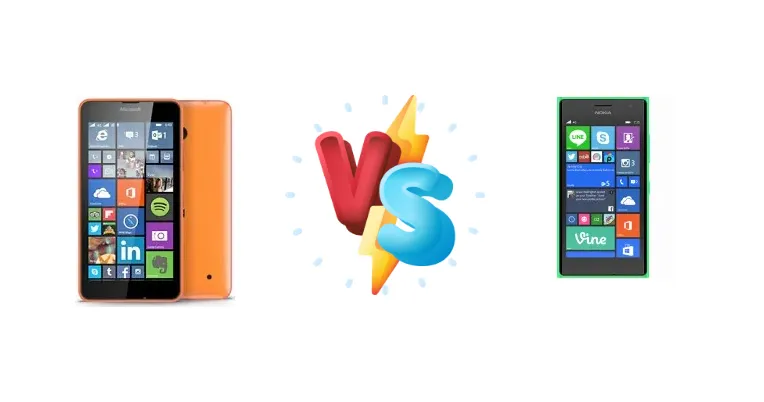
Released around the same timeframe, the Microsoft Lumia 640 LTE Dual SIM and the Nokia Lumia 735 represent different priorities within the budget Windows Phone segment. The 640 LTE focuses on maximizing battery life and offering dual-SIM functionality, while the 735 emphasizes convenience with wireless charging. This comparison dissects their specifications to determine which device best suits your needs.
🏆 Quick Verdict
For the average user prioritizing longevity, the Microsoft Lumia 640 LTE Dual SIM is the clear winner. Its 76-hour endurance rating significantly outpaces the Lumia 735’s 59 hours. However, those valuing wireless charging and a slightly more streamlined experience will find the Lumia 735 appealing.
| Network |
|---|
| 2G bands | GSM 850 / 900 / 1800 / 1900 - SIM 1 & SIM 2 | GSM 850 / 900 / 1800 / 1900 |
| 3G bands | HSDPA 850 / 900 / 1700 / 1900 / 2100 | HSDPA 850 / 1700(AWS) / 1900 / 2100 - RM-1039 |
| 4G bands | 1, 2, 3, 4, 5, 7, 8, 12, 17, 20, 28, 38, 40 | 2, 4, 5, 7, 17 - RM-1039 |
| Speed | HSPA 42.2/5.76 Mbps, LTE Cat4 150/50 Mbps | HSPA 42.2/5.76 Mbps, LTE Cat4 150/50 Mbps |
| Technology | GSM / HSPA / LTE | GSM / HSPA / LTE |
| | - | 3, 7, 20 - RM-1038 |
| Launch |
|---|
| Announced | 2015, March. Released 2015, April | 2014, September. Released 2014, September |
| Status | Discontinued | Discontinued |
| Body |
|---|
| Dimensions | 141.3 x 72.2 x 8.8 mm (5.56 x 2.84 x 0.35 in) | 134.7 x 68.5 x 8.9 mm (5.30 x 2.70 x 0.35 in) |
| SIM | Dual SIM (Micro-SIM, dual stand-by) | Nano-SIM |
| Weight | 145 g (5.11 oz) | 134 g (4.73 oz) |
| Display |
|---|
| Protection | Corning Gorilla Glass 3 | Corning Gorilla Glass 3 |
| Resolution | 720 x 1280 pixels, 16:9 ratio (~294 ppi density) | 720 x 1280 pixels, 16:9 ratio (~312 ppi density) |
| Size | 5.0 inches, 68.9 cm2 (~67.6% screen-to-body ratio) | 4.7 inches, 60.9 cm2 (~66.0% screen-to-body ratio) |
| Type | IPS LCD | OLED |
| | ClearBlack display | ClearBlack display |
| Platform |
|---|
| CPU | Quad-core 1.2 GHz Cortex-A7 | Quad-core 1.2 GHz Cortex-A7 |
| Chipset | Qualcomm MSM8926 Snapdragon 400 (28 nm) | Qualcomm Snapdragon 400 (28 nm) |
| GPU | Adreno 305 | Adreno 305 |
| OS | Microsoft Windows Phone 8.1, upgradable to Microsoft Windows 10 | Microsoft Windows Phone 8.1, upgradable to Microsoft Windows 10 |
| Memory |
|---|
| Card slot | microSDXC (dedicated slot) | microSDXC (dedicated slot) |
| Internal | 8GB 1GB RAM | 8GB 1GB RAM |
| | eMMC 4.5 | eMMC 4.5 |
| Main Camera |
|---|
| Features | LED flash | Zeiss optics, LED flash, panorama |
| Single | 8 MP, f/2.2, 28mm (wide), 1/4.0", AF | 6.7 MP (6.1 MP effective), 1/3.4", AF |
| Video | 1080p@30fps | 1080p@30fps, stereo sound rec. |
| Selfie camera |
|---|
| Single | 1 MP | 5 MP |
| Video | 720p | 1080p@30fps |
| Sound |
|---|
| 3.5mm jack | Yes | Yes |
| 35mm jack | Yes | Yes |
| Loudspeaker | Yes | Yes |
| Comms |
|---|
| Bluetooth | 4.0, A2DP | 4.0, A2DP, LE/ aptX after WP8 Denim update |
| NFC | Yes | Yes |
| Positioning | GPS, GLONASS, BDS | GPS, GLONASS, BDS |
| Radio | FM radio | FM radio |
| USB | microUSB 2.0 | microUSB 2.0 |
| WLAN | Wi-Fi 802.11 b/g/n, DLNA, hotspot | Wi-Fi 802.11 b/g/n, DLNA, hotspot |
| Features |
|---|
| Sensors | Accelerometer, proximity, compass | Accelerometer, gyro, proximity, compass, sensor core |
| Battery |
|---|
| Charging | - | Wireless (Qi) |
| Music play | - | Up to 60 h |
| Stand-by | Up to 864 h (2G) / Up to 864 h (3G) | Up to 600 h |
| Talk time | Up to 26 h 30 min (2G) / Up to 17 h 30 min (3G) | Up to 22 h (2G) / Up to 17 h (3G) |
| Type | Li-Ion 2500 mAh, removable | Li-Ion 2200 mAh, removable (BV-T5A) |
| Misc |
|---|
| Colors | Glossy cyan, Orange, White, Matte black | Orange, green, white, black |
| Price | About 150 EUR | About 220 EUR |
| SAR | - | 1.38 W/kg (head) 0.78 W/kg (body) |
| SAR EU | - | 0.80 W/kg (head) 0.48 W/kg (body) |
| Tests |
|---|
| Audio quality |
Noise -93.1dB / Crosstalk -93.2dB | - |
| Battery life |
Endurance rating 76h
|
Endurance rating 59h
|
| Camera | - |
Photo / Video |
| Display |
Contrast ratio: 1034 (nominal), 2.563 (sunlight) | - |
| Loudspeaker |
Voice 70dB / Noise 65dB / Ring 75dB
| - |
Microsoft Lumia 640 LTE Dual SIM
- Significantly longer battery life (76h endurance)
- Dual SIM support for added flexibility
- Superior display contrast for better outdoor visibility
- Lacks wireless charging convenience
- Potentially bulkier design due to larger battery
Nokia Lumia 735
- Convenient wireless charging (Qi)
- Potentially slimmer and lighter design
- Simple, streamlined user experience
- Significantly shorter battery life (59h endurance)
- Lacks dual SIM functionality
- Display contrast likely inferior to the 640 LTE
Display Comparison
Both devices share the same Qualcomm Snapdragon 400 chipset, suggesting similar display controllers. However, the Lumia 640 LTE boasts a superior contrast ratio of 1034 (nominal) and 2.563 (sunlight) compared to the Lumia 735’s unspecified contrast ratio. This indicates better visibility in direct sunlight for the 640 LTE, a crucial advantage for outdoor users. While both likely utilize LCD panels, the higher contrast ratio suggests improved color reproduction and black levels on the 640 LTE.
Camera Comparison
Both phones feature photo and video capabilities, but the provided data lacks specifics regarding sensor size, aperture, or image processing. Given the market positioning, it’s safe to assume both utilize relatively basic camera modules. The absence of details prevents a meaningful comparison beyond acknowledging their shared functionality. It's unlikely either phone excels in low-light photography or offers advanced features like optical image stabilization.
Performance
Both the Lumia 640 LTE and 735 are powered by the Qualcomm Snapdragon 400 (28nm) with a quad-core 1.2 GHz Cortex-A7 CPU. This means performance will be nearly identical for everyday tasks like browsing, social media, and basic app usage. The 28nm manufacturing process is relatively mature, meaning thermal throttling shouldn’t be a significant concern for either device under moderate loads. The lack of RAM specification in the provided data prevents a deeper analysis of multitasking capabilities, but both likely feature 1GB of RAM, typical for this price point.
Battery Life
The most significant difference lies in battery life. The Lumia 640 LTE achieves an impressive endurance rating of 76 hours, while the Lumia 735 manages only 59 hours. This 17-hour difference is substantial and translates to a full day of extra usage for the 640 LTE. The Lumia 735 compensates with wireless charging (Qi standard), offering a convenient alternative to traditional cable charging. However, wireless charging is generally slower than wired charging, meaning a full charge will take longer on the 735.
Buying Guide
Buy the Microsoft Lumia 640 LTE Dual SIM if you need extended battery life for travel or heavy usage, and if the flexibility of dual-SIM support is essential. Buy the Nokia Lumia 735 if you prefer the convenience of wireless charging, and are willing to trade battery endurance for that feature. Both phones offer similar processing power for basic tasks.
Frequently Asked Questions
❓ Does the Lumia 640 LTE's dual SIM functionality support 4G LTE on both SIMs simultaneously?
While the Lumia 640 LTE supports dual SIM, it's important to note that it likely operates in a 'single active' mode for 4G LTE. This means only one SIM can utilize the 4G network at a time, while the other will fall back to 3G or 2G. Check your carrier's compatibility for specific details.
❓ How much slower is wireless charging on the Lumia 735 compared to wired charging?
Wireless charging (Qi) on the Lumia 735 is considerably slower than wired charging. Expect a full charge to take several hours via wireless charging, whereas a wired charge using a compatible charger should be significantly faster. The exact charging time depends on the wattage of the wireless charger and the cable used.
❓ Is the Snapdragon 400 in these phones capable of running modern apps smoothly?
The Snapdragon 400 is a relatively older processor. While it can handle basic tasks like calling, texting, and social media, it may struggle with more demanding apps or multitasking. Expect some lag or slowdown when running multiple apps simultaneously.