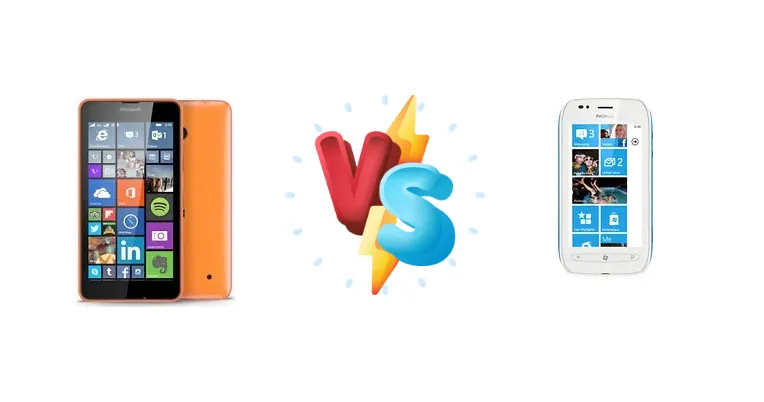
Released years apart, the Microsoft Lumia 640 LTE Dual SIM and the Nokia Lumia 710 represent different eras of Microsoft’s Windows Phone strategy. The 710 aimed for affordability in 2011, while the 640 LTE, released in 2015, attempted to offer a more modern experience with LTE connectivity and dual SIM support. This comparison dissects their key differences to determine which provides the best value today, considering their age and original market positioning.
🏆 Quick Verdict
For the average user seeking a functional, albeit aged, Windows Phone experience, the Microsoft Lumia 640 LTE Dual SIM is the clear winner. Its significantly superior battery life (76 hours vs 27 hours) and more powerful Snapdragon 400 chipset outweigh the Lumia 710’s slightly better nominal display contrast.
| Network |
|---|
| 2G bands | GSM 850 / 900 / 1800 / 1900 - SIM 1 & SIM 2 | GSM 850 / 900 / 1800 / 1900 |
| 3G bands | HSDPA 850 / 900 / 1700 / 1900 / 2100 | HSDPA 900 / 1900 / 2100 - RM-803 |
| 4G bands | 1, 2, 3, 4, 5, 7, 8, 12, 17, 20, 28, 38, 40 | - |
| Speed | HSPA 42.2/5.76 Mbps, LTE Cat4 150/50 Mbps | HSPA 14.4/5.76 Mbps |
| Technology | GSM / HSPA / LTE | GSM / HSPA |
| | - | HSDPA 850 / 900 / 1700 / 1900 / 2100 - For Canada |
| Launch |
|---|
| Announced | 2015, March. Released 2015, April | 2011, October. Released 2011, December |
| Status | Discontinued | Discontinued |
| Body |
|---|
| Dimensions | 141.3 x 72.2 x 8.8 mm (5.56 x 2.84 x 0.35 in) | 119 x 62.4 x 12.5 mm, 81.1 cc (4.69 x 2.46 x 0.49 in) |
| SIM | Dual SIM (Micro-SIM, dual stand-by) | Micro-SIM |
| Weight | 145 g (5.11 oz) | 125.5 g (4.41 oz) |
| Display |
|---|
| Protection | Corning Gorilla Glass 3 | Corning Gorilla Glass |
| Resolution | 720 x 1280 pixels, 16:9 ratio (~294 ppi density) | 480 x 800 pixels, 5:3 ratio (~252 ppi density) |
| Size | 5.0 inches, 68.9 cm2 (~67.6% screen-to-body ratio) | 3.7 inches, 39.0 cm2 (~52.5% screen-to-body ratio) |
| Type | IPS LCD | TFT |
| | ClearBlack display | Nokia ClearBlack display |
| Platform |
|---|
| CPU | Quad-core 1.2 GHz Cortex-A7 | 1.4 GHz Scorpion |
| Chipset | Qualcomm MSM8926 Snapdragon 400 (28 nm) | Qualcomm MSM8255 Snapdragon S2 |
| GPU | Adreno 305 | Adreno 205 |
| OS | Microsoft Windows Phone 8.1, upgradable to Microsoft Windows 10 | Microsoft Windows Phone 7.5 Mango |
| Memory |
|---|
| Card slot | microSDXC (dedicated slot) | No |
| Internal | 8GB 1GB RAM | 8GB 512MB RAM |
| | eMMC 4.5 | - |
| Main Camera |
|---|
| Features | LED flash | LED flash |
| Single | 8 MP, f/2.2, 28mm (wide), 1/4.0", AF | 5 MP, AF |
| Video | 1080p@30fps | 720p@30fps |
| Selfie camera |
|---|
| Single | 1 MP | - |
| Video | 720p | - |
| | - | No |
| Sound |
|---|
| 3.5mm jack | Yes | Yes |
| 35mm jack | Yes | Yes |
| Loudspeaker | Yes | Yes |
| Comms |
|---|
| Bluetooth | 4.0, A2DP | 2.1, A2DP, EDR |
| NFC | Yes | - |
| Positioning | GPS, GLONASS, BDS | GPS, A-GPS |
| Radio | FM radio | Stereo FM radio, RDS |
| USB | microUSB 2.0 | microUSB 2.0 |
| WLAN | Wi-Fi 802.11 b/g/n, DLNA, hotspot | Wi-Fi 802.11 b/g/n |
| Features |
|---|
| Sensors | Accelerometer, proximity, compass | Accelerometer, proximity, compass |
| | - | MP3/WAV/eAAC+/WMA player
MP4/H.264/WMV player
Document viewer/editor
Video/photo editor |
| Battery |
|---|
| Music play | - | Up to 38 h |
| Stand-by | Up to 864 h (2G) / Up to 864 h (3G) | Up to 400 h (2G) / Up to 400 h (3G) |
| Talk time | Up to 26 h 30 min (2G) / Up to 17 h 30 min (3G) | Up to 6 h 50 min (2G) / Up to 7 h 40 min (3G) |
| Type | Li-Ion 2500 mAh, removable | Removable Li-Ion 1300 mAh battery (BP-3L) |
| Misc |
|---|
| Colors | Glossy cyan, Orange, White, Matte black | Black, White (front)/ black, white, cyan, fuchsia, yellow (back) |
| Price | About 150 EUR | About 100 EUR |
| SAR | - | 1.06 W/kg (head) 0.94 W/kg (body) |
| SAR EU | - | 1.30 W/kg (head) |
| Tests |
|---|
| Audio quality |
Noise -93.1dB / Crosstalk -93.2dB |
Noise -80.9dB / Crosstalk -85.7dB |
| Battery life |
Endurance rating 76h
| Endurance rating 27h |
| Camera | - |
Photo / Video |
| Display |
Contrast ratio: 1034 (nominal), 2.563 (sunlight) |
Contrast ratio: 1115:1 (nominal) |
| Loudspeaker |
Voice 70dB / Noise 65dB / Ring 75dB
|
Voice 65dB / Noise 61dB / Ring 65dB |
Microsoft Lumia 640 LTE Dual SIM
- Significantly longer battery life (76h endurance)
- More powerful Snapdragon 400 processor
- LTE connectivity for faster data speeds
- Slightly lower nominal display contrast ratio
- Older Windows Phone OS (limited app support)
Nokia Lumia 710
- Higher nominal display contrast ratio (1115:1)
- Lower price point (likely, given its age)
- Compact form factor
- Poor battery life (27h endurance)
- Outdated Snapdragon S2 processor
- No LTE connectivity
Display Comparison
Both devices feature similar nominal display contrast ratios, with the Lumia 710 edging out the 640 LTE at 1115:1 versus 1034:1. However, the Lumia 640 LTE boasts a significantly improved sunlight contrast ratio of 2.563, indicating much better visibility outdoors. While neither display is particularly high-resolution by modern standards, the improved outdoor visibility of the 640 LTE is a practical advantage for everyday use. The panel technology used in both is likely TFT LCD, common for this price point at the time, lacking the color vibrancy of AMOLED displays.
Camera Comparison
Both devices offer basic photo and video capabilities, but detailed camera specifications are limited in the provided data. Given the Lumia 710’s age, its camera sensor is likely smaller and less capable than what was available in the 640 LTE. While neither phone will compete with modern smartphone cameras, the 640 LTE likely benefits from improved image processing algorithms available at the time of its release. The absence of details like megapixel count or aperture makes a precise comparison impossible, but the 640 LTE’s later release date suggests a more refined camera experience.
Performance
The Microsoft Lumia 640 LTE’s Qualcomm MSM8926 Snapdragon 400, with its quad-core 1.2 GHz Cortex-A7 CPU, represents a substantial leap in processing power over the Nokia Lumia 710’s Qualcomm MSM8255 Snapdragon S2 and its single-core 1.4 GHz Scorpion CPU. The Snapdragon 400’s architecture, built on a 28nm process, allows for more efficient multitasking and smoother app performance. The Lumia 710’s older Snapdragon S2, while adequate for basic tasks in 2011, will struggle with modern app demands and web browsing. The 640 LTE’s Adreno 305 GPU also provides a better graphics experience.
Battery Life
The most significant difference lies in battery endurance. The Lumia 640 LTE achieves an impressive 76-hour endurance rating, nearly tripling the Lumia 710’s 27-hour rating. This difference is attributable to the more efficient Snapdragon 400 chipset and potentially a slightly larger battery capacity (though not specified). For users prioritizing all-day battery life, the Lumia 640 LTE is the clear choice. While both phones are old, the 640 LTE’s battery will likely hold a charge for a longer period due to its superior efficiency.
Buying Guide
Buy the Microsoft Lumia 640 LTE Dual SIM if you need longer battery life, LTE connectivity for data, and the flexibility of dual SIM support. This is ideal for travelers or those wanting to separate work and personal lines. Buy the Nokia Lumia 710 if you prioritize a slightly higher nominal display contrast ratio and are looking for the absolute cheapest entry point into the Windows Phone ecosystem, understanding its limitations in performance and connectivity.
Frequently Asked Questions
❓ Will the Lumia 640 LTE receive any further Windows 10 Mobile updates?
Unfortunately, official support for Windows 10 Mobile has ended. Neither device will receive further official updates. However, the community may offer unofficial solutions, but these come with inherent risks and are not guaranteed.
❓ Is the dual SIM functionality on the Lumia 640 LTE useful in 2024?
Yes, the dual SIM functionality remains valuable for users who want to separate work and personal phone lines, or for travelers who use local SIM cards. It offers flexibility that the single-SIM Lumia 710 lacks.
❓ How will the age of the batteries affect the real-world performance of these phones?
Given the age of both devices, battery degradation is a significant concern. Expect the actual battery life to be considerably lower than the original endurance ratings. The Lumia 640 LTE’s superior initial endurance rating provides a larger buffer against this degradation.