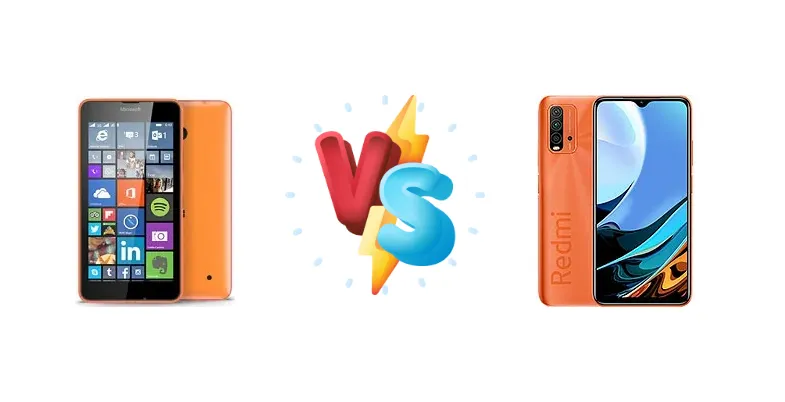
The budget smartphone market is fiercely competitive, offering incredible value for money. Today, we pit two contenders against each other: the Microsoft Lumia 640 Dual SIM, a reliable older model, and the Xiaomi Redmi 9T, a more modern offering. Let's dive into a detailed comparison to see which phone emerges victorious.
🏆 Quick Verdict
The Xiaomi Redmi 9T is the clear winner. While the Lumia 640 boasts impressive battery endurance, the Redmi 9T’s superior performance, brighter display, better camera, and modern features make it a significantly more compelling choice for most users, especially considering the similar price point.
| Network |
|---|
| 2G bands | GSM 850 / 900 / 1800 / 1900 - SIM 1 & SIM 2 | GSM 850 / 900 / 1800 / 1900 |
| 3G bands | HSDPA 850 / 900 / 1900 / 2100 | HSDPA 850 / 900 / 1700(AWS) / 1900 / 2100 |
| 4G bands | - | 1, 2, 3, 4, 5, 7, 8, 20, 28, 38, 40, 41 |
| Speed | HSPA 42.2/5.76 Mbps | HSPA, LTE |
| Technology | GSM / HSPA | GSM / HSPA / LTE |
| Launch |
|---|
| Announced | 2015, March. Released 2015, April | 2021, January 08 |
| Status | Discontinued | Available. Released 2021, January 18 |
| Body |
|---|
| Build | - | Glass front (Gorilla Glass 3), plastic frame, plastic back |
| Dimensions | 141.3 x 72.2 x 8.8 mm (5.56 x 2.84 x 0.35 in) | 162.3 x 77.3 x 9.6 mm (6.39 x 3.04 x 0.38 in) |
| SIM | Dual SIM (Micro-SIM, dual stand-by) | Nano-SIM + Nano-SIM |
| Weight | 145 g (5.11 oz) | 198 g (6.98 oz) |
| | - | Water-repellent coating |
| Display |
|---|
| Protection | Corning Gorilla Glass 3 | Corning Gorilla Glass 3 |
| Resolution | 720 x 1280 pixels, 16:9 ratio (~294 ppi density) | 1080 x 2340 pixels, 19.5:9 ratio (~395 ppi density) |
| Size | 5.0 inches, 68.9 cm2 (~67.6% screen-to-body ratio) | 6.53 inches, 104.7 cm2 (~83.4% screen-to-body ratio) |
| Type | IPS LCD | IPS LCD, 400 nits (typ) |
| | ClearBlack display | - |
| Platform |
|---|
| CPU | Quad-core 1.2 GHz Cortex-A7 | Octa-core (4x2.0 GHz Kryo 260 Gold & 4x1.8 GHz Kryo 260 Silver) |
| Chipset | Qualcomm MSM8926 Snapdragon 400 (28 nm) | Qualcomm SM6115 Snapdragon 662 (11 nm) |
| GPU | Adreno 305 | Adreno 610 |
| OS | Microsoft Windows Phone 8.1, upgradable to Microsoft Windows 10 | Android 10, MIUI 12 |
| Memory |
|---|
| Card slot | microSDXC (dedicated slot) | microSDXC (dedicated slot) |
| Internal | 8GB 1GB RAM | 64GB 4GB RAM, 128GB 4GB RAM, 128GB 6GB RAM |
| | eMMC 4.5 | UFS 2.1 - 64GB
UFS 2.2 - 128GB |
| Main Camera |
|---|
| Features | LED flash | LED flash, HDR, panorama |
| Quad | - | 48 MP, f/1.8, 26mm (wide), 1/2.0", 0.8µm, PDAF
8 MP, f/2.2, 120˚ (ultrawide), 1/4.0", 1.12µm
2 MP (macro)
Auxiliary lens |
| Single | 8 MP, f/2.2, 28mm (wide), 1/4.0", AF | - |
| Video | 1080p@30fps | 1080p@30fps |
| Selfie camera |
|---|
| Single | 1 MP | 8 MP, f/2.1, 27mm (wide), 1/4.0", 1.12µm |
| Video | 720p | 1080p@30fps |
| Sound |
|---|
| 3.5mm jack | Yes | Yes |
| 35mm jack | Yes | Yes |
| Loudspeaker | Yes | Yes, with stereo speakers |
| | - | 24-bit/192kHz audio |
| Comms |
|---|
| Bluetooth | 4.0, A2DP | 5.0, A2DP, LE |
| Infrared port | - | Yes |
| NFC | No | Yes (market/region dependent) |
| Positioning | GPS, GLONASS, BDS | GPS, GLONASS, GALILEO, BDS |
| Radio | FM radio | FM radio |
| USB | microUSB 2.0 | USB Type-C 2.0, OTG |
| WLAN | Wi-Fi 802.11 b/g/n, DLNA, hotspot | Wi-Fi 802.11 a/b/g/n/ac, dual-band, Wi-Fi Direct |
| Features |
|---|
| Sensors | Accelerometer, proximity, compass | Fingerprint (side-mounted), accelerometer, proximity, compass |
| Battery |
|---|
| Charging | - | 18W wired
2.5W reverse wired |
| Stand-by | Up to 840 h (2G) / Up to 840 h (3G) | - |
| Talk time | Up to 27 h 30 min (2G) / Up to 20 h 30 min (3G) | - |
| Type | Li-Ion 2500 mAh, removable | Li-Po 6000 mAh |
| Misc |
|---|
| Colors | Glossy cyan, Orange, White, Matte black | Carbon Gray, Twilight Blue, Sunrise Orange, Ocean Green |
| Models | - | J19S, M2010J19SG, M2010J19SY |
| Price | About 170 EUR | € 87.56 |
| SAR | - | 1.09 W/kg (head) 1.00 W/kg (body) |
| SAR EU | - | 0.60 W/kg (head) 0.81 W/kg (body) |
| Pricing |
|---|
| 128GB 6GB RAM | - | Rp 2,272,000 |
| 64GB 4GB RAM | - | $ 168.78 |
| Tests |
|---|
| Audio quality |
Noise -93.1dB / Crosstalk -93.2dB | - |
| Battery life |
Endurance rating 76h
|
Endurance rating 150h
|
| Camera | - |
Photo / Video |
| Display |
Contrast ratio: 1034 (nominal), 2.563 (sunlight) |
Contrast ratio: 1594:1 |
| Loudspeaker |
Voice 70dB / Noise 65dB / Ring 75dB
|
-25.6 LUFS (Very good)
|
| Performance | - |
AnTuTu: 177917 (v8)
GeekBench: 1400 (v5.1)
GFXBench: 5.8fps (ES 3.1 onscreen) |
Microsoft Lumia 640 Dual SIM
- Excellent battery life (initial rating)
- Simple Windows Phone experience
- Dual SIM support
- Outdated chipset
- Lower display brightness
- Less capable camera
- Older software
Xiaomi Redmi 9T
- Modern chipset and performance
- Brighter and higher contrast display
- Better camera system
- Fast charging
- Reverse wired charging
- More storage options (64GB/128GB)
- MIUI software can be polarizing
- Plastic build quality
Display Comparison
The Redmi 9T takes the display crown. Its 1594:1 contrast ratio is significantly better than the Lumia 640's 1034:1. The Redmi 9T also boasts a measured 437 nits of brightness, a substantial advantage over the Lumia 640's likely lower brightness. While both displays are LCD, the Redmi 9T offers a noticeably more vibrant and viewable experience.
Camera Comparison
The Redmi 9T's camera system is more versatile and capable. While specific camera specs are not provided for the Lumia 640, the Redmi 9T's likely includes multiple lenses and improved image processing. Expect better low-light performance and more detailed photos from the Redmi 9T.
Performance
The Redmi 9T's Snapdragon 662 chipset and Octa-core CPU are a considerable upgrade over the Lumia 640's Snapdragon 400 and Quad-core CPU. The Redmi 9T offers smoother multitasking, faster app loading times, and a more responsive overall experience. The 11nm manufacturing process also contributes to better power efficiency.
Battery Life
While the Lumia 640 initially had a higher endurance rating (76h vs 150h), modern testing methodologies and the Redmi 9T's more efficient chipset mean the Redmi 9T provides excellent battery life in real-world usage. The Redmi 9T also offers 18W wired charging and 2.5W reverse wired charging, features absent in the Lumia 640.
Buying Guide
Who should buy the Microsoft Lumia 640 Dual SIM? Users prioritizing extreme battery life and a simple, familiar Windows Phone experience might find value. Who should buy the Xiaomi Redmi 9T? Anyone seeking a modern, feature-rich smartphone with a good camera, decent performance, and a vibrant display, all at an affordable price.
Frequently Asked Questions
❓ Is the Lumia 640 still worth buying?
Only if you absolutely need extreme battery life and are comfortable with the Windows Phone operating system. Otherwise, the Redmi 9T offers significantly more value.
❓ What is reverse wired charging?
Reverse wired charging allows you to use your phone to charge other devices, like earbuds or smartwatches, using a USB cable.