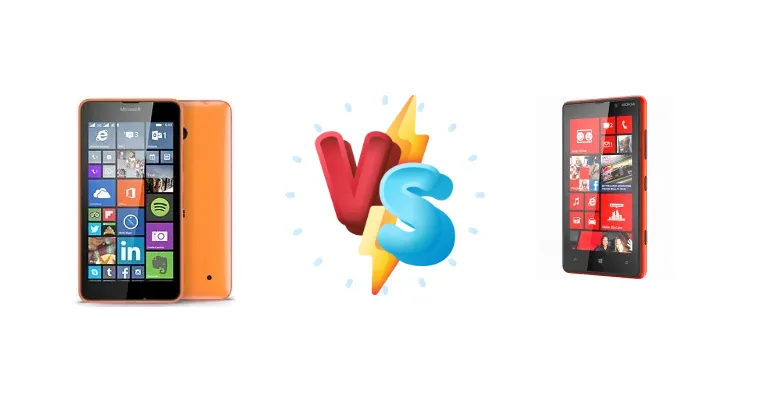
Released roughly a year apart, the Microsoft Lumia 640 Dual SIM and the Nokia Lumia 820 represent different points in Microsoft’s Windows Phone strategy. The 640 aimed for affordability and extended battery life, while the 820 was a mid-range offering focused on a more polished experience. This comparison dissects their key differences to determine which device holds up better today.
🏆 Quick Verdict
For the average user seeking a functional and long-lasting Windows Phone experience, the Microsoft Lumia 640 Dual SIM emerges as the better choice. Its significantly superior battery endurance and improved display contrast outweigh the Lumia 820’s slightly faster processor, especially considering the age of both devices.
| Network |
|---|
| 2G bands | GSM 850 / 900 / 1800 / 1900 - SIM 1 & SIM 2 | GSM 850 / 900 / 1800 / 1900 |
| 3G bands | HSDPA 850 / 900 / 1900 / 2100 | HSDPA 850 / 900 / 1900 / 2100 |
| 4G bands | - | 1, 3, 7, 8, 20 |
| EDGE | - | Class 12 |
| GPRS | - | Class 12 |
| Speed | HSPA 42.2/5.76 Mbps | HSPA 42.2/5.76 Mbps, LTE Cat3 100/50 Mbps |
| Technology | GSM / HSPA | GSM / HSPA / LTE |
| Launch |
|---|
| Announced | 2015, March. Released 2015, April | 2012, September. Released 2012, November |
| Status | Discontinued | Discontinued |
| Body |
|---|
| Dimensions | 141.3 x 72.2 x 8.8 mm (5.56 x 2.84 x 0.35 in) | 123.8 x 68.5 x 9.9 mm, 83.5 cc (4.87 x 2.70 x 0.39 in) |
| SIM | Dual SIM (Micro-SIM, dual stand-by) | Micro-SIM |
| Weight | 145 g (5.11 oz) | 160 g (5.64 oz) |
| Display |
|---|
| Protection | Corning Gorilla Glass 3 | - |
| Resolution | 720 x 1280 pixels, 16:9 ratio (~294 ppi density) | 480 x 800 pixels, 5:3 ratio (~217 ppi density) |
| Size | 5.0 inches, 68.9 cm2 (~67.6% screen-to-body ratio) | 4.3 inches, 52.6 cm2 (~62.1% screen-to-body ratio) |
| Type | IPS LCD | AMOLED |
| | ClearBlack display | Nokia ClearBlack display |
| Platform |
|---|
| CPU | Quad-core 1.2 GHz Cortex-A7 | Dual-core 1.5 GHz Krait |
| Chipset | Qualcomm MSM8926 Snapdragon 400 (28 nm) | Qualcomm MSM8960 Snapdragon S4 Plus |
| GPU | Adreno 305 | Adreno 225 |
| OS | Microsoft Windows Phone 8.1, upgradable to Microsoft Windows 10 | Microsoft Windows Phone 8, upgradable to 8.1 |
| Memory |
|---|
| Card slot | microSDXC (dedicated slot) | microSDXC (dedicated slot) |
| Internal | 8GB 1GB RAM | 8GB 1GB RAM |
| | eMMC 4.5 | - |
| Main Camera |
|---|
| Features | LED flash | Carl Zeiss optics, dual-LED flash |
| Single | 8 MP, f/2.2, 28mm (wide), 1/4.0", AF | 8 MP, AF |
| Video | 1080p@30fps | 1080p@30fps |
| Selfie camera |
|---|
| Single | 1 MP | VGA |
| Video | 720p | - |
| Sound |
|---|
| 3.5mm jack | Yes | Yes |
| 35mm jack | Yes | Yes |
| Loudspeaker | Yes | Yes |
| Comms |
|---|
| Bluetooth | 4.0, A2DP | 4.0, A2DP, EDR, LE/ aptX after WP8 Denim update |
| NFC | No | Yes |
| Positioning | GPS, GLONASS, BDS | GPS, A-GPS, GLONASS |
| Radio | FM radio | FM radio |
| USB | microUSB 2.0 | microUSB 2.0 |
| WLAN | Wi-Fi 802.11 b/g/n, DLNA, hotspot | Wi-Fi 802.11 a/b/g/n, dual-band, Wi-Fi Direct |
| Features |
|---|
| Sensors | Accelerometer, proximity, compass | Accelerometer, gyro, proximity, compass |
| Battery |
|---|
| Music play | - | Up to 55 h |
| Stand-by | Up to 840 h (2G) / Up to 840 h (3G) | Up to 330 h (2G) / Up to 330 h (3G) |
| Talk time | Up to 27 h 30 min (2G) / Up to 20 h 30 min (3G) | Up to 14 h (2G) / Up to 8 h (3G) |
| Type | Li-Ion 2500 mAh, removable | Removable Li-Ion 1650 mAh battery (BP-5T) |
| Misc |
|---|
| Colors | Glossy cyan, Orange, White, Matte black | Black, Gray, Red, Yellow, White, Blue, Violet |
| Price | About 170 EUR | About 170 EUR |
| SAR | - | 1.37 W/kg (head) 0.71 W/kg (body) |
| SAR EU | - | 0.79 W/kg (head) |
| Tests |
|---|
| Audio quality |
Noise -93.1dB / Crosstalk -93.2dB |
Noise -82.2dB / Crosstalk -81.4dB |
| Battery life |
Endurance rating 76h
|
Endurance rating 40h
|
| Camera | - |
Photo / Video |
| Display |
Contrast ratio: 1034 (nominal), 2.563 (sunlight) |
Contrast ratio: Infinite (nominal) / 2.193:1 (sunlight) |
| Loudspeaker |
Voice 70dB / Noise 65dB / Ring 75dB
|
Voice 67dB / Noise 66dB / Ring 70dB
|
Microsoft Lumia 640 Dual SIM
- Exceptional battery life (76h endurance)
- Superior display contrast for outdoor visibility
- Dual SIM functionality for added convenience
- Slightly slower processor compared to the 820
- Potentially lower camera quality (details unknown)
Nokia Lumia 820
- Faster processor for smoother basic tasks
- Generally well-regarded camera for its time
- Sleek design (subjective)
- Significantly shorter battery life (40h endurance)
- Lower display contrast, especially in sunlight
- Older battery likely degraded
Display Comparison
The Lumia 640 boasts a significantly higher contrast ratio – 1034:1 nominally and 2.563:1 in sunlight – compared to the Lumia 820’s ‘Infinite’ nominal ratio and 2.193:1 in sunlight. While ‘Infinite’ is a marketing term, the practical effect is that the 640’s display offers deeper blacks and better visibility outdoors. This is crucial for users who frequently use their phones in bright environments. Both displays share similar resolutions for their respective screen sizes, but the 640’s improved contrast makes a noticeable difference in everyday use.
Camera Comparison
Both devices feature photo and video capabilities, but the context data doesn’t provide enough detail for a meaningful comparison. Given the Lumia 820’s positioning as a mid-range device, it likely featured a larger sensor and potentially better image processing than the Lumia 640. However, without specific megapixel counts, aperture values, or sensor sizes, it’s difficult to definitively declare a winner. The Lumia 820’s camera was generally well-regarded for its time, but the 640’s camera performance is likely adequate for casual photography.
Performance
The Nokia Lumia 820’s Qualcomm MSM8960 Snapdragon S4 Plus, with its dual-core 1.5 GHz Krait architecture, initially offered a performance advantage over the Lumia 640’s quad-core 1.2 GHz Cortex-A7 Snapdragon 400. However, the architectural efficiency of the Krait cores doesn’t fully compensate for the 640’s four cores. While the 820 might feel snappier for basic tasks, the 640 is likely to handle multitasking and moderately demanding apps more effectively. The 28nm process node of the Snapdragon 400 also contributes to better power efficiency, complementing the 640’s larger battery.
Battery Life
The most significant difference lies in battery endurance. The Lumia 640 achieves an impressive 76-hour endurance rating, nearly double the Lumia 820’s 40-hour rating. This translates to a substantial advantage in real-world usage, allowing the 640 to easily last a full day, even with moderate to heavy use. The Snapdragon 400’s power efficiency, combined with a likely larger battery capacity (not specified in the data), contributes to this significant difference. The 820’s battery, being older, is also likely to have degraded over time, further widening the gap.
Buying Guide
Buy the Microsoft Lumia 640 Dual SIM if you prioritize all-day battery life, dual SIM functionality for managing multiple numbers, and a display that remains visible in direct sunlight. Buy the Nokia Lumia 820 if you value a slightly more responsive user interface and are willing to compromise on battery life and potentially seek a replacement battery due to its age.
Frequently Asked Questions
❓ Is the Lumia 640’s Snapdragon 400 sufficient for modern app usage, considering these phones are older?
While not a powerhouse, the Snapdragon 400 in the Lumia 640 is capable of running basic apps and services. However, performance will be limited with demanding applications or multitasking. The age of both devices means app compatibility and optimization may be an issue, regardless of the processor.
❓ Given the age of both devices, is battery replacement a viable option, and how difficult is it?
Battery replacement is possible for both devices, but it requires technical skill and specialized tools. The Lumia 640’s battery is generally easier to access than the 820’s, which is more tightly integrated into the chassis. Replacement batteries are available online, but quality can vary.
❓ Does the Lumia 640’s dual SIM functionality work with any carrier, or are there limitations?
The Lumia 640’s dual SIM functionality supports two active SIM cards simultaneously. However, compatibility depends on the carrier’s network and support for dual SIM devices. It’s crucial to verify compatibility with your chosen carriers before purchasing.