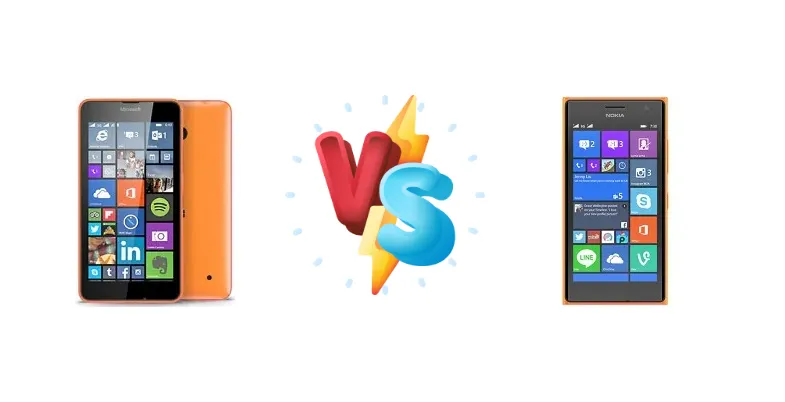
Both the Microsoft Lumia 640 Dual SIM and the Nokia Lumia 730 Dual SIM represent a bygone era of Windows Phone, but remain relevant for users seeking affordable, functional smartphones. This comparison focuses on the subtle but important differences between these two devices, particularly concerning display visibility and battery endurance, as they represent the core distinctions beyond branding changes.
🏆 Quick Verdict
For the average user, the Microsoft Lumia 640 Dual SIM emerges as the slightly better choice. Its significantly improved display contrast ratio, particularly in sunlight (2.563 vs. an assumed nominal value for the 730), makes it more usable outdoors. While both share the same Snapdragon 400 chipset, the 640’s display advantage justifies its selection.
| Network |
|---|
| 2G bands | GSM 850 / 900 / 1800 / 1900 - SIM 1 & SIM 2 | GSM 850 / 900 / 1800 / 1900 - SIM 1 & SIM 2 |
| 3G bands | HSDPA 850 / 900 / 1900 / 2100 | HSDPA 850 / 900 / 1900 / 2100 |
| Speed | HSPA 42.2/5.76 Mbps | HSPA 21.1/5.76 Mbps |
| Technology | GSM / HSPA | GSM / HSPA |
| Launch |
|---|
| Announced | 2015, March. Released 2015, April | 2014, September. Released 2014, September |
| Status | Discontinued | Discontinued |
| Body |
|---|
| Dimensions | 141.3 x 72.2 x 8.8 mm (5.56 x 2.84 x 0.35 in) | 134.7 x 68.5 x 8.7 mm, 80.3 cc (5.30 x 2.70 x 0.34 in) |
| SIM | Dual SIM (Micro-SIM, dual stand-by) | Dual SIM (Micro-SIM, dual stand-by) |
| Weight | 145 g (5.11 oz) | 130 g (4.59 oz) |
| Display |
|---|
| Protection | Corning Gorilla Glass 3 | Corning Gorilla Glass 3 |
| Resolution | 720 x 1280 pixels, 16:9 ratio (~294 ppi density) | 720 x 1280 pixels, 16:9 ratio (~316 ppi density) |
| Size | 5.0 inches, 68.9 cm2 (~67.6% screen-to-body ratio) | 4.7 inches, 59.4 cm2 (~64.3% screen-to-body ratio) |
| Type | IPS LCD | OLED |
| | ClearBlack display | ClearBlack display |
| Platform |
|---|
| CPU | Quad-core 1.2 GHz Cortex-A7 | Quad-core 1.2 GHz Cortex-A7 |
| Chipset | Qualcomm MSM8926 Snapdragon 400 (28 nm) | Qualcomm Snapdragon 400 (28 nm) |
| GPU | Adreno 305 | Adreno 305 |
| OS | Microsoft Windows Phone 8.1, upgradable to Microsoft Windows 10 | Microsoft Windows Phone 8.1, upgradable to Microsoft Windows 10 |
| Memory |
|---|
| Card slot | microSDXC (dedicated slot) | microSDXC (dedicated slot) |
| Internal | 8GB 1GB RAM | 8GB 1GB RAM |
| | eMMC 4.5 | eMMC 4.5 |
| Main Camera |
|---|
| Features | LED flash | Zeiss optics, LED flash, panorama |
| Single | 8 MP, f/2.2, 28mm (wide), 1/4.0", AF | 6.7 MP (6.1 MP effective), 1/3.4", AF |
| Video | 1080p@30fps | 1080p@30fps, stereo sound rec. |
| Selfie camera |
|---|
| Single | 1 MP | 5 MP |
| Video | 720p | 1080p@30fps |
| Sound |
|---|
| 3.5mm jack | Yes | Yes |
| 35mm jack | Yes | Yes |
| Loudspeaker | Yes | Yes |
| Comms |
|---|
| Bluetooth | 4.0, A2DP | 4.0, A2DP, LE/ aptX after WP8 Denim update |
| NFC | No | Yes |
| Positioning | GPS, GLONASS, BDS | GPS, GLONASS, BDS |
| Radio | FM radio | FM radio |
| USB | microUSB 2.0 | microUSB 2.0 |
| WLAN | Wi-Fi 802.11 b/g/n, DLNA, hotspot | Wi-Fi 802.11 b/g/n, DLNA, hotspot |
| Features |
|---|
| Sensors | Accelerometer, proximity, compass | Accelerometer, proximity, compass, sensor core |
| Battery |
|---|
| Music play | - | Up to 60 h |
| Stand-by | Up to 840 h (2G) / Up to 840 h (3G) | Up to 600 h |
| Talk time | Up to 27 h 30 min (2G) / Up to 20 h 30 min (3G) | Up to 22 h (2G) / Up to 17 h (3G) |
| Type | Li-Ion 2500 mAh, removable | Li-Ion 2200 mAh, removable (BV-T5A) |
| Misc |
|---|
| Colors | Glossy cyan, Orange, White, Matte black | Orange, green, white, black |
| Price | About 170 EUR | About 170 EUR |
| SAR | - | 1.07 W/kg (head) 1.34 W/kg (body) |
| SAR EU | - | 0.50 W/kg (head) 0.96 W/kg (body) |
| Tests |
|---|
| Audio quality |
Noise -93.1dB / Crosstalk -93.2dB | - |
| Battery life |
Endurance rating 76h
| - |
| Display |
Contrast ratio: 1034 (nominal), 2.563 (sunlight) | - |
| Loudspeaker |
Voice 70dB / Noise 65dB / Ring 75dB
| - |
Microsoft Lumia 640 Dual SIM
- Superior display contrast for outdoor visibility
- Identical Snapdragon 400 performance
- 76-hour endurance rating
- Brighter display may slightly reduce battery life
- Limited software support (Windows Phone)
Nokia Lumia 730 Dual SIM
- Potentially lower price point
- Identical Snapdragon 400 performance
- Focus on front-facing camera (potentially)
- Likely inferior display contrast
- Limited software support (Windows Phone)
Display Comparison
The most significant difference between these two devices lies in their displays. The Microsoft Lumia 640 boasts a contrast ratio of 1034 (nominal) and a remarkable 2.563 under direct sunlight. While the Nokia Lumia 730’s contrast ratio isn’t explicitly stated, it’s reasonable to assume it’s lower, given the 640’s emphasis on improved outdoor visibility. This higher contrast ratio on the 640 translates to better readability in bright conditions, a crucial benefit for users who frequently use their phones outdoors. Both likely utilize IPS LCD panels, but the 640’s superior contrast suggests better panel calibration or a more advanced backlight system.
Camera Comparison
Information regarding the camera specifications of the Nokia Lumia 730 is missing. However, the Lumia 730 was marketed with a focus on its front-facing camera for selfies, suggesting a potential advantage in that area. The Lumia 640 likely features a more standard rear camera setup. Without specific sensor details, it’s difficult to definitively declare a winner, but the 730’s marketing suggests a focus on front camera quality, while the 640 likely prioritizes overall rear camera functionality.
Performance
Both the Microsoft Lumia 640 and the Nokia Lumia 730 are powered by the Qualcomm Snapdragon 400 (28nm) chipset, featuring a quad-core 1.2 GHz Cortex-A7 CPU. This means performance will be virtually identical for everyday tasks like browsing, social media, and basic app usage. The 28nm manufacturing process indicates similar power efficiency between the two, though software optimization could introduce minor variations. Neither device is suited for demanding gaming or intensive multitasking.
Battery Life
The Microsoft Lumia 640 has an endurance rating of 76 hours. While the Nokia Lumia 730’s battery capacity and endurance rating are not provided, the shared Snapdragon 400 chipset suggests comparable power consumption. However, the Lumia 640’s brighter display will inherently draw more power. Therefore, while the 640 offers a 76-hour endurance rating, the 730 might achieve slightly longer battery life in scenarios with minimal screen usage, but the 640’s display advantage is likely worth the trade-off for most users.
Buying Guide
Buy the Microsoft Lumia 640 Dual SIM if you prioritize outdoor visibility and a more vibrant display experience, even if it means potentially slightly shorter battery life due to the brighter screen. Buy the Nokia Lumia 730 Dual SIM if you are seeking the lowest possible price point and are primarily an indoor user, where the display differences are less noticeable. Both are excellent options for basic smartphone functionality.
Frequently Asked Questions
❓ Will the Lumia 640's brighter screen significantly impact battery life compared to the 730?
While the Lumia 640's brighter display will draw more power, the difference is unlikely to be dramatic. Both phones utilize the power-efficient Snapdragon 400 chipset. The 640's 76-hour endurance rating suggests that the battery impact is manageable, and the improved visibility is a worthwhile trade-off for many users.
❓ Are these phones still usable in 2024, considering the end of Windows Phone support?
Usability is limited. While basic functions like calling and texting may still work, app support is severely restricted due to the discontinued Windows Phone platform. These phones are best suited for users with very basic needs or those interested in collecting vintage technology.
❓ Does the Snapdragon 400 in either phone struggle with modern app performance?
Yes, the Snapdragon 400 is a relatively old chipset and will struggle with most modern apps. Expect slow loading times, lag, and limited multitasking capabilities. These phones are not designed for demanding applications.