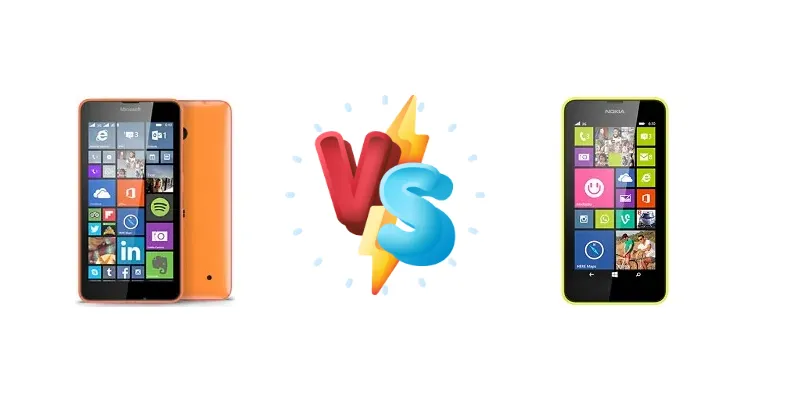
The Microsoft Lumia 640 and Nokia Lumia 630, both dual-SIM Windows Phone 8.1 devices, represent a bygone era of mobile competition. While both aimed for the budget-conscious consumer, the Lumia 640 introduced subtle but significant improvements. This comparison dissects those differences, focusing on where the extra investment in the 640 translates to a better user experience.
🏆 Quick Verdict
For the average user seeking a slightly more refined experience, the Microsoft Lumia 640 is the better choice. Its significantly improved display contrast, particularly in sunlight, and longer endurance rating outweigh the essentially identical processing power offered by both devices.
| Network |
|---|
| 2G bands | GSM 850 / 900 / 1800 / 1900 - SIM 1 & SIM 2 | GSM 850 / 900 / 1800 / 1900 - SIM 1 & SIM 2 |
| 3G bands | HSDPA 850 / 900 / 1900 / 2100 | HSDPA 900 / 2100 |
| Speed | HSPA 42.2/5.76 Mbps | HSPA 21.1/5.76 Mbps |
| Technology | GSM / HSPA | GSM / HSPA |
| Launch |
|---|
| Announced | 2015, March. Released 2015, April | 2014, April. Released 2014, May |
| Status | Discontinued | Discontinued |
| Body |
|---|
| Dimensions | 141.3 x 72.2 x 8.8 mm (5.56 x 2.84 x 0.35 in) | 129.5 x 66.7 x 9.2 mm, 78.5 cc (5.10 x 2.63 x 0.36 in) |
| SIM | Dual SIM (Micro-SIM, dual stand-by) | Dual SIM (Micro-SIM, dual stand-by) |
| Weight | 145 g (5.11 oz) | 134 g (4.73 oz) |
| Display |
|---|
| Protection | Corning Gorilla Glass 3 | Corning Gorilla Glass 3 |
| Resolution | 720 x 1280 pixels, 16:9 ratio (~294 ppi density) | 480 x 854 pixels, 16:9 ratio (~221 ppi density) |
| Size | 5.0 inches, 68.9 cm2 (~67.6% screen-to-body ratio) | 4.5 inches, 54.3 cm2 (~62.9% screen-to-body ratio) |
| Type | IPS LCD | IPS LCD |
| | ClearBlack display | ClearBlack display |
| Platform |
|---|
| CPU | Quad-core 1.2 GHz Cortex-A7 | Quad-core 1.2 GHz Cortex-A7 |
| Chipset | Qualcomm MSM8926 Snapdragon 400 (28 nm) | Qualcomm Snapdragon 400 (28 nm) |
| GPU | Adreno 305 | Adreno 305 |
| OS | Microsoft Windows Phone 8.1, upgradable to Microsoft Windows 10 | Microsoft Windows Phone 8.1 |
| Memory |
|---|
| Card slot | microSDXC (dedicated slot) | microSDXC (dedicated slot) |
| Internal | 8GB 1GB RAM | 8GB 512MB RAM |
| | eMMC 4.5 | eMMC 4.5 |
| Main Camera |
|---|
| Features | LED flash | Panorama |
| Single | 8 MP, f/2.2, 28mm (wide), 1/4.0", AF | 5 MP, 1/4.0", AF |
| Video | 1080p@30fps | 720p@30fps |
| Selfie camera |
|---|
| Single | 1 MP | - |
| Video | 720p | - |
| | - | No |
| Sound |
|---|
| 3.5mm jack | Yes | Yes |
| 35mm jack | Yes | Yes |
| Loudspeaker | Yes | Yes |
| Comms |
|---|
| Bluetooth | 4.0, A2DP | 4.0, A2DP, LE/ aptX after WP8 Denim update |
| NFC | No | No |
| Positioning | GPS, GLONASS, BDS | GPS, GLONASS |
| Radio | FM radio | FM radio |
| USB | microUSB 2.0 | microUSB 2.0 |
| WLAN | Wi-Fi 802.11 b/g/n, DLNA, hotspot | Wi-Fi 802.11 b/g/n, DLNA, hotspot |
| Features |
|---|
| Sensors | Accelerometer, proximity, compass | Accelerometer, sensor core |
| Battery |
|---|
| Music play | - | Up to 58 h |
| Stand-by | Up to 840 h (2G) / Up to 840 h (3G) | Up to 648 h |
| Talk time | Up to 27 h 30 min (2G) / Up to 20 h 30 min (3G) | Up to 16 h 20 min (2G) / Up to 13 h 10 min (3G) |
| Type | Li-Ion 2500 mAh, removable | Li-Ion 1830 mAh, removable (BL-5H) |
| Misc |
|---|
| Colors | Glossy cyan, Orange, White, Matte black | Bright Orange, bright green, bright yellow, white, black |
| Price | About 170 EUR | About 140 EUR |
| SAR | - | 1.23 W/kg (head) 1.13 W/kg (body) |
| SAR EU | - | 1.51 W/kg (head) 1.52 W/kg (body) |
| Tests |
|---|
| Audio quality |
Noise -93.1dB / Crosstalk -93.2dB | - |
| Battery life |
Endurance rating 76h
| - |
| Display |
Contrast ratio: 1034 (nominal), 2.563 (sunlight) | - |
| Loudspeaker |
Voice 70dB / Noise 65dB / Ring 75dB
| - |
Microsoft Lumia 640 Dual SIM
- Superior display contrast for better outdoor visibility
- Longer battery endurance (76h rating)
- Potentially optimized power management
- Shares the same basic Snapdragon 400 performance as the 630
- Likely a higher price point than the 630
Nokia Lumia 630 Dual SIM
- Lower cost of entry
- Identical Snapdragon 400 performance to the 640
- Dual SIM functionality
- Inferior display contrast, especially in sunlight
- Likely shorter battery life compared to the 640
Display Comparison
The most notable difference between these two devices lies in their displays. While both share a similar resolution, the Microsoft Lumia 640 boasts a significantly superior contrast ratio – 1034:1 nominally, and a remarkable 2563:1 in direct sunlight. This means blacks appear deeper and colors are more vibrant, especially when used outdoors. The Nokia Lumia 630’s contrast ratio is not specified, implying a lower value, making it harder to view in bright conditions. This improved sunlight readability on the 640 is a tangible benefit for users frequently exposed to outdoor light.
Camera Comparison
Context data does not provide sufficient detail to compare camera performance. Given both phones target the budget segment, it’s reasonable to assume they feature similar, basic camera modules. Without sensor size, aperture, or image processing details, a meaningful comparison is impossible. It's likely both rely on similar software algorithms for image enhancement.
Performance
Both the Microsoft Lumia 640 and Nokia Lumia 630 are powered by the Qualcomm Snapdragon 400 (28nm) chipset, featuring a quad-core 1.2 GHz Cortex-A7 CPU. This means performance in everyday tasks – launching apps, browsing the web, and basic multitasking – will be virtually identical. The 28nm manufacturing process indicates similar power efficiency, though the Lumia 640’s battery endurance suggests optimizations elsewhere in the system. Neither device is suited for demanding gaming or resource-intensive applications.
Battery Life
The Microsoft Lumia 640 demonstrates a clear advantage in battery life, achieving an endurance rating of 76 hours. While the Nokia Lumia 630’s battery capacity and charging specifications are not provided, the 640’s higher endurance rating suggests either a larger battery capacity, more efficient power management, or a combination of both. This translates to a longer time between charges, a crucial benefit for users who rely on their phone throughout the day.
Buying Guide
Buy the Microsoft Lumia 640 Dual SIM if you prioritize a more visible screen outdoors and longer battery life between charges, making it ideal for users who spend significant time in bright environments or rely heavily on their phone throughout the day. Buy the Nokia Lumia 630 Dual SIM if you are looking for the absolute lowest cost entry point into the Windows Phone ecosystem and are primarily concerned with basic functionality, accepting compromises in display quality and battery endurance.
Frequently Asked Questions
❓ Is the difference in display contrast on the Lumia 640 noticeable in everyday use?
Yes, the Lumia 640's significantly higher contrast ratio, especially its sunlight contrast of 2563:1, makes a tangible difference when viewing the screen outdoors or in brightly lit environments. Colors appear more vibrant, and text is easier to read compared to the Nokia Lumia 630.
❓ Will I notice a performance difference between the Lumia 640 and 630 when running apps like Facebook or WhatsApp?
No, you likely won't notice a performance difference. Both phones utilize the same Qualcomm Snapdragon 400 processor and CPU, meaning basic app performance will be nearly identical. The difference lies in the user experience surrounding the display and battery, not raw processing power.
❓ Given the age of these phones, are they still secure to use with online accounts?
Security is a significant concern with older, unsupported devices. Microsoft no longer provides security updates for Windows Phone 8.1. Using these phones with online accounts carries inherent risks, and it's strongly recommended to avoid using them for sensitive data or financial transactions.