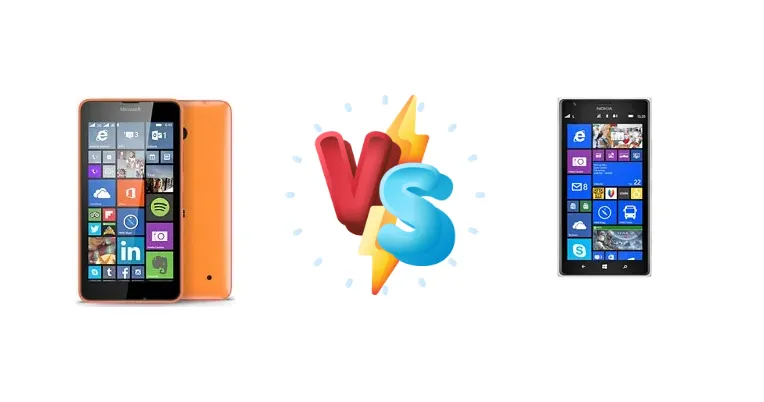
The Microsoft Lumia 640 Dual SIM and Nokia Lumia 1520 represent distinct eras and priorities within the Windows Phone ecosystem. The 640 aimed for affordability and dual-SIM convenience, while the 1520 was a flagship focused on a premium experience with a large display and powerful processor. This comparison dissects their key differences to determine which device holds up better today.
🏆 Quick Verdict
For the average user seeking a functional and affordable Windows Phone, the Lumia 640 Dual SIM offers sufficient performance and battery life. However, the Lumia 1520’s significantly more powerful Snapdragon 800 processor and superior display contrast make it the clear winner for those prioritizing performance and a better viewing experience, despite its age.
| Network |
|---|
| 2G bands | GSM 850 / 900 / 1800 / 1900 - SIM 1 & SIM 2 | GSM 850 / 900 / 1800 / 1900 - all versions |
| 3G bands | HSDPA 850 / 900 / 1900 / 2100 | HSDPA 850 / 900 / 1900 / 2100 - RM-937, RM-939, RM-940 |
| 4G bands | - | 1, 3, 7, 8, 20 - RM-937 |
| Speed | HSPA 42.2/5.76 Mbps | HSPA 42.2/5.76 Mbps, LTE Cat4 150/50 Mbps |
| Technology | GSM / HSPA | GSM / HSPA / LTE |
| | - | 2, 4, 5, 7, 17 - RM-938, RM-940 |
| Launch |
|---|
| Announced | 2015, March. Released 2015, April | 2013, October. Released 2013, November |
| Status | Discontinued | Discontinued |
| Body |
|---|
| Dimensions | 141.3 x 72.2 x 8.8 mm (5.56 x 2.84 x 0.35 in) | 162.8 x 85.4 x 8.7 mm, 120.3 cc (6.41 x 3.36 x 0.34 in) |
| SIM | Dual SIM (Micro-SIM, dual stand-by) | Nano-SIM |
| Weight | 145 g (5.11 oz) | 209 g (7.37 oz) |
| Display |
|---|
| Protection | Corning Gorilla Glass 3 | Corning Gorilla Glass 2 |
| Resolution | 720 x 1280 pixels, 16:9 ratio (~294 ppi density) | 1080 x 1920 pixels, 16:9 ratio (~367 ppi density) |
| Size | 5.0 inches, 68.9 cm2 (~67.6% screen-to-body ratio) | 6.0 inches, 99.2 cm2 (~71.4% screen-to-body ratio) |
| Type | IPS LCD | IPS LCD |
| | ClearBlack display | ClearBlack display |
| Platform |
|---|
| CPU | Quad-core 1.2 GHz Cortex-A7 | Quad-core 2.2 GHz Krait 400 |
| Chipset | Qualcomm MSM8926 Snapdragon 400 (28 nm) | Qualcomm MSM8974 Snapdragon 800 (28 nm) |
| GPU | Adreno 305 | Adreno 330 |
| OS | Microsoft Windows Phone 8.1, upgradable to Microsoft Windows 10 | Microsoft Windows Phone 8, upgradable to Windows 10 |
| Memory |
|---|
| Card slot | microSDXC (dedicated slot) | microSDXC (dedicated slot) |
| Internal | 8GB 1GB RAM | 16GB 2GB RAM, 32GB 2GB RAM |
| | eMMC 4.5 | eMMC 4.5 |
| Main Camera |
|---|
| Features | LED flash | Zeiss optics, dual-LED flash, panorama |
| Single | 8 MP, f/2.2, 28mm (wide), 1/4.0", AF | 20 MP, f/2.4, 26mm (wide), 1/2.5", 1.12µm, AF, OIS |
| Video | 1080p@30fps | 4K@30fps (after WP8 Denim update), 1080p@30fps, stereo sound rec. |
| Selfie camera |
|---|
| Single | 1 MP | 1.2 MP, f/2.4 |
| Video | 720p | 720p@30fps |
| Sound |
|---|
| 3.5mm jack | Yes | Yes |
| 35mm jack | Yes | Yes |
| Loudspeaker | Yes | Yes |
| Comms |
|---|
| Bluetooth | 4.0, A2DP | 4.0, A2DP, EDR, LE/ aptX after WP8 Denim update |
| NFC | No | Yes |
| Positioning | GPS, GLONASS, BDS | GPS, GLONASS |
| Radio | FM radio | FM radio |
| USB | microUSB 2.0 | microUSB 2.0 |
| WLAN | Wi-Fi 802.11 b/g/n, DLNA, hotspot | Wi-Fi 802.11 a/b/g/n/ac, dual-band, hotspot |
| Features |
|---|
| Sensors | Accelerometer, proximity, compass | Accelerometer, gyro, proximity, compass, sensor core |
| Battery |
|---|
| Charging | - | Wireless (Qi) |
| Music play | - | Up to 124 h |
| Stand-by | Up to 840 h (2G) / Up to 840 h (3G) | Up to 768 h (2G) / Up to 768 h (3G) |
| Talk time | Up to 27 h 30 min (2G) / Up to 20 h 30 min (3G) | Up to 27 h 40 min (2G) / Up to 25 h (3G) |
| Type | Li-Ion 2500 mAh, removable | Li-Ion 3400 mAh, non-removable (BV-4BW) |
| Misc |
|---|
| Colors | Glossy cyan, Orange, White, Matte black | Yellow, white, black, red, green (AT&T) |
| Price | About 170 EUR | About 350 EUR |
| SAR EU | - | 0.64 W/kg (head) 0.20 W/kg (body) |
| Tests |
|---|
| Audio quality |
Noise -93.1dB / Crosstalk -93.2dB |
Noise -89.3dB / Crosstalk -89.4dB |
| Battery life |
Endurance rating 76h
|
Endurance rating 107h
|
| Camera | - |
Photo / Video |
| Display |
Contrast ratio: 1034 (nominal), 2.563 (sunlight) |
Contrast ratio: 1207:1 (nominal) / 1.813:1 (sunlight) |
| Loudspeaker |
Voice 70dB / Noise 65dB / Ring 75dB
|
Voice 73dB / Noise 66dB / Ring 74dB
|
Microsoft Lumia 640 Dual SIM
- Affordable price point
- Dual SIM support for convenient multi-number management
- Long standby time (76h endurance rating)
- Underpowered Snapdragon 400 processor
- Smaller, lower-quality display
- Lacks wireless charging
Nokia Lumia 1520
- Powerful Snapdragon 800 processor for smooth performance
- Larger, higher-contrast display for an immersive viewing experience
- Wireless charging (Qi) for added convenience
- Higher initial cost
- Battery life may be reduced due to age
- Larger size may be less comfortable for some users
Display Comparison
The Lumia 1520 boasts a superior display experience. While both phones utilize similar contrast ratios in nominal conditions (1207:1 vs 1034:1), the 1520’s larger 6-inch screen and higher contrast under sunlight (1.813:1 vs 2.563:1) provide better visibility outdoors. The 640’s smaller display is adequate for basic tasks, but lacks the immersive quality of the 1520. Neither specification details panel technology, but the 1520’s larger size likely benefits from a wider viewing angle.
Camera Comparison
Both devices feature photo and video capabilities, but the Lumia 1520 likely offers a more refined experience. While specific camera specs are not provided beyond 'Photo / Video', the 1520’s flagship status suggests a higher-quality sensor and image processing. The 640’s camera is likely adequate for casual snapshots, but will not match the detail and low-light performance of the 1520. The absence of details regarding sensor size or aperture makes a precise comparison impossible, but the 1520’s overall hardware superiority suggests a better camera.
Performance
The performance gap between these devices is substantial. The Lumia 1520’s Qualcomm MSM8974 Snapdragon 800, with its quad-core 2.2 GHz Krait 400 CPU, significantly outperforms the Lumia 640’s Snapdragon 400 (1.2 GHz Cortex-A7). The Snapdragon 800 was a flagship processor in its time, offering a much smoother experience for multitasking, gaming, and demanding applications. The 640’s Snapdragon 400 is sufficient for basic tasks like calls, texts, and light web browsing, but will struggle with more intensive workloads. Both are built on a 28nm process, but the architectural differences are key.
Battery Life
The Lumia 1520’s endurance rating of 107 hours significantly exceeds the Lumia 640’s 76 hours. This difference is attributable to a larger battery capacity (not specified in the data) and the more efficient Snapdragon 800 processor when handling less demanding tasks. The 1520 also benefits from wireless charging (Qi), a feature absent on the 640. While both batteries have aged, the 1520’s initial advantage provides a more substantial buffer against capacity degradation.
Buying Guide
Buy the Microsoft Lumia 640 Dual SIM if you need a budget-friendly device with dual-SIM support for managing multiple phone numbers, and prioritize long standby time over raw processing power. Buy the Nokia Lumia 1520 if you prefer a larger, higher-quality display, demand smoother performance for multitasking and demanding apps, and appreciate the convenience of wireless charging, even if it means a higher initial investment and potentially shorter battery lifespan due to age.
Frequently Asked Questions
❓ Given the age of both devices, is battery degradation a significant concern?
Yes, battery degradation is a major factor to consider. Both phones are several years old, and their battery capacities will have diminished over time. The Lumia 1520’s initially larger battery and higher endurance rating provide a greater buffer against this degradation, but both devices may require battery replacement for optimal performance.
❓ Does the Lumia 1520’s Snapdragon 800 still hold up for modern app usage, considering Windows Phone support has ended?
While official Windows Phone support has ended, the Snapdragon 800’s processing power still allows for a relatively smooth experience with the existing app ecosystem. However, compatibility issues with newer apps are likely, and performance may degrade over time as apps are no longer updated for the platform. The 640's Snapdragon 400 will struggle even more with these limitations.
❓ Is the dual-SIM functionality on the Lumia 640 useful in 2024?
For users who frequently travel internationally or need to manage separate personal and work phone numbers, the dual-SIM functionality remains a valuable feature. However, the limited app ecosystem and lack of ongoing support may diminish its overall usefulness.