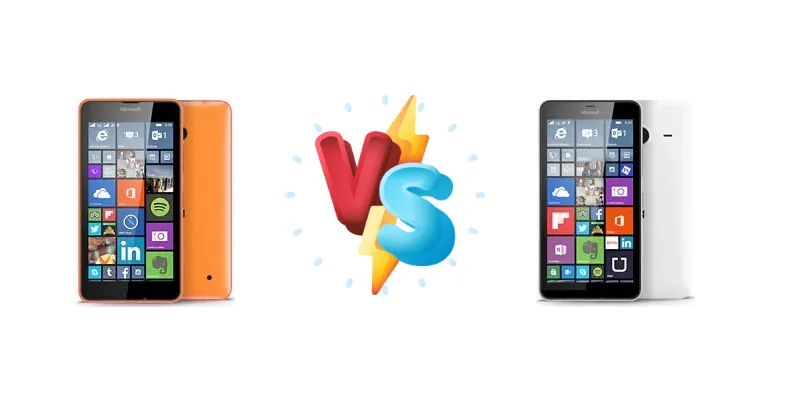
The Microsoft Lumia 640 and 640 XL represent a pivotal moment in Microsoft's mobile strategy – a focused effort on affordable, feature-rich smartphones. While both devices share a similar software experience and target the budget-conscious consumer, key differences in screen size, display quality, and battery endurance necessitate a detailed comparison to determine which model best suits your needs.
🏆 Quick Verdict
For most users, the Microsoft Lumia 640 XL emerges as the superior choice. While both phones utilize the same Snapdragon 400 chipset, the XL’s larger display with significantly improved contrast and slightly better battery life justifies the price difference, offering a more immersive and usable experience.
| Network |
|---|
| 2G bands | GSM 850 / 900 / 1800 / 1900 - SIM 1 & SIM 2 | GSM 850 / 900 / 1800 / 1900 |
| 3G bands | HSDPA 850 / 900 / 1900 / 2100 | HSDPA 850 / 900 / 1900 / 2100 |
| Speed | HSPA 42.2/5.76 Mbps | HSPA 42.2/5.76 Mbps |
| Technology | GSM / HSPA | GSM / HSPA |
| Launch |
|---|
| Announced | 2015, March. Released 2015, April | 2015, March. Released 2015, April |
| Status | Discontinued | Discontinued |
| Body |
|---|
| Dimensions | 141.3 x 72.2 x 8.8 mm (5.56 x 2.84 x 0.35 in) | 157.9 x 81.5 x 9 mm (6.22 x 3.21 x 0.35 in) |
| SIM | Dual SIM (Micro-SIM, dual stand-by) | Micro-SIM |
| Weight | 145 g (5.11 oz) | 171 g (6.03 oz) |
| Display |
|---|
| Protection | Corning Gorilla Glass 3 | Corning Gorilla Glass 3 |
| Resolution | 720 x 1280 pixels, 16:9 ratio (~294 ppi density) | 720 x 1280 pixels, 16:9 ratio (~259 ppi density) |
| Size | 5.0 inches, 68.9 cm2 (~67.6% screen-to-body ratio) | 5.7 inches, 88.9 cm2 (~69.1% screen-to-body ratio) |
| Type | IPS LCD | IPS LCD |
| | ClearBlack display | ClearBlack display |
| Platform |
|---|
| CPU | Quad-core 1.2 GHz Cortex-A7 | Quad-core 1.2 GHz Cortex-A7 |
| Chipset | Qualcomm MSM8926 Snapdragon 400 (28 nm) | Qualcomm MSM8226 Snapdragon 400 (28 nm) |
| GPU | Adreno 305 | Adreno 305 |
| OS | Microsoft Windows Phone 8.1, upgradable to Microsoft Windows 10 | Microsoft Windows Phone 8.1, upgradable to Microsoft Windows 10 |
| Memory |
|---|
| Card slot | microSDXC (dedicated slot) | microSDXC (dedicated slot) |
| Internal | 8GB 1GB RAM | 8GB 1GB RAM |
| | eMMC 4.5 | eMMC 4.5 |
| Main Camera |
|---|
| Features | LED flash | Zeiss optics, LED flash |
| Single | 8 MP, f/2.2, 28mm (wide), 1/4.0", AF | 13 MP, f/2.0, 28mm (wide), 1/3.0", AF |
| Video | 1080p@30fps | 1080p@30fps |
| Selfie camera |
|---|
| Single | 1 MP | 5 MP |
| Video | 720p | 1080p@30fps |
| Sound |
|---|
| 3.5mm jack | Yes | Yes |
| 35mm jack | Yes | Yes |
| Loudspeaker | Yes | Yes |
| Comms |
|---|
| Bluetooth | 4.0, A2DP | 4.0, A2DP |
| NFC | No | Yes |
| Positioning | GPS, GLONASS, BDS | GPS, GLONASS, BDS |
| Radio | FM radio | FM radio |
| USB | microUSB 2.0 | microUSB 2.0 |
| WLAN | Wi-Fi 802.11 b/g/n, DLNA, hotspot | Wi-Fi 802.11 b/g/n, DLNA, hotspot |
| Features |
|---|
| Sensors | Accelerometer, proximity, compass | Accelerometer, proximity, compass, sensor core |
| Battery |
|---|
| Stand-by | Up to 840 h (2G) / Up to 840 h (3G) | Up to 936 h (2G) / Up to 936 h (3G) |
| Talk time | Up to 27 h 30 min (2G) / Up to 20 h 30 min (3G) | Up to 31 h 20 min (2G) / Up to 23 h 40 min (3G) |
| Type | Li-Ion 2500 mAh, removable | Li-Ion 3000 mAh, removable |
| Misc |
|---|
| Colors | Glossy cyan, Orange, White, Matte black | Matte cyan, Orange, Black, Matte white, Glossy white |
| Price | About 170 EUR | About 170 EUR |
| Tests |
|---|
| Audio quality |
Noise -93.1dB / Crosstalk -93.2dB |
Noise -93.0dB / Crosstalk -94.4dB |
| Battery life |
Endurance rating 76h
|
Endurance rating 74h
|
| Display |
Contrast ratio: 1034 (nominal), 2.563 (sunlight) |
Contrast ratio: 1119:1 (nominal), 3.065 (sunlight) |
| Loudspeaker |
Voice 70dB / Noise 65dB / Ring 75dB
| - |
Microsoft Lumia 640 Dual SIM
- More compact and pocketable design.
- Slightly better battery endurance rating.
- Lower price point.
- Smaller display size.
- Lower display contrast, especially in sunlight.
- Less immersive viewing experience.
Microsoft Lumia 640 XL
- Larger, more vibrant display with superior contrast.
- Better outdoor visibility.
- Potentially larger battery capacity.
- Less portable due to larger size.
- Slightly lower battery endurance rating.
- Higher price.
Display Comparison
The Lumia 640 features a smaller display, while the 640 XL boasts a larger screen with a demonstrably superior contrast ratio. The 640 achieves a nominal contrast ratio of 1034:1, increasing to 2.563 under direct sunlight. In contrast, the 640 XL delivers 1119:1 nominal contrast and a significantly brighter 3.065 in sunlight. This higher sunlight contrast on the XL translates to better readability outdoors, a crucial advantage for users frequently exposed to bright environments. Both displays share the same resolution, meaning the XL has a lower pixel density, but the larger size mitigates this, resulting in a more comfortable viewing experience overall.
Camera Comparison
Unfortunately, detailed camera specifications beyond the presence of a camera are absent. Given the target market, it’s safe to assume both devices feature modest camera sensors. The focus should be on practical image quality in good lighting conditions, rather than expecting advanced features like optical image stabilization or exceptional low-light performance. The absence of detailed sensor information suggests neither device will excel in photography, serving primarily for casual snapshots.
Performance
Both the Lumia 640 and 640 XL are powered by the Qualcomm MSM8926 Snapdragon 400 (28nm), featuring a quad-core 1.2 GHz Cortex-A7 CPU. This means processing power is virtually identical between the two devices. While the MSM8226 in the XL is a slightly different variant of the 400, the core performance remains the same. The 28nm manufacturing process, while dated, is adequate for basic tasks, but users should expect limitations with demanding applications or multitasking. Thermal management is unlikely to be a significant concern given the low-power chipset.
Battery Life
The Lumia 640 offers an endurance rating of 76 hours, while the 640 XL achieves 74 hours. This slight difference, despite the XL’s larger screen, suggests efficient power management. While the exact battery capacity isn’t specified, the XL’s larger size likely accommodates a larger battery. The real-world impact is a slightly longer usage time between charges for the XL, particularly during media consumption due to the improved display contrast. Charging times are likely similar, given the shared chipset and probable use of a standard 5W charger.
Buying Guide
Buy the Microsoft Lumia 640 Dual SIM if you prioritize ultimate portability and a lower price point, and are comfortable with a smaller screen. It’s ideal for users who primarily need a reliable phone for calls, texts, and basic app usage. Buy the Microsoft Lumia 640 XL if you value a larger, more vibrant display for media consumption, improved outdoor visibility, and a slightly longer-lasting battery, making it better suited for users who frequently browse the web, watch videos, or play casual games.
Frequently Asked Questions
❓ Is the Snapdragon 400 in either phone capable of running modern apps smoothly?
The Snapdragon 400 is a relatively old chipset. While it can handle basic apps like calls, texts, and social media, expect noticeable lag and slowdowns with more demanding applications or heavy multitasking. It's best suited for light usage.
❓ How does the dual SIM functionality work on the Lumia 640, and is it useful for travel?
The Lumia 640 supports dual SIM functionality, allowing you to use two SIM cards simultaneously. This is particularly useful for separating work and personal calls, or for using a local SIM card while traveling internationally to avoid roaming charges. The phone allows you to choose which SIM to use for calls, texts, and data.
❓ Given the age of these phones, are software updates still available?
Microsoft has officially ended support for Windows Phone 8.1, the operating system these phones run. This means no further software updates, including security patches, are being released. Using these phones carries inherent security risks.