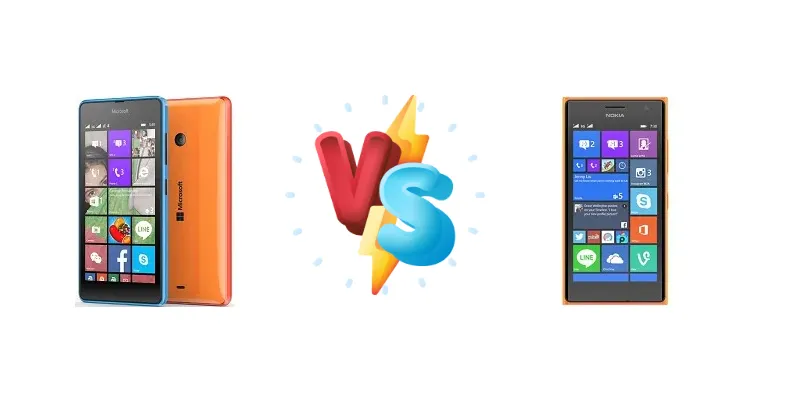
Released within a similar timeframe and targeting the budget-conscious smartphone user, the Microsoft Lumia 540 Dual SIM and the Nokia Lumia 730 Dual SIM represent different tiers within the Windows Phone ecosystem. While both offer dual-SIM functionality, a key differentiator lies in their underlying chipsets – the Snapdragon 200 in the 540 versus the Snapdragon 400 in the 730. This comparison will dissect these differences to determine which device delivers the best value.
🏆 Quick Verdict
For the average user prioritizing responsiveness and a smoother experience, the Nokia Lumia 730 Dual SIM is the clear winner. The Snapdragon 400 chipset provides a noticeable performance uplift over the Snapdragon 200 in the Lumia 540, making everyday tasks and light multitasking significantly more fluid. While the 540 is more affordable, the 730’s improved performance justifies the price difference.
| Network |
|---|
| 2G bands | GSM 850 / 900 / 1800 / 1900 - SIM 1 & SIM 2 | GSM 850 / 900 / 1800 / 1900 - SIM 1 & SIM 2 |
| 3G bands | HSDPA 900 / 2100 | HSDPA 850 / 900 / 1900 / 2100 |
| Speed | HSPA 42.2/5.76 Mbps | HSPA 21.1/5.76 Mbps |
| Technology | GSM / HSPA | GSM / HSPA |
| Launch |
|---|
| Announced | 2015, April. Released 2015, May | 2014, September. Released 2014, September |
| Status | Discontinued | Discontinued |
| Body |
|---|
| Dimensions | 144 x 73.7 x 8.6 mm (5.67 x 2.90 x 0.34 in) | 134.7 x 68.5 x 8.7 mm, 80.3 cc (5.30 x 2.70 x 0.34 in) |
| SIM | Dual SIM (Micro-SIM, dual stand-by) | Dual SIM (Micro-SIM, dual stand-by) |
| Weight | 152 g (5.36 oz) | 130 g (4.59 oz) |
| Display |
|---|
| Protection | - | Corning Gorilla Glass 3 |
| Resolution | 720 x 1280 pixels, 16:9 ratio (~294 ppi density) | 720 x 1280 pixels, 16:9 ratio (~316 ppi density) |
| Size | 5.0 inches, 68.9 cm2 (~64.9% screen-to-body ratio) | 4.7 inches, 59.4 cm2 (~64.3% screen-to-body ratio) |
| Type | IPS LCD | OLED |
| | ClearBlack display | ClearBlack display |
| Platform |
|---|
| CPU | Quad-core 1.2 GHz Cortex-A7 | Quad-core 1.2 GHz Cortex-A7 |
| Chipset | Qualcomm Snapdragon 200 (28 nm) | Qualcomm Snapdragon 400 (28 nm) |
| GPU | Adreno 302 | Adreno 305 |
| OS | Microsoft Windows Phone 8.1 with Lumia Denim | Microsoft Windows Phone 8.1, upgradable to Microsoft Windows 10 |
| Memory |
|---|
| Card slot | microSDXC (dedicated slot) | microSDXC (dedicated slot) |
| Internal | 8GB 1GB RAM | 8GB 1GB RAM |
| | eMMC 4.5 | eMMC 4.5 |
| Main Camera |
|---|
| Features | LED flash | Zeiss optics, LED flash, panorama |
| Single | 8 MP, f/2.2, 28mm (wide), 1/4.0", AF | 6.7 MP (6.1 MP effective), 1/3.4", AF |
| Video | 480p@30fps | 1080p@30fps, stereo sound rec. |
| Selfie camera |
|---|
| Single | 5 MP | 5 MP |
| Video | 480p | 1080p@30fps |
| Sound |
|---|
| 3.5mm jack | Yes | Yes |
| 35mm jack | Yes | Yes |
| Loudspeaker | Yes | Yes |
| Comms |
|---|
| Bluetooth | 4.0, A2DP | 4.0, A2DP, LE/ aptX after WP8 Denim update |
| NFC | No | Yes |
| Positioning | GPS, GLONASS | GPS, GLONASS, BDS |
| Radio | FM radio | FM radio |
| USB | microUSB 2.0 | microUSB 2.0 |
| WLAN | Wi-Fi 802.11 b/g/n, DLNA, hotspot | Wi-Fi 802.11 b/g/n, DLNA, hotspot |
| Features |
|---|
| Sensors | Accelerometer, proximity | Accelerometer, proximity, compass, sensor core |
| Battery |
|---|
| Music play | Up to 81 h | Up to 60 h |
| Stand-by | Up to 576 h (2G) / Up to 576 h (3G) | Up to 600 h |
| Talk time | Up to 26 h (2G) / Up to 15 h (3G) | Up to 22 h (2G) / Up to 17 h (3G) |
| Type | Li-Ion 2200 mAh, removable | Li-Ion 2200 mAh, removable (BV-T5A) |
| Misc |
|---|
| Colors | Orange, white, black, gray, blue | Orange, green, white, black |
| Price | About 100 EUR | About 170 EUR |
| SAR | - | 1.07 W/kg (head) 1.34 W/kg (body) |
| SAR EU | - | 0.50 W/kg (head) 0.96 W/kg (body) |
Microsoft Lumia 540 Dual SIM
- More affordable price point
- Dual SIM functionality for convenient connectivity
- Compact and lightweight design
- Significantly slower performance due to Snapdragon 200
- Limited multitasking capabilities
- Potentially lower camera image quality
Nokia Lumia 730 Dual SIM
- Faster and more responsive performance with Snapdragon 400
- Improved GPU for smoother gaming and video playback
- Potentially better camera image quality due to advanced ISP
- Higher price compared to the Lumia 540
- May not offer a substantial upgrade for very basic users
- Similar design aesthetic to the Lumia 540
Display Comparison
Both devices utilize similar display technologies, likely LCD panels, given their market segment. However, detailed specifications like resolution and brightness are unavailable. The focus here is on the chipset's ability to drive the display smoothly. The Snapdragon 400 in the Lumia 730, with its more capable GPU, will likely handle UI animations and video playback with fewer stutters compared to the 540’s Snapdragon 200. While both are 28nm, the 400's architecture is more efficient.
Camera Comparison
Without detailed camera specifications, a direct comparison is challenging. However, the Snapdragon 400’s image signal processor (ISP) is more advanced than the one found in the Snapdragon 200. This suggests the Lumia 730 will likely produce images with better dynamic range, color accuracy, and noise reduction, particularly in low-light conditions. While both phones likely feature similar sensor sizes given their price points, the 730’s ISP will extract more detail from the sensor.
Performance
The core difference lies in the chipsets. The Nokia Lumia 730’s Snapdragon 400, while also employing a quad-core 1.2 GHz Cortex-A7 CPU, benefits from a more advanced architecture and a more powerful Adreno 305 GPU. This translates to faster app loading times, smoother multitasking, and improved gaming performance. The Snapdragon 200 in the Lumia 540, while adequate for basic tasks, will struggle with more demanding applications and may exhibit noticeable lag. The 400's improved GPU is a significant advantage for even casual gaming.
Battery Life
Battery capacity details are missing for both devices. However, the Snapdragon 400, despite being a 28nm chip like the 200, is more power-efficient due to its architectural improvements. This means the Lumia 730 could potentially offer slightly longer battery life on a single charge, even with a similar battery capacity to the Lumia 540. Charging wattage is also unknown, but the more efficient chipset could lead to faster overall charging times.
Buying Guide
Buy the Microsoft Lumia 540 Dual SIM if you need an extremely affordable Windows Phone for basic communication – calls, texts, and minimal app usage. It’s suitable for first-time smartphone users or as a secondary device. Buy the Nokia Lumia 730 Dual SIM if you prefer a more responsive user experience, occasionally use more demanding apps, or value a slightly better camera performance. It’s a better all-around choice for daily use.
Frequently Asked Questions
❓ Will the Lumia 540 struggle with modern app updates, given its older Snapdragon 200 chipset?
Yes, the Snapdragon 200 is a relatively old chipset. As app developers optimize for newer hardware, the Lumia 540 may experience increasing performance issues with updated apps, potentially leading to slower loading times and reduced responsiveness. It's likely to become increasingly limited over time.
❓ Is the difference in performance between the Snapdragon 200 and 400 noticeable for everyday tasks like browsing and social media?
Absolutely. While both chipsets can handle basic tasks, the Snapdragon 400 in the Lumia 730 provides a significantly smoother and more fluid experience. You'll notice faster page loading times, quicker app switching, and less lag when scrolling through social media feeds. The 200 will feel noticeably slower and less responsive.
❓ Does the Lumia 730 support more advanced features like Bluetooth 4.1 or NFC compared to the Lumia 540?
While specific feature sets aren't detailed, the Snapdragon 400 generally supports more advanced connectivity options than the Snapdragon 200. It's highly probable the Lumia 730 includes Bluetooth 4.0 or 4.1, and potentially NFC, features that may be absent or limited on the Lumia 540.