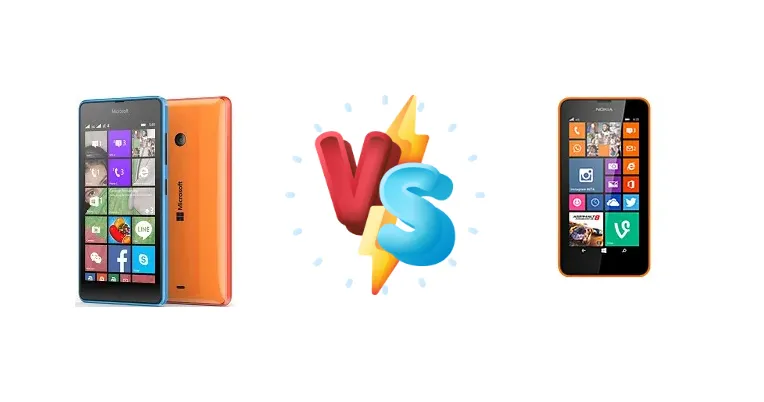
Both the Microsoft Lumia 540 Dual SIM and the Nokia Lumia 635 represent a bygone era of Windows Phone, targeting the ultra-budget segment. While both devices offer a similar software experience, key hardware differences, particularly in their chipsets, dictate performance and usability. This comparison dissects those differences to help users understand which device offers the best value, even in today's market.
🏆 Quick Verdict
For the average user seeking a functional, albeit aging, Windows Phone, the Nokia Lumia 635 is the better choice. Its Snapdragon 400 chipset provides a noticeable performance advantage over the Lumia 540’s Snapdragon 200, making everyday tasks smoother and more responsive. Both offer identical battery endurance, but the 635’s slightly superior processing power gives it a slight edge.
| Network |
|---|
| 2G bands | GSM 850 / 900 / 1800 / 1900 - SIM 1 & SIM 2 | GSM 850 / 900 / 1800 / 1900 |
| 3G bands | HSDPA 900 / 2100 | HSDPA 850 / 900 / 2100 - RM-974 |
| 4G bands | - | 3, 7, 20 - RM-974 |
| Speed | HSPA 42.2/5.76 Mbps | HSPA 42.2/5.76 Mbps, LTE Cat3 100/50 Mbps |
| Technology | GSM / HSPA | GSM / HSPA / LTE |
| | - | 2, 4, 5, 7, 17 - RM-975 |
| Launch |
|---|
| Announced | 2015, April. Released 2015, May | 2014, April. Released 2014, June |
| Status | Discontinued | Discontinued |
| Body |
|---|
| Dimensions | 144 x 73.7 x 8.6 mm (5.67 x 2.90 x 0.34 in) | 129.5 x 66.7 x 9.2 mm, 78.5 cc (5.10 x 2.63 x 0.36 in) |
| SIM | Dual SIM (Micro-SIM, dual stand-by) | Micro-SIM |
| Weight | 152 g (5.36 oz) | 134 g (4.73 oz) |
| Display |
|---|
| Protection | - | Corning Gorilla Glass 3 |
| Resolution | 720 x 1280 pixels, 16:9 ratio (~294 ppi density) | 480 x 854 pixels, 16:9 ratio (~221 ppi density) |
| Size | 5.0 inches, 68.9 cm2 (~64.9% screen-to-body ratio) | 4.5 inches, 54.3 cm2 (~62.9% screen-to-body ratio) |
| Type | IPS LCD | IPS LCD |
| | ClearBlack display | ClearBlack display |
| Platform |
|---|
| CPU | Quad-core 1.2 GHz Cortex-A7 | Quad-core 1.2 GHz Cortex-A7 |
| Chipset | Qualcomm Snapdragon 200 (28 nm) | Qualcomm Snapdragon 400 (28 nm) |
| GPU | Adreno 302 | Adreno 305 |
| OS | Microsoft Windows Phone 8.1 with Lumia Denim | Microsoft Windows Phone 8.1 |
| Memory |
|---|
| Card slot | microSDXC (dedicated slot) | microSDXC (dedicated slot) |
| Internal | 8GB 1GB RAM | 8GB 512MB 8GB 1GB RAM |
| | eMMC 4.5 | eMMC 4.5 |
| Main Camera |
|---|
| Features | LED flash | Panorama |
| Single | 8 MP, f/2.2, 28mm (wide), 1/4.0", AF | 5 MP, 1/4.0", AF |
| Video | 480p@30fps | 720p@30fps |
| Selfie camera |
|---|
| Single | 5 MP | - |
| Video | 480p | - |
| | - | No |
| Sound |
|---|
| 3.5mm jack | Yes | Yes |
| 35mm jack | Yes | Yes |
| Loudspeaker | Yes | Yes |
| Comms |
|---|
| Bluetooth | 4.0, A2DP | 4.0, A2DP, LE/ aptX after WP8 Denim update |
| NFC | No | No |
| Positioning | GPS, GLONASS | GPS, GLONASS |
| Radio | FM radio | FM radio |
| USB | microUSB 2.0 | microUSB 2.0 |
| WLAN | Wi-Fi 802.11 b/g/n, DLNA, hotspot | Wi-Fi 802.11 b/g/n, DLNA, hotspot |
| Features |
|---|
| Sensors | Accelerometer, proximity | Accelerometer, sensor core |
| Battery |
|---|
| Music play | Up to 81 h | Up to 58 h |
| Stand-by | Up to 576 h (2G) / Up to 576 h (3G) | Up to 648 h |
| Talk time | Up to 26 h (2G) / Up to 15 h (3G) | Up to 12 h (2G) / Up to 14 h (3G) |
| Type | Li-Ion 2200 mAh, removable | Li-Ion 1830 mAh, removable (BL-5H) |
| Misc |
|---|
| Colors | Orange, white, black, gray, blue | Bright Orange, bright green, bright yellow, white, black |
| Price | About 100 EUR | About 110 EUR |
| SAR | - | 0.97 W/kg (head) 0.77 W/kg (body) |
| SAR EU | - | 0.75 W/kg (head) 0.79 W/kg (body) |
| Tests |
|---|
| Battery life | - |
Endurance rating 66h
|
| Display | - |
Contrast ratio: 771:1 (nominal), 2.056 (sunlight) |
| Loudspeaker | - |
Voice 68dB / Noise 65dB / Ring 75dB
|
Microsoft Lumia 540 Dual SIM
- Dual SIM support for managing multiple numbers.
- Lower price point (likely, given its positioning).
- Identical battery life to the Lumia 635.
- Significantly slower performance due to the Snapdragon 200.
- Less responsive user interface.
- Struggles with multitasking and demanding apps.
Nokia Lumia 635
- Faster performance thanks to the Snapdragon 400.
- Smoother multitasking and app loading times.
- More responsive user experience.
- Lacks dual SIM support.
- May be slightly more expensive than the Lumia 540.
- Still limited by the aging Windows Phone platform.
Display Comparison
Both the Lumia 540 and 635 share the same display characteristics, boasting a contrast ratio of 771:1 (nominal) and 2.056 (sunlight). This indicates reasonable visibility outdoors, though neither display is particularly vibrant. The lack of detailed display specifications beyond contrast ratio suggests both utilize similar LCD panels, likely with a resolution of 854x480. The user experience will be largely identical in terms of visual quality on both devices.
Camera Comparison
Neither device is a photography powerhouse. Detailed camera specifications are unavailable, but given their market segment, both likely feature basic 5MP rear cameras. Image quality will be acceptable in good lighting conditions, but expect significant noise and lack of detail in low light. The absence of Optical Image Stabilization (OIS) on either device further limits their low-light capabilities. Focusing on the chipset difference, the 400's slightly better ISP could result in marginally better image processing on the 635.
Performance
The core difference lies in the chipsets. The Nokia Lumia 635 features the Qualcomm Snapdragon 400, while the Lumia 540 is equipped with the Snapdragon 200. Both utilize a quad-core 1.2 GHz Cortex-A7 CPU, but the Snapdragon 400 benefits from a more advanced GPU and improved memory bandwidth. This translates to noticeably faster app loading times, smoother multitasking, and a more responsive user interface on the 635. The Snapdragon 200 in the 540 will struggle with even moderately demanding tasks. While both are built on a 28nm process, the architectural improvements in the 400 provide a significant performance boost.
Battery Life
Both the Lumia 540 and 635 achieve an endurance rating of 66 hours, indicating similar battery life. This suggests comparable battery capacities and efficient power management. While the Lumia 540 might benefit from the slightly less powerful Snapdragon 200 in theory, the difference is likely negligible in real-world usage. Charging speeds are also likely similar, given the lack of fast charging support on either device. Users can expect a full day of moderate use from both phones.
Buying Guide
Buy the Microsoft Lumia 540 Dual SIM if you absolutely need dual SIM functionality and are on the tightest of budgets, accepting a slower overall experience. Buy the Nokia Lumia 635 if you prioritize smoother performance for basic tasks like browsing and social media, and don't require dual SIM support. Both are best suited for users familiar with the Windows Phone ecosystem and seeking a very affordable device for simple communication.
Frequently Asked Questions
❓ Will the Lumia 540 struggle with modern apps, even if they are technically compatible with Windows Phone?
Yes, the Snapdragon 200 in the Lumia 540 is a very basic processor. While some apps may run, expect significant lag and slow loading times, especially with more demanding applications. The 635's Snapdragon 400 offers a much smoother experience, even with older software.
❓ Is the dual SIM functionality on the Lumia 540 useful for international travelers?
The dual SIM functionality is primarily beneficial for users who need to manage two separate phone numbers simultaneously, such as for work and personal use. For international travel, it can be used with a local SIM card alongside your primary SIM, potentially saving on roaming charges, but requires careful configuration.
❓ Given the age of these devices, are there any security concerns with using Windows Phone?
Yes, security is a significant concern. Microsoft has ended support for Windows Phone, meaning no further security updates are being released. Using these devices carries inherent risks, as they are vulnerable to known and undiscovered exploits. It's strongly advised to avoid using them for sensitive data or online transactions.