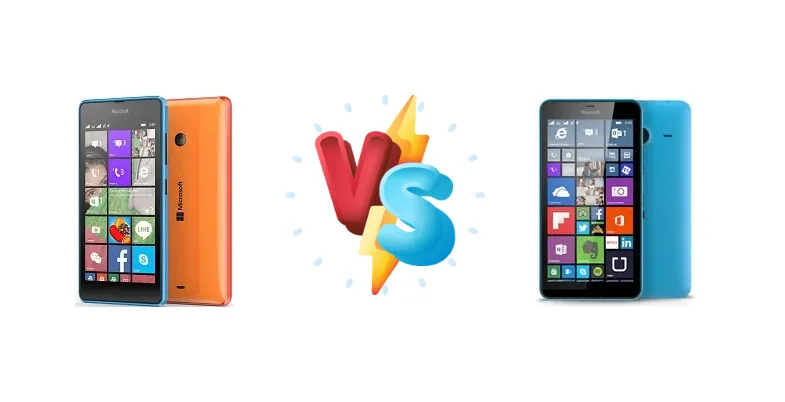
The Microsoft Lumia 540 and 640 XL represent a bygone era of Windows Phone, but remain relevant for enthusiasts and those seeking ultra-budget dual-SIM devices. While both share the core Windows experience, significant differences in chipset and screen size dictate their suitability for different users. This comparison dissects those differences to help you choose.
🏆 Quick Verdict
For the average user prioritizing a slightly smoother experience and a larger screen for media consumption, the Lumia 640 XL is the better choice. Its Snapdragon 400 chipset offers a noticeable performance uplift over the 540’s Snapdragon 200, despite both phones sharing an identical 74-hour endurance rating.
| Network |
|---|
| 2G bands | GSM 850 / 900 / 1800 / 1900 - SIM 1 & SIM 2 | GSM 850 / 900 / 1800 / 1900 - SIM 1 & SIM 2 |
| 3G bands | HSDPA 900 / 2100 | HSDPA 850 / 900 / 1900 / 2100 |
| Speed | HSPA 42.2/5.76 Mbps | HSPA 42.2/5.76 Mbps |
| Technology | GSM / HSPA | GSM / HSPA |
| Launch |
|---|
| Announced | 2015, April. Released 2015, May | 2015, March. Released 2015, April |
| Status | Discontinued | Discontinued |
| Body |
|---|
| Dimensions | 144 x 73.7 x 8.6 mm (5.67 x 2.90 x 0.34 in) | 157.9 x 81.5 x 9 mm (6.22 x 3.21 x 0.35 in) |
| SIM | Dual SIM (Micro-SIM, dual stand-by) | Dual SIM (Micro-SIM, dual stand-by) |
| Weight | 152 g (5.36 oz) | 171 g (6.03 oz) |
| Display |
|---|
| Protection | - | Corning Gorilla Glass 3 |
| Resolution | 720 x 1280 pixels, 16:9 ratio (~294 ppi density) | 720 x 1280 pixels, 16:9 ratio (~259 ppi density) |
| Size | 5.0 inches, 68.9 cm2 (~64.9% screen-to-body ratio) | 5.7 inches, 88.9 cm2 (~69.1% screen-to-body ratio) |
| Type | IPS LCD | IPS LCD |
| | ClearBlack display | ClearBlack display |
| Platform |
|---|
| CPU | Quad-core 1.2 GHz Cortex-A7 | Quad-core 1.2 GHz Cortex-A7 |
| Chipset | Qualcomm Snapdragon 200 (28 nm) | Qualcomm MSM8226 Snapdragon 400 (28 nm) |
| GPU | Adreno 302 | Adreno 305 |
| OS | Microsoft Windows Phone 8.1 with Lumia Denim | Microsoft Windows Phone 8.1, upgradable to Microsoft Windows 10 |
| Memory |
|---|
| Card slot | microSDXC (dedicated slot) | microSDXC (dedicated slot) |
| Internal | 8GB 1GB RAM | 8GB 1GB RAM |
| | eMMC 4.5 | eMMC 4.5 |
| Main Camera |
|---|
| Features | LED flash | Zeiss optics, LED flash |
| Single | 8 MP, f/2.2, 28mm (wide), 1/4.0", AF | 13 MP, f/2.0, 28mm (wide), 1/3.0", AF |
| Video | 480p@30fps | 1080p@30fps |
| Selfie camera |
|---|
| Single | 5 MP | 5 MP |
| Video | 480p | 1080p@30fps |
| Sound |
|---|
| 3.5mm jack | Yes | Yes |
| 35mm jack | Yes | Yes |
| Loudspeaker | Yes | Yes |
| Comms |
|---|
| Bluetooth | 4.0, A2DP | 4.0, A2DP |
| NFC | No | Yes |
| Positioning | GPS, GLONASS | GPS, GLONASS, BDS |
| Radio | FM radio | FM radio |
| USB | microUSB 2.0 | microUSB 2.0 |
| WLAN | Wi-Fi 802.11 b/g/n, DLNA, hotspot | Wi-Fi 802.11 b/g/n, DLNA, hotspot |
| Features |
|---|
| Sensors | Accelerometer, proximity | Accelerometer, proximity, compass, sensor core |
| Battery |
|---|
| Music play | Up to 81 h | - |
| Stand-by | Up to 576 h (2G) / Up to 576 h (3G) | Up to 936 h (2G) / Up to 936 h (3G) |
| Talk time | Up to 26 h (2G) / Up to 15 h (3G) | Up to 31 h 20 min (2G) / Up to 23 h 40 min (3G) |
| Type | Li-Ion 2200 mAh, removable | Li-Ion 3000 mAh, removable |
| Misc |
|---|
| Colors | Orange, white, black, gray, blue | Matte cyan, Orange, Black, Matte white, Glossy white |
| Price | About 100 EUR | About 170 EUR |
| Tests |
|---|
| Audio quality | - |
Noise -93.0dB / Crosstalk -94.4dB |
| Battery life | - |
Endurance rating 74h
|
| Camera | - |
Photo / Video |
| Display | - |
Contrast ratio: 1119:1 (nominal), 3.065 (sunlight) |
| Loudspeaker | - |
Voice 72dB / Noise 67dB / Ring 73dB
|
Microsoft Lumia 540 Dual SIM
- More compact and pocketable design.
- Lower price point (likely).
- Slightly easier to handle with one hand.
- Significantly slower performance due to Snapdragon 200.
- Less enjoyable media consumption experience due to smaller screen.
Microsoft Lumia 640 XL Dual SIM
- Faster performance with Snapdragon 400.
- Larger display for improved media viewing.
- Potentially better camera image processing.
- Larger size and weight.
- May be slightly more expensive.
Display Comparison
Both the Lumia 540 and 640 XL share the same contrast ratios of 1119:1 (nominal) and 3.065 (sunlight), suggesting similar viewing experiences in varying lighting conditions. However, the 640 XL’s larger display size is the key differentiator. While resolution isn’t specified, the larger screen real estate will be more comfortable for browsing, video playback, and gaming. The shared contrast ratio indicates neither display excels in color accuracy or black levels, typical for this price segment.
Camera Comparison
Both devices are listed with 'Photo / Video' capabilities, but lack specific details regarding sensor size or megapixel count. Given their market positioning, it’s safe to assume both cameras are adequate for casual snapshots in good lighting conditions. However, the 640 XL likely benefits from the slightly more powerful ISP (Image Signal Processor) within the Snapdragon 400, potentially resulting in better image processing and slightly improved low-light performance. Without further specifications, a definitive camera comparison is impossible.
Performance
The core difference lies in the chipsets. The Lumia 540 utilizes the Qualcomm Snapdragon 200, a budget-oriented processor, while the 640 XL steps up to the Snapdragon 400. Both feature quad-core 1.2 GHz Cortex-A7 CPUs, but the Snapdragon 400 benefits from architectural improvements and a more capable Adreno 305 GPU. This translates to noticeably faster app loading times, smoother multitasking, and a better gaming experience on the 640 XL. While neither phone is a performance powerhouse, the 400 offers a significant advantage for users who demand more than basic functionality.
Battery Life
Interestingly, both the Lumia 540 and 640 XL boast an endurance rating of 74 hours. This suggests that despite the 640 XL’s larger display, its power efficiency is comparable to the 540. The shared 28nm manufacturing process for both chipsets likely contributes to this similarity. While battery capacity (mAh) isn’t specified, the 74-hour rating indicates both phones can comfortably last a full day of moderate use.
Buying Guide
Buy the Microsoft Lumia 540 Dual SIM if you need an extremely affordable, compact dual-SIM phone for basic communication and light tasks. It’s ideal for users who prioritize portability and minimal cost. Buy the Microsoft Lumia 640 XL Dual SIM if you prefer a larger display for comfortable media viewing, slightly improved performance for multitasking, and don’t mind a larger device footprint. It’s better suited for users who consume more content and require a bit more responsiveness.
Frequently Asked Questions
❓ Will the Lumia 640 XL struggle with modern app performance given its age and chipset?
While the Snapdragon 400 is dated, it's still capable of handling basic apps and tasks. However, demanding applications or newer games may experience slowdowns or require reduced graphics settings. The 640 XL will perform noticeably better than the 540, but don't expect flagship-level performance.
❓ Is the dual SIM functionality on either phone truly useful, or is it just a marketing gimmick?
The dual SIM functionality is genuinely useful for users who need to manage two separate phone numbers – for example, one for work and one for personal use, or when traveling internationally. It eliminates the need to carry two separate devices.
❓ Given the limited information on camera specs, should I expect good photo quality from either device?
Manage your expectations. Both cameras are likely adequate for casual snapshots in good lighting conditions, but don't expect exceptional image quality, especially in low light. The 640 XL may offer slightly better results due to the more powerful ISP.