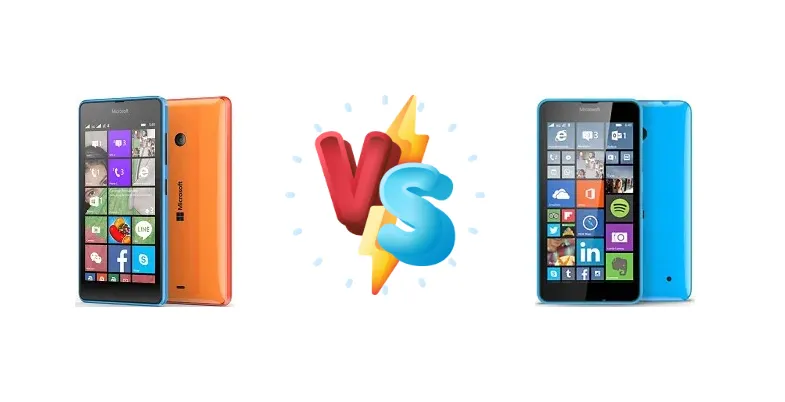
The Microsoft Lumia 540 Dual SIM and 640 LTE represent Microsoft’s attempts to capture the budget smartphone market. Both devices run Windows Phone 8.1, but diverge in their internal hardware. This comparison dissects the key differences, focusing on performance, battery endurance, and display quality to determine which device offers the best value for money.
🏆 Quick Verdict
For most users, the Microsoft Lumia 640 LTE is the better choice. While both phones share a similar design and display, the Snapdragon 400 chipset provides a noticeable performance boost over the Snapdragon 200 in the 540, making it more responsive for everyday tasks and light multitasking. The identical battery endurance mitigates the slightly higher cost.
| Network |
|---|
| 2G bands | GSM 850 / 900 / 1800 / 1900 - SIM 1 & SIM 2 | GSM 850 / 900 / 1800 / 1900 |
| 3G bands | HSDPA 900 / 2100 | HSDPA 850 / 900 / 2100 |
| 4G bands | - | 1, 3, 7, 8, 20 |
| Speed | HSPA 42.2/5.76 Mbps | HSPA 42.2/5.76 Mbps, LTE Cat4 150/50 Mbps |
| Technology | GSM / HSPA | GSM / HSPA / LTE |
| | - | 1, 2, 4, 5, 7, 12, 17 - T-Mobile |
| Launch |
|---|
| Announced | 2015, April. Released 2015, May | 2015, March. Released 2015, April |
| Status | Discontinued | Discontinued |
| Body |
|---|
| Dimensions | 144 x 73.7 x 8.6 mm (5.67 x 2.90 x 0.34 in) | 141.3 x 72.2 x 8.8 mm (5.56 x 2.84 x 0.35 in) |
| SIM | Dual SIM (Micro-SIM, dual stand-by) | Micro-SIM |
| Weight | 152 g (5.36 oz) | 145 g (5.11 oz) |
| Display |
|---|
| Protection | - | Corning Gorilla Glass 3 |
| Resolution | 720 x 1280 pixels, 16:9 ratio (~294 ppi density) | 720 x 1280 pixels, 16:9 ratio (~294 ppi density) |
| Size | 5.0 inches, 68.9 cm2 (~64.9% screen-to-body ratio) | 5.0 inches, 68.9 cm2 (~67.6% screen-to-body ratio) |
| Type | IPS LCD | IPS LCD |
| | ClearBlack display | ClearBlack display |
| Platform |
|---|
| CPU | Quad-core 1.2 GHz Cortex-A7 | Quad-core 1.2 GHz Cortex-A7 |
| Chipset | Qualcomm Snapdragon 200 (28 nm) | Qualcomm MSM8926 Snapdragon 400 (28 nm) |
| GPU | Adreno 302 | Adreno 305 |
| OS | Microsoft Windows Phone 8.1 with Lumia Denim | Microsoft Windows Phone 8.1, upgradable to Microsoft Windows 10 |
| Memory |
|---|
| Card slot | microSDXC (dedicated slot) | microSDXC (dedicated slot) |
| Internal | 8GB 1GB RAM | 8GB 1GB RAM |
| | eMMC 4.5 | eMMC 4.5 |
| Main Camera |
|---|
| Features | LED flash | LED flash |
| Single | 8 MP, f/2.2, 28mm (wide), 1/4.0", AF | 8 MP, f/2.2, 28mm (wide), 1/4.0", AF |
| Video | 480p@30fps | 1080p@30fps |
| Selfie camera |
|---|
| Single | 5 MP | 1 MP |
| Video | 480p | 720p |
| Sound |
|---|
| 3.5mm jack | Yes | Yes |
| 35mm jack | Yes | Yes |
| Loudspeaker | Yes | Yes |
| Comms |
|---|
| Bluetooth | 4.0, A2DP | 4.0, A2DP |
| NFC | No | Yes |
| Positioning | GPS, GLONASS | GPS, GLONASS, BDS |
| Radio | FM radio | FM radio |
| USB | microUSB 2.0 | microUSB 2.0 |
| WLAN | Wi-Fi 802.11 b/g/n, DLNA, hotspot | Wi-Fi 802.11 b/g/n, DLNA, hotspot |
| Features |
|---|
| Sensors | Accelerometer, proximity | Accelerometer, proximity, compass |
| Battery |
|---|
| Music play | Up to 81 h | - |
| Stand-by | Up to 576 h (2G) / Up to 576 h (3G) | Up to 864 h (2G) / Up to 864 h (3G) |
| Talk time | Up to 26 h (2G) / Up to 15 h (3G) | Up to 26 h 30 min (2G) / Up to 17 h 30 min (3G) |
| Type | Li-Ion 2200 mAh, removable | Li-Ion 2500 mAh, removable |
| Misc |
|---|
| Colors | Orange, white, black, gray, blue | Glossy cyan, Orange, White, Matte black |
| Price | About 100 EUR | About 120 EUR |
| Tests |
|---|
| Audio quality | - |
Noise -93.1dB / Crosstalk -93.2dB |
| Battery life | - |
Endurance rating 76h
|
| Camera | - |
Photo / Video |
| Display | - |
Contrast ratio: 1034 (nominal), 2.563 (sunlight) |
| Loudspeaker | - |
Voice 70dB / Noise 65dB / Ring 75dB
|
Microsoft Lumia 540 Dual SIM
- Lower price point makes it very accessible.
- Dual SIM functionality offers flexibility.
- Identical battery endurance to the 640 LTE.
- Significantly slower performance due to the Snapdragon 200.
- Less responsive user experience.
- Limited multitasking capabilities.
Microsoft Lumia 640 LTE
- Faster performance with the Snapdragon 400.
- Smoother multitasking and app loading.
- LTE connectivity for faster data speeds.
- Slightly higher price compared to the Lumia 540.
- Battery life is not demonstrably better.
- Camera specifications are not significantly improved.
Display Comparison
Both the Lumia 540 and 640 LTE share the same display characteristics, boasting a contrast ratio of 1034 (nominal) and 2.563 in sunlight. This suggests similar outdoor visibility and color reproduction. However, the specific panel technology and resolution are not specified, implying both likely utilize IPS LCD panels at a resolution of 854 x 480. The identical contrast ratios mean neither device offers a significant advantage in visual clarity or color accuracy.
Camera Comparison
Both devices are listed with 'Photo / Video' capabilities, but lack specific details regarding sensor size, aperture, or features like Optical Image Stabilization (OIS). Given their budget positioning, it’s reasonable to assume both feature relatively basic camera modules. Without further information, it’s difficult to definitively state which device offers superior image quality. The absence of details suggests neither phone is a standout performer in the camera department.
Performance
The core difference lies in the chipset. The Lumia 540 utilizes the Qualcomm Snapdragon 200, built on a 28nm process, paired with a quad-core 1.2 GHz Cortex-A7 CPU. The Lumia 640 LTE steps up to the Qualcomm MSM8926 Snapdragon 400, also on a 28nm process, with the same quad-core 1.2 GHz Cortex-A7 CPU. While the CPU clock speed is identical, the Snapdragon 400 features a more advanced GPU and improved memory controller, resulting in noticeably faster application loading times and smoother multitasking. The 400’s architecture handles graphics-intensive tasks more efficiently, making it better suited for casual gaming.
Battery Life
Interestingly, both the Lumia 540 and 640 LTE achieve an endurance rating of 76 hours. This suggests that despite the more powerful chipset in the 640 LTE, Microsoft has optimized power consumption to maintain comparable battery life. While the actual mAh capacity isn’t specified, the identical endurance rating indicates that users won’t experience a significant difference in day-to-day battery performance between the two devices. Charging speeds are also unspecified, but likely similar given the shared power adapter requirements.
Buying Guide
Buy the Microsoft Lumia 540 Dual SIM if your primary need is a very affordable smartphone with dual SIM functionality and you prioritize cost savings above all else. You’ll be content with basic tasks like calls, texts, and light web browsing. Buy the Microsoft Lumia 640 LTE if you prefer a smoother, more responsive user experience, especially when running multiple apps or browsing more complex websites. The LTE connectivity also provides faster data speeds where available.
Frequently Asked Questions
❓ Will the Lumia 640 LTE handle basic games like Candy Crush or Angry Birds without significant lag?
Yes, the Snapdragon 400 in the Lumia 640 LTE is capable of running casual games like Candy Crush and Angry Birds smoothly. While it won’t handle graphically demanding titles, it provides a noticeably better gaming experience than the Snapdragon 200 in the 540.
❓ Does the Lumia 540's dual SIM functionality allow for simultaneous active SIMs?
The Lumia 540 supports dual SIM functionality, but it's likely a dual-standby implementation. This means only one SIM can be actively used for calls or data at a time. The phone will switch between SIMs when a call is received on the inactive SIM.
❓ Is the lack of detailed camera specifications a concern? Should I expect good photo quality?
The limited camera information suggests both phones offer basic camera performance. Don't expect flagship-level image quality. They'll be adequate for casual snapshots in good lighting conditions, but struggle in low light. The focus should be on functionality, not photographic excellence.